Clear Sky Science · en
Stabilized real-time Brillouin microscopy reveals fractal organization of protein condensates in living cells
Why the softness of cell droplets matters
Inside our cells, tiny droplets made of proteins and RNA constantly appear and disappear as we respond to stress, repair damage, and carry out everyday biochemistry. In many neurodegenerative diseases, however, these droplets lose their fluid character and harden into stubborn clumps linked to conditions like ALS and frontotemporal dementia. This study introduces a new kind of optical microscope that can watch how such droplets change their mechanical softness in real time inside living cells, opening a window onto how healthy cellular droplets turn into harmful, solid-like deposits.
Droplets without walls
Cells contain many small compartments that have no surrounding membrane. Instead, they form by a kind of microscopic phase separation, much like oil droplets forming in water. Stress granules are one example: they gather specific proteins and RNAs together when a cell is under stress and dissolve again when the stress passes. In healthy cells these structures behave like liquids: their components move freely, mix, and exchange with the surrounding fluid. In disease, however, the same components can jam into a more gel-like or solid state, trapping molecules and forming aggregates typical of damaged brain tissue. The crucial difference between healthy and diseased droplets lies in their internal mechanics—their softness, elasticity, and how freely molecules can move—yet probing these properties inside living cells has been technically very challenging.
Listening to light to feel softness
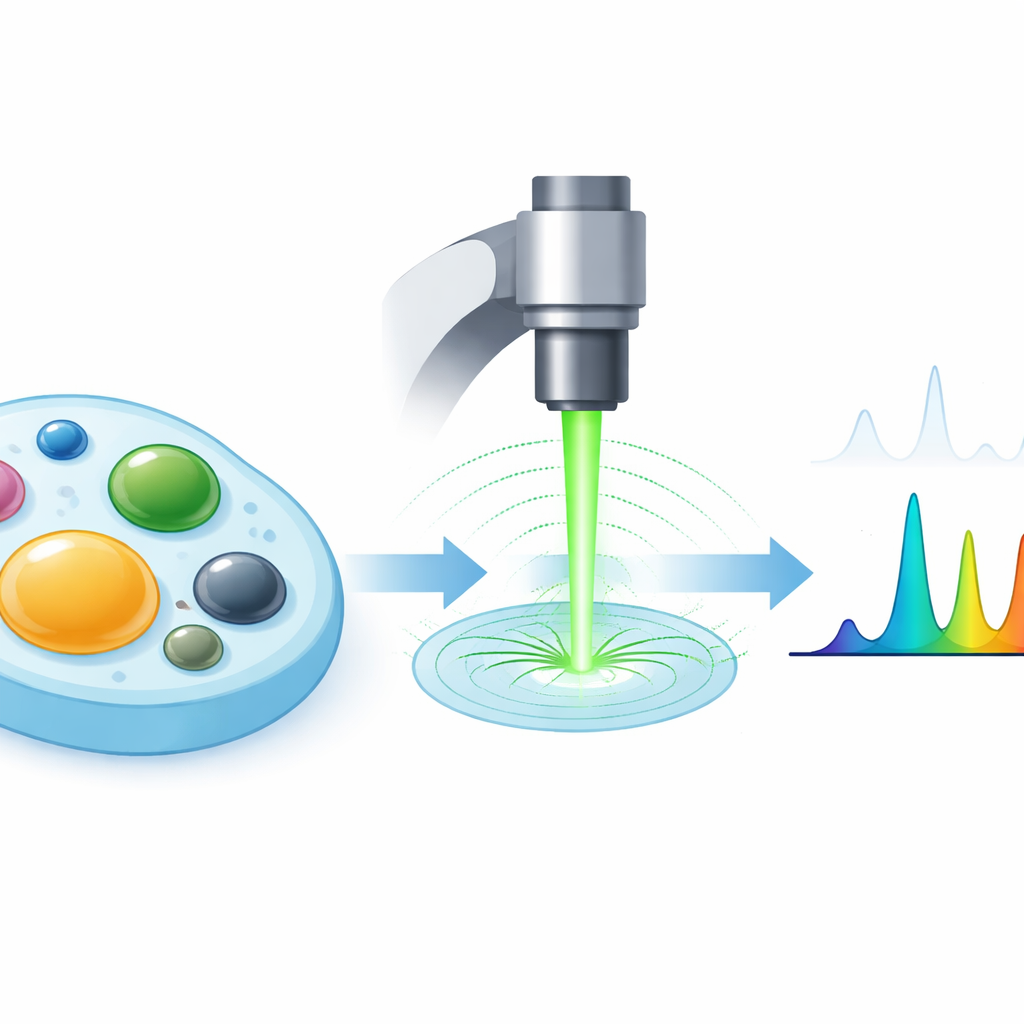
Brillouin microscopy offers a way to "feel" mechanical properties without touching the sample. When a focused laser beam passes through material, a tiny fraction of the light bounces off sound-like vibrations inside it, shifting in color by an amount that depends on how stiff or soft the material is. By mapping this subtle color shift across a cell, scientists can infer local mechanical properties in three dimensions, without dyes or physical contact. However, conventional Brillouin microscopes are notoriously finicky: slight room temperature drifts or minute changes in the optics can cause the measured spectra to shift over time, forcing frequent manual recalibration. Because the differences in mechanical properties between cellular regions are themselves very small, these instrumental drifts can easily swamp the biological signal, limiting Brillouin studies to short, carefully supervised experiments.
A steadier way to measure cell mechanics
The authors solved this stability problem by integrating an electro–optic modulator into a state-of-the-art Brillouin microscope and wrapping the whole system in a feedback loop. The modulator takes a small fraction of the laser light and imprints on it precise, known frequency offsets, which appear as extra peaks in the detected spectrum. These built-in reference peaks act like a ruler and a metronome at once: they allow the instrument to continuously convert camera pixels into absolute frequency units, and to sense any drift due to temperature or mechanical changes. Custom software periodically checks the reference peaks and gently retunes the laser so that the spectrum remains perfectly centered. With automatic, sample-free calibration based solely on these internal references, the microscope maintains high precision over many hours to days, without user intervention, and with tenfold better accuracy than standard approaches that rely on external liquids such as water or methanol.
Watching disease-linked droplets stiffen
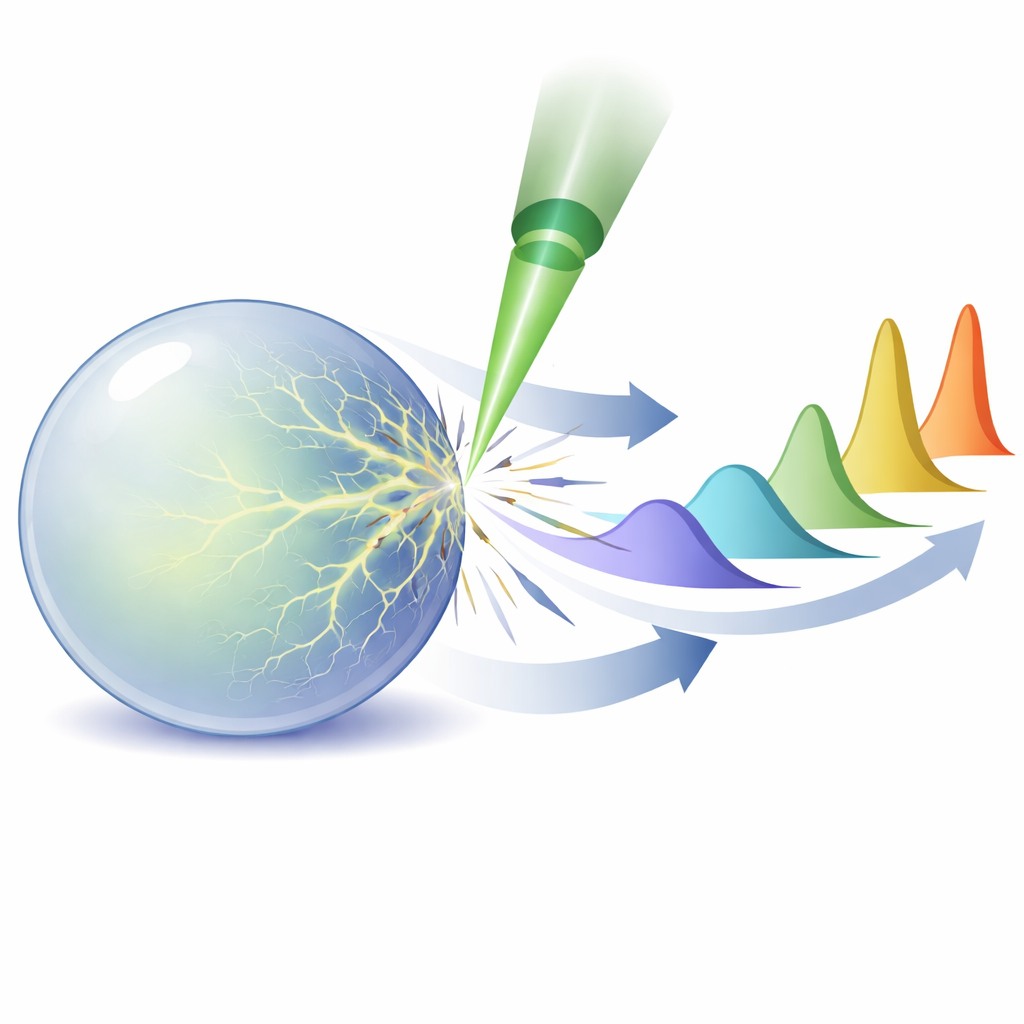
Armed with this stabilized instrument, the team examined living nerve-like cells engineered to form different types of protein condensates, including disease-linked variants of SOD1 and TDP-43—proteins strongly implicated in ALS and related dementias—as well as stress granules built around the G3BP1 protein. In parallel, they used a classic fluorescence technique, FRAP, which tracks how quickly fluorescently labeled proteins move back into a region after being bleached by a brief laser pulse. Fast, full recovery signals a liquid-like interior; slow, incomplete recovery points to a more rigid, gel-like structure. The Brillouin maps revealed that pathological condensates had distinctly higher frequency shifts, indicating a stiffer, more solid-like character, while FRAP showed higher immobile fractions and slower recovery. Because Brillouin microscopy is label-free, it reports on the mechanical behavior of the entire compartment—including unlabeled proteins—rather than just the tagged marker used in fluorescence.
A hidden fractal architecture inside cell droplets
When the researchers compared mechanical stiffness from Brillouin data with molecular mobility from FRAP across many types of condensates and conditions, a striking pattern emerged: the two measures followed a power-law relationship characteristic of a percolation process. This behavior suggests that as more protein-protein connections form within a droplet, a spanning network suddenly appears, causing a sharp change from a fluid to a gel-like state. Such a transition is consistent with a fractal internal architecture, in which the network is hierarchical and self-similar over scales, rather than uniformly filled. The data provide rare in-cell experimental evidence that stress granules and related condensates are not simple homogeneous droplets, but instead contain complex, branching internal networks whose structure governs both how stiff they are and how molecules move inside.
What this means for brain disease
By turning a delicate optical method into a robust, automated tool, this work makes it possible to track subtle mechanical changes in protein condensates over long periods in living cells and even in fixed samples. The stabilized Brillouin microscope can distinguish healthy, reversible droplets from pathological, gel-like assemblies, and can detect mechanical effects of disease-causing proteins that escape standard fluorescence assays. In practical terms, it offers a new way to study how soft cellular compartments harden into toxic aggregates in ALS and other protein aggregation disorders, and lays the groundwork for comparing measurements across laboratories. Ultimately, understanding—and perhaps one day reversing—these hidden changes in the softness and internal architecture of cell droplets may be key to tackling a wide range of neurodegenerative diseases.
Citation: Testi, C., Pontecorvo, E., Bartoli, C. et al. Stabilized real-time Brillouin microscopy reveals fractal organization of protein condensates in living cells. Nat Commun 17, 2387 (2026). https://doi.org/10.1038/s41467-026-68984-2
Keywords: Brillouin microscopy, protein condensates, stress granules, neurodegenerative disease, cell mechanics