Clear Sky Science · en
Bioinspired triboelectric droplet sensor for ammonia monitoring
Why watching invisible gas matters
Ammonia is a common but dangerous gas that escapes from fertilizers, livestock barns, and many industrial processes. At high levels it can burn the lungs and even be fatal, yet its colorless nature makes it hard to notice until it is too late. This article reports a new type of tiny sensor, inspired by the air sacs in our lungs, that can spot changes in ammonia levels in just over a second. Such speed and accuracy could help keep greenhouses safer, protect workers, and warn of leaks before they cause harm. 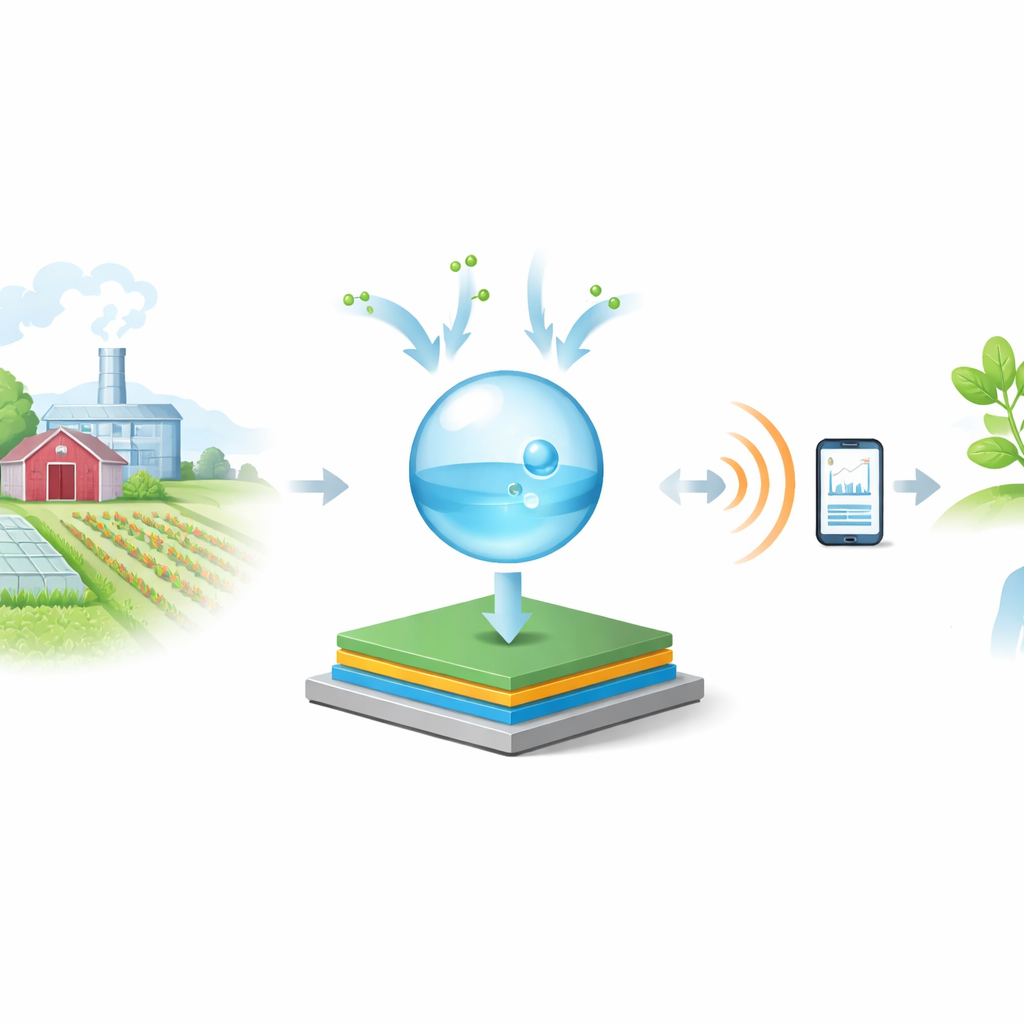
A new way to catch a fast-moving gas
Most existing ammonia detectors depend on solid materials that must chemically react with the gas before they produce a readable signal. Because these reactions take time to start and stop, the sensors often respond slowly and can lag behind what is really happening in the air. The researchers behind this work took a very different approach. They use droplets of water that contain tiny pockets of gas, mimicking the hollow structure of lung alveoli, to collect ammonia directly from the air. Instead of waiting for slow chemical changes in a solid, the device reads out the rapid movement of electric charge where the droplet touches a specially coated surface.
How droplets become tiny power generators
The core of the sensor is a layered chip known as a triboelectric nanogenerator probe. Above it, a coaxial needle creates special “air-cavity droplets” by surrounding a small bubble of gas with a shell of water containing a mild soapy additive. When one of these droplets falls and hits the surface, it spreads out and then retracts, briefly forming and breaking contact with the chip. This motion causes electrons to jump between the liquid and the solid, producing a sharp electrical pulse. By adjusting the gas and liquid flow, the team found a droplet structure that spreads smoothly without wrinkles, rebounds very little, and almost never breaks into smaller “satellite” drops. This stability leads to highly repeatable pulses, with the sensor’s output varying by only a few percent over long runs.
Turning ammonia into an electrical fingerprint
Ammonia’s behavior in water is the key to the sensing trick. When ammonia molecules dissolve, they react with water and create charged particles that increase the liquid’s conductivity. Molecular simulations and infrared measurements show that ammonia mixes strongly with water, unlike several other common gases tested. As the ammonia-rich droplet strikes the surface, these extra ions crowd the interface and compete with electrons for available sites. This competition weakens the usual flow of electrons that would occur with pure water, reducing the size of the electrical pulse in a way that depends on ammonia concentration. The researchers show a clean, nearly straight-line relationship between pulse change and ammonia level from 0 to 200 parts per million, while other gases have little effect, giving the device strong selectivity.
From lab bench to smart greenhouse
To demonstrate practical use, the team built a complete ammonia sensing platform by combining the droplet generator, the triboelectric sensor, and a small wireless circuit. As droplets fall at a few times per second, the chip’s pulses are conditioned by simple electronics and passed to a microcontroller, which then transmits the data via Bluetooth to a phone or tablet. In greenhouse-style tests, the system reported changes in ammonia level in about 1.4 seconds and kept working reliably across a broad range of temperatures and humidity. The researchers then applied a deep learning model to the incoming pulse patterns, improving the accuracy of automatic concentration classification to over 96%, even in less controlled conditions. 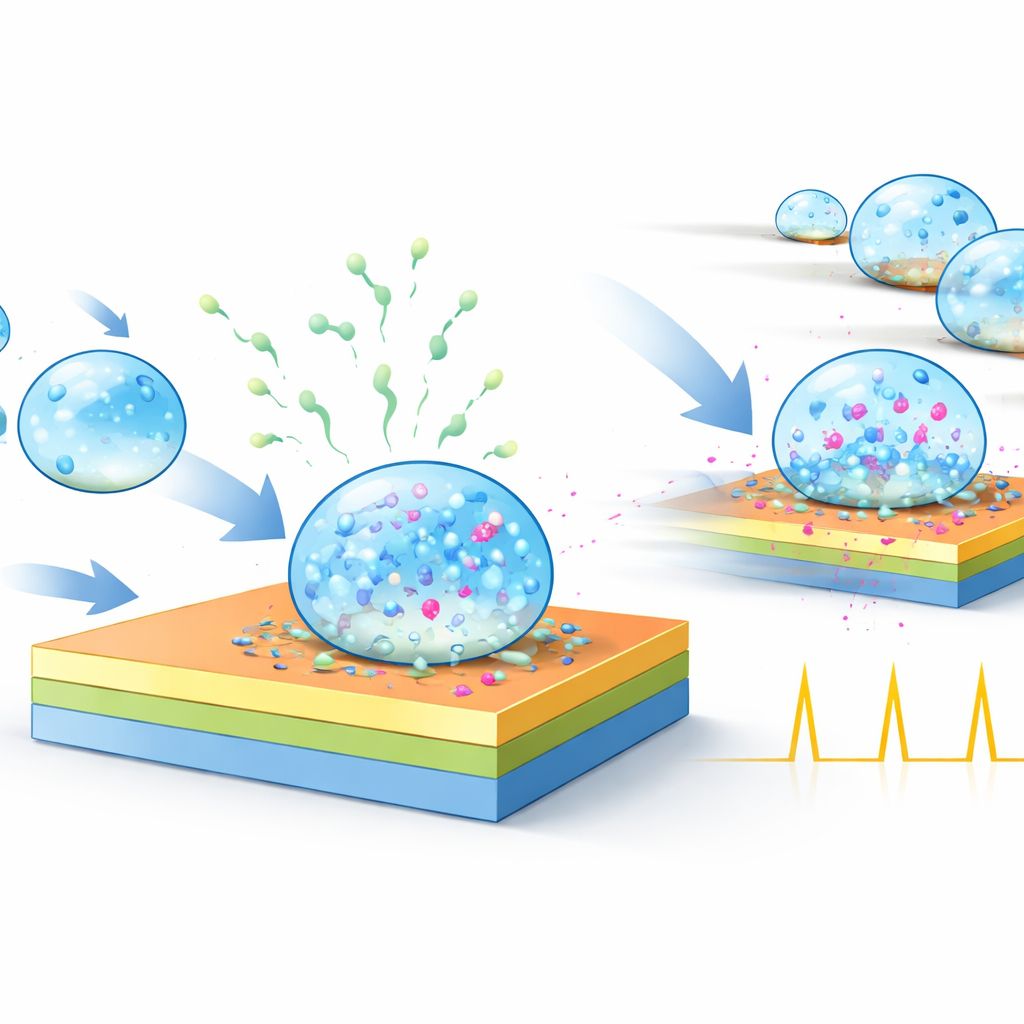
What this means for everyday safety
In plain terms, this work shows that cleverly designed droplets can act as fast, sensitive messengers between invisible gases and simple electronics. By letting water with tiny air pockets “inhale” ammonia and convert its presence into instant electrical spikes, the sensor sidesteps the sluggish chemistry that limits many traditional detectors. The result is a compact, stable, and selective ammonia monitor that can plug into wireless networks and smart algorithms. If further developed and ruggedized, similar droplet-based devices could help watch over farms, food storage, factories, and even medical settings, providing early warnings of harmful gas buildups before people ever smell a thing.
Citation: Liu, T., Li, X., He, H. et al. Bioinspired triboelectric droplet sensor for ammonia monitoring. Nat Commun 17, 2153 (2026). https://doi.org/10.1038/s41467-026-68974-4
Keywords: ammonia sensor, triboelectric droplet, gas monitoring, environmental safety, deep learning