Clear Sky Science · en
Copper-catalysed enantioconvergent N-alkylation of hydrazines with racemic α-haloamides to access enantioenriched hydrazines
Why these tiny molecules matter
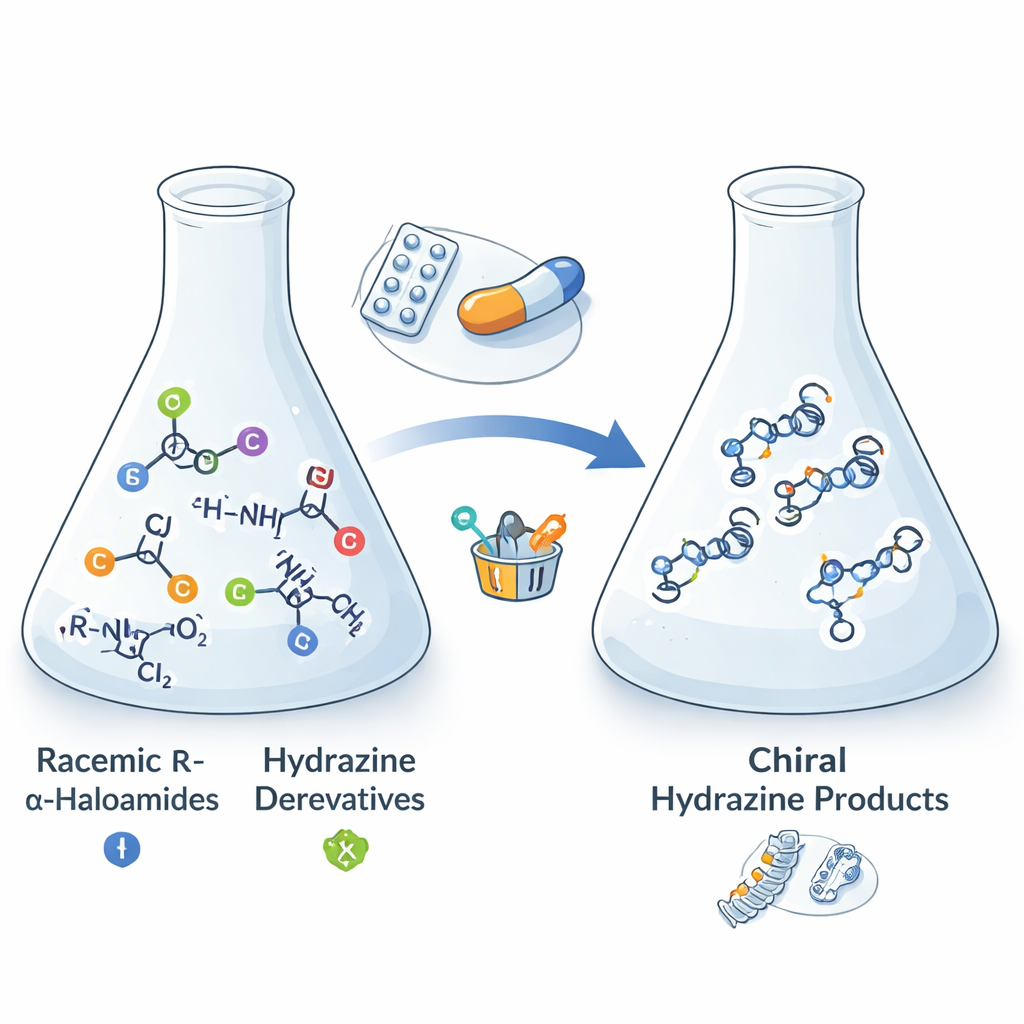
Many modern medicines and experimental drug-like compounds contain a small but powerful unit called a hydrazine. When this unit is “handed” – that is, it exists mostly as one mirror-image form rather than a 50:50 mix – it can dramatically change how a molecule behaves in the body. The study behind this article introduces a new, efficient way to make such single-handed (chiral) hydrazines from cheap, widely available starting materials, potentially streamlining the creation of new drugs and bioactive molecules.
From simple ingredients to precise products
The authors focus on two types of simple building blocks: hydrazines and racemic α-haloamides. Hydrazines contain a nitrogen–nitrogen pair and are common in pharmaceuticals, peptide-like structures, and nitrogen-rich ring systems. Racemic α-haloamides are easy-to-make compounds in which a reactive carbon sits next to both a halogen (like chlorine or bromine) and an amide group. If one could link these two partners in a controlled way, it would provide a direct path to chiral hydrazines without having to pre-build more complex intermediates. Until now, however, existing methods either needed multiple steps, unstable oxidized reagents, or were limited to special types of partners that are less common in real-world molecules.
A new role for copper as a molecular guide
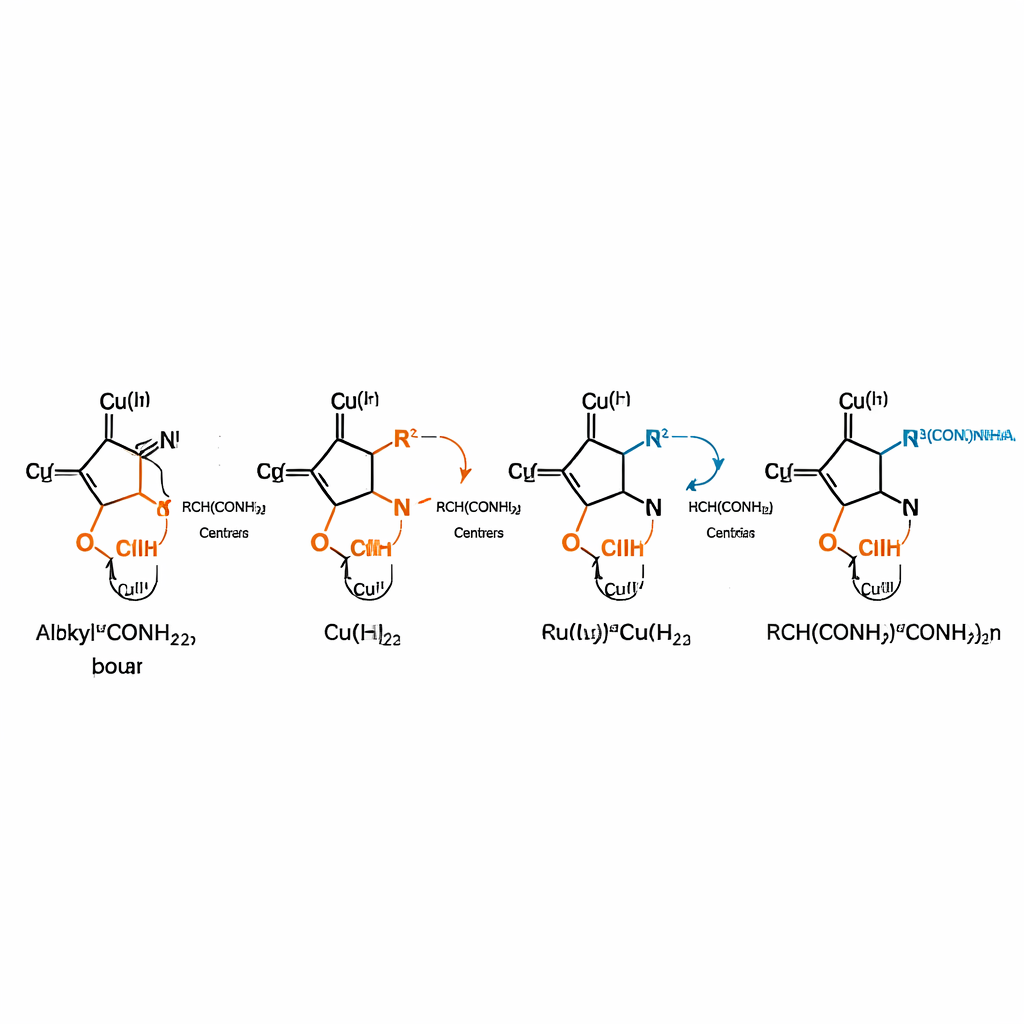
To solve this, the team designed a copper-based catalyst that can transform a messy racemic mixture of α-haloamides into a single preferred handed product when combined with hydrazines. Instead of the classic “two-electron” bond-forming route that struggles with these nucleophilic, catalyst-poisoning hydrazines, they exploit a radical–polar crossover path. In the first phase, the copper complex uses single-electron chemistry to strip a halogen atom from the α-haloamide, creating a short-lived radical bound to the metal. This radical then recombines within the copper center to give a highly reactive, positively polarized copper complex. In the second phase, the hydrazine attacks this activated partner from a carefully controlled side, so that only one mirror image is formed with high selectivity.
Tuning the recipe for broad and practical use
A key part of the advance lies in the design of the chiral ligand that wraps around the copper atom. The researchers discovered that a tridentate, negatively charged N,N,N-ligand – a three-armed, nitrogen-rich scaffold – is crucial. It binds tightly, boosts the reducing power of copper so radicals form quickly, and stabilizes the high-energy copper(III) stage where selectivity is set. By systematically testing different hydrazine protecting groups, they identified N,N-bis-Boc hydrazine as an ideal partner: it directs the reaction to just one nitrogen site, survives the process, and can later be gently unmasked to reveal the free chiral hydrazine. Under optimized mild conditions, this system converts dozens of racemic α-haloamides into chiral hydrazines in good yields and excellent enantiomeric purities, whether the starting carbon is attached to aromatic rings or to plain alkyl chains.
Building peptides and rings with precise shape
The power of this platform becomes clear when applied to more complex building blocks. Using α-haloamides derived from natural amino acids, the team prepared N-amino dipeptides – short peptide-like fragments in which one nitrogen is replaced by a hydrazine. These N-amino units are known to stabilize unusual peptide shapes and resist breakdown by enzymes, making them attractive in drug design. Remarkably, by pairing either the normal or mirror-image version of the chiral ligand with amino-acid starting materials of either handedness, the chemists could access all four possible stereoisomers of a given N-amino dipeptide. This “stereodivergent” control means that, from the same simple inputs, a full panel of shape-variants can be made for biological testing.
From building blocks to complex structures
After the protected hydrazines are formed, their protective groups can be removed to give free chiral hydrazines as stable salts. These in turn react smoothly with simple carbonyl compounds to form a range of nitrogen-rich ring systems – such as pyrazoles, phthalazinones, and fused peptide–ring hybrids – all while preserving their single-handed character. The authors also demonstrate that the chemistry scales up without losing efficiency, an important step toward real-world use. Overall, the work delivers a straightforward, modular route from off-the-shelf materials to finely tuned chiral hydrazines and their derivatives.
What this means going forward
For a non-specialist, the key message is that the researchers have taught an inexpensive metal catalyst, copper, to take a scrambled mixture of starting pieces and assemble them into precisely one “handed” product, on demand. Because these chiral hydrazines can be easily transformed into peptides and nitrogen-rich rings that are central to many drugs, this method offers a powerful shortcut for medicinal chemists and chemical biologists. It should make it easier and faster to explore how molecular shape affects biological activity, ultimately helping to identify new therapeutic candidates and functional materials.
Citation: Li, N., He, SY., Wang, PF. et al. Copper-catalysed enantioconvergent N-alkylation of hydrazines with racemic α-haloamides to access enantioenriched hydrazines. Nat Commun 17, 2070 (2026). https://doi.org/10.1038/s41467-026-68961-9
Keywords: chiral hydrazines, copper catalysis, radical-polar crossover, enantioselective synthesis, N-amino peptides