Clear Sky Science · en
Ultralow CNT-reinforced phase-change fibers for scalable wearable thermoregulation
Clothes That Help You Feel Just Right
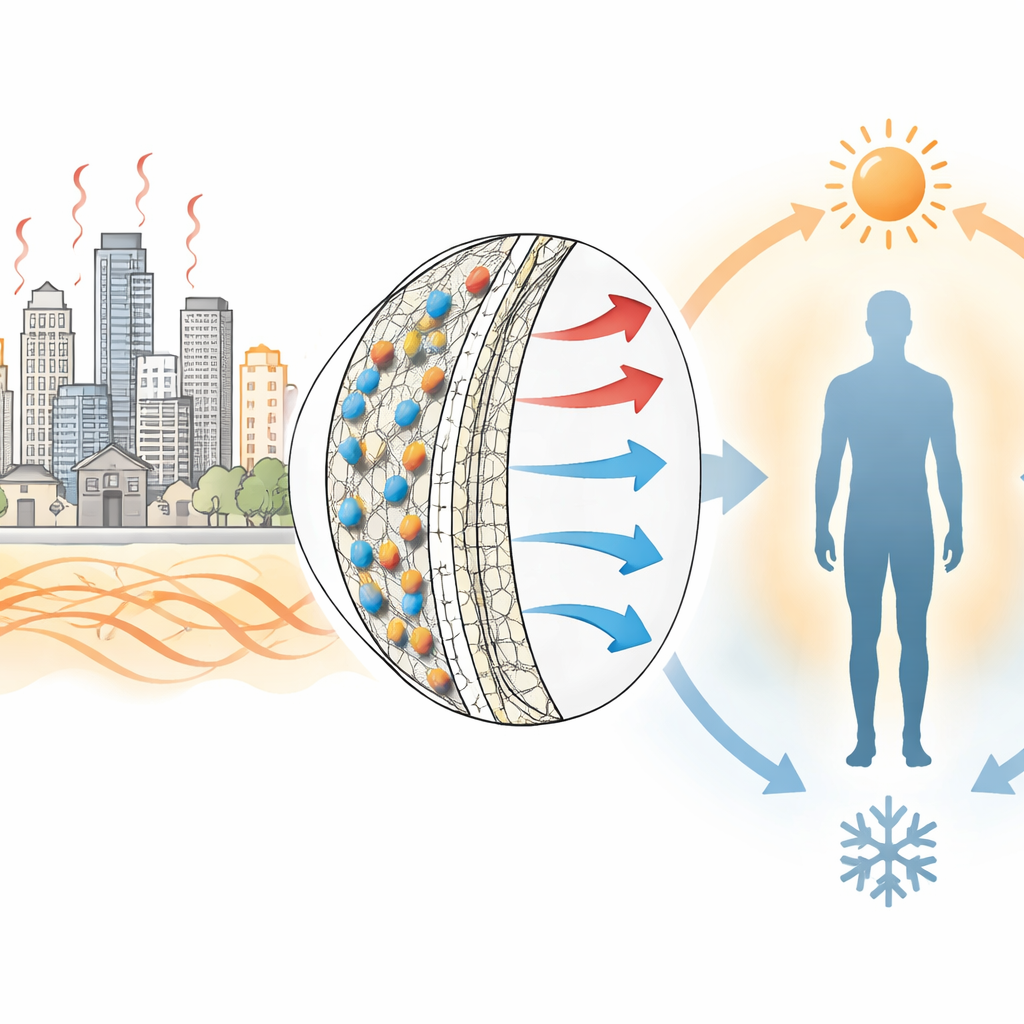
Staying comfortable in hot summers and cold winters usually means cranking up air conditioners and heaters—systems that waste a great deal of energy. This study explores a different path: clothing that quietly absorbs, stores, and releases heat, helping keep your body in a comfortable temperature range with far less energy use. The researchers have designed new fibers that can be woven into everyday fabrics yet hide a powerful trick inside: they temporarily melt and solidify to buffer temperature swings, all while remaining strong, durable, and easy to manufacture at scale.
Why Smarter Clothing Matters
Buildings account for a large share of global energy use and carbon emissions because traditional heating and cooling systems must keep entire rooms and offices at uniform temperatures. Personal thermal management flips that idea around, focusing instead on the thin layer of air around each person. If garments themselves can keep wearers comfortable, homes and offices might be run at wider temperature ranges, saving energy without sacrificing comfort. Phase-change materials—substances that soak up heat as they melt and give it back as they re-freeze—are promising candidates for such smart textiles, but in current products they often leak, break easily, or store too little heat to be practical.
Building Heat-Storing Fibers from the Inside Out
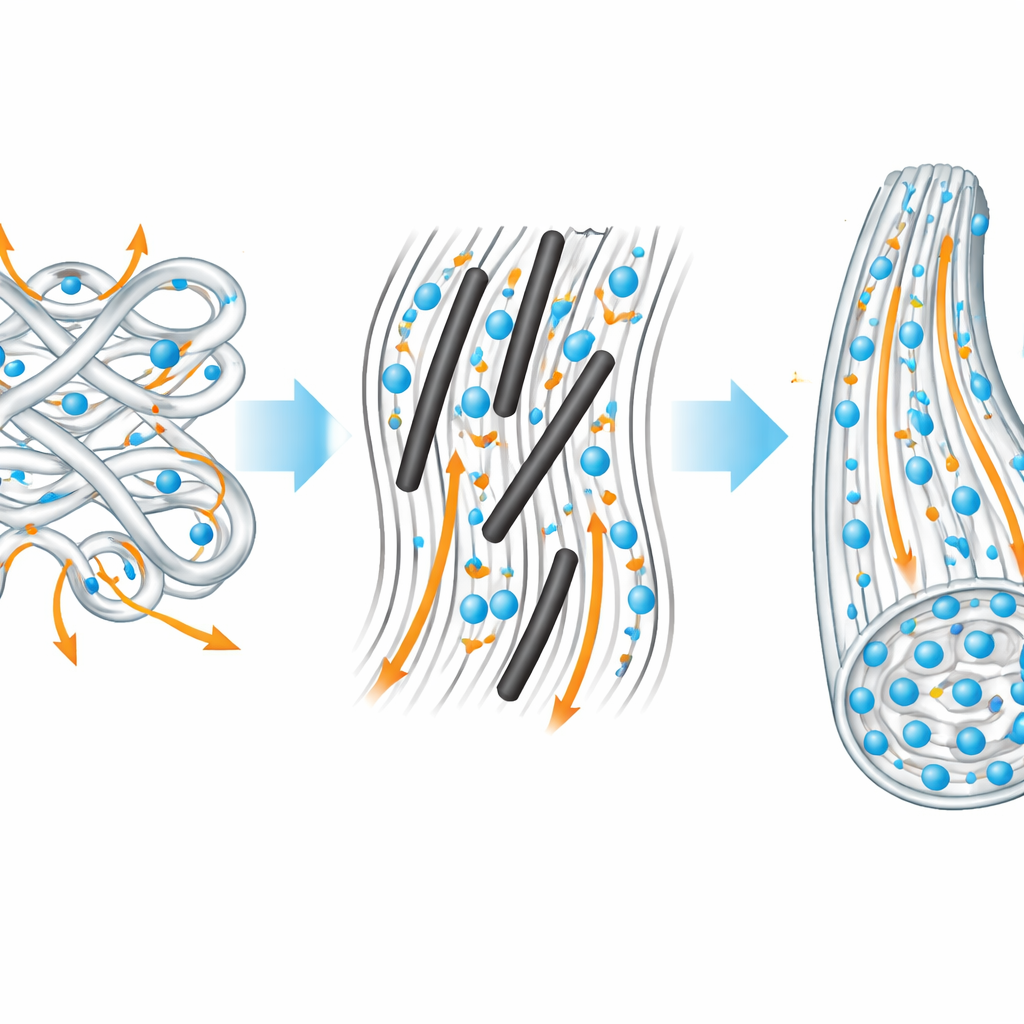
The authors tackled these problems by engineering a new kind of phase-change fiber from the molecular level upward. At its heart is a wax-like substance, n-docosane, which melts around skin-friendly temperatures and can store a large amount of heat during that transition. This material is tightly trapped inside a three-dimensional tangle of two common plastics, which act like a microscopic cage. That cage prevents the wax from oozing out as it melts and re-solidifies, while still allowing it to absorb and release heat. The entire mixture is then pushed through standard melt-spinning equipment—the same basic approach used in making many synthetic fibers—and stretched several times to align the internal structure, creating long, continuous strands suitable for weaving and sewing.
Harnessing Nanotubes for Extra Performance
A key insight of the work is that adding only a tiny amount of carbon nanotubes—around one part in a thousand by weight—dramatically boosts the fibers’ behavior. These hair-thin carbon cylinders form a sparse internal scaffold. They act as starting points where the wax can crystallize more efficiently, which increases the heat the material can store and improves the repeatability of the melting-freezing cycle. At the same time, the nanotubes form pathways for heat to move quickly along the fiber, and they help the surrounding plastics line up and share mechanical loads. Computer simulations at the atomic scale reveal why: at low nanotube concentrations, molecules stick just enough to the tube surfaces to form ordered, low-strain crystals and well-oriented chains; at higher concentrations the tubes start to crowd and hinder motion, so there is a sweet spot at ultralow loading.
From Lab Fibers to Real-World Fabrics
In tests, the optimized fibers stored heat on par with much bulkier phase-change materials, while remaining highly stretchable and tough—able to elongate more than fifteen times their original length before breaking. Their thermal conductivity rose several-fold compared with similar fibers without nanotubes, so they could rapidly take up and release heat. When woven into fabrics and sewn with standard textile machinery, these fibers produced garments that could be cut and stitched with almost no damage. Under simulated sunlight, fabrics with nanotubes heated up efficiently, then slowly released that heat thanks to the internal melting process. When integrated into test vests worn outdoors on a sunny day, these phase-change garments kept the surface and the wearer’s skin several degrees cooler than ordinary clothing; in a hot, furnace-like indoor environment, they likewise slowed heat build-up next to the body.
What This Means for Everyday Life
Overall, this research shows that it is possible to design clothing fibers that behave like tiny, rechargeable heat batteries without sacrificing comfort, strength, or manufacturability. By carefully combining a waxy heat-storage core, a supportive plastic framework, and just enough carbon nanotubes to guide how the material solidifies and conducts heat, the team created fibers that can be produced on equipment already used in the textile industry. Fabrics made from these fibers can passively smooth out temperature swings around the wearer, potentially cutting the need for energy-hungry heating and cooling systems. In the long term, such smart textiles could find roles not only in everyday clothing, but also in protective gear for workers and first responders, outdoor shelters, and even medical applications where gentle, controlled warmth or cooling is needed.
Citation: Geng, X., Wang, Z., Xiong, F. et al. Ultralow CNT-reinforced phase-change fibers for scalable wearable thermoregulation. Nat Commun 17, 2228 (2026). https://doi.org/10.1038/s41467-026-68951-x
Keywords: smart textiles, phase-change materials, wearable thermoregulation, carbon nanotube fibers, energy-efficient clothing