Clear Sky Science · en
Divergent representation and processing of task cues in sensory and prefrontal cortices of preterm-born mice
Why Early Birth Matters for the Brain
Being born too early is one of the strongest risk factors for attention problems, learning difficulties, and conditions such as autism. Yet doctors still do not know exactly how prematurity changes the brain circuits that underlie seeing, thinking, and self-control. This study uses a carefully controlled mouse model of preterm birth to peer into those circuits directly, revealing how early birth can leave lasting marks on brain regions that help us focus on useful signals and ignore distractions.
How the Scientists Modeled Preterm Birth
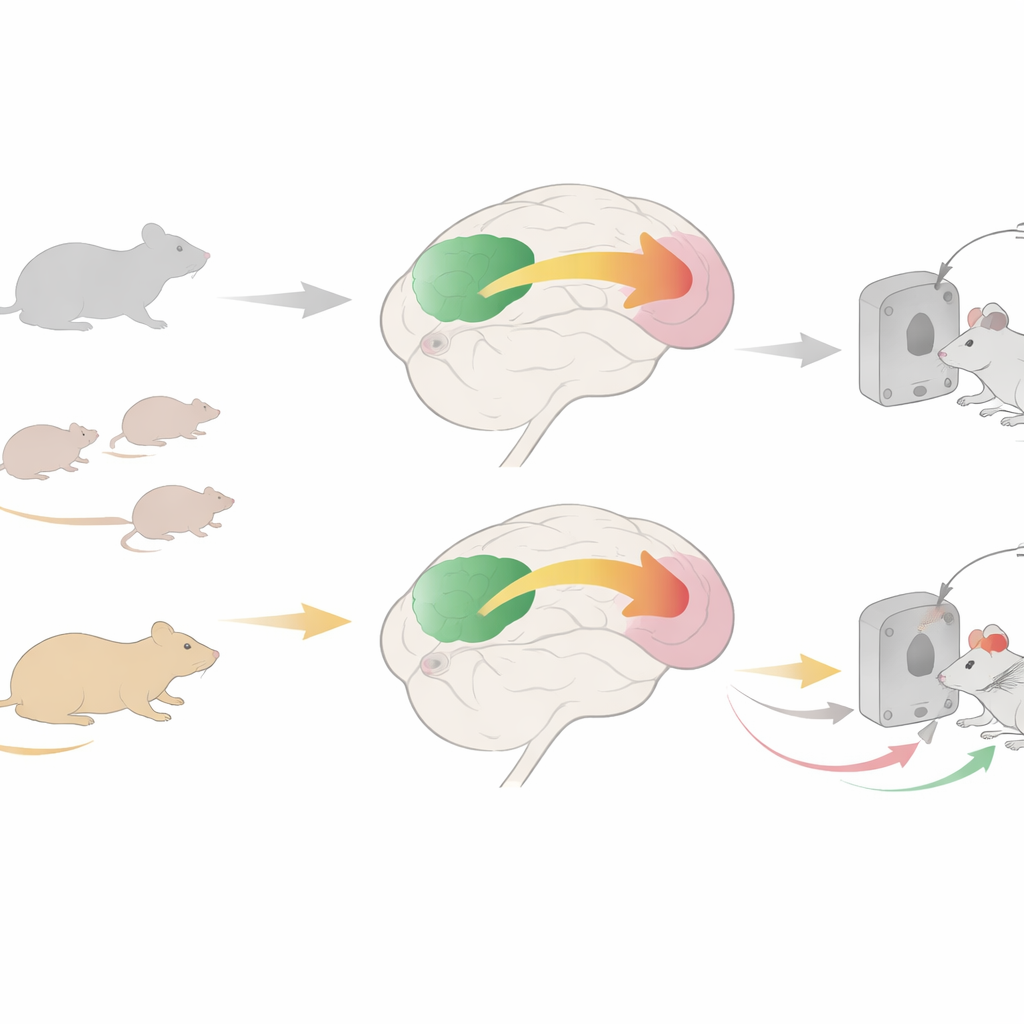
To mimic human prematurity, the researchers induced mice to be born one day early, a meaningful shift in mouse development. As adults, these preterm-born mice and their term-born peers learned a simple visual task while the scientists recorded activity from their brains. The animals saw one of two striped patterns on a screen. Licking a water spout during the “rewarded” pattern delivered a drink, while licking during the “non-rewarded” pattern gave nothing. The task tests both visual discrimination and response inhibition—the ability to hold back an action when it will not pay off.
Errors Without Obvious Sensory or Motor Problems
Preterm mice could see normally: nerve cells in their primary visual cortex responded to different line orientations just as sharply as in term-born animals. Their basic movement in an open field and their motivation for water rewards were also similar. Yet when it came to learning the task, preterm mice struggled. Many never reached the high accuracy levels that term-born mice achieved. The main issue was not missing rewards but making too many “false alarms”—licking when the non-rewarded pattern appeared. This pattern of behavior mirrors difficulties with impulse control and attention often reported in children born prematurely.
Vision Circuits Look Busy but Less Selective
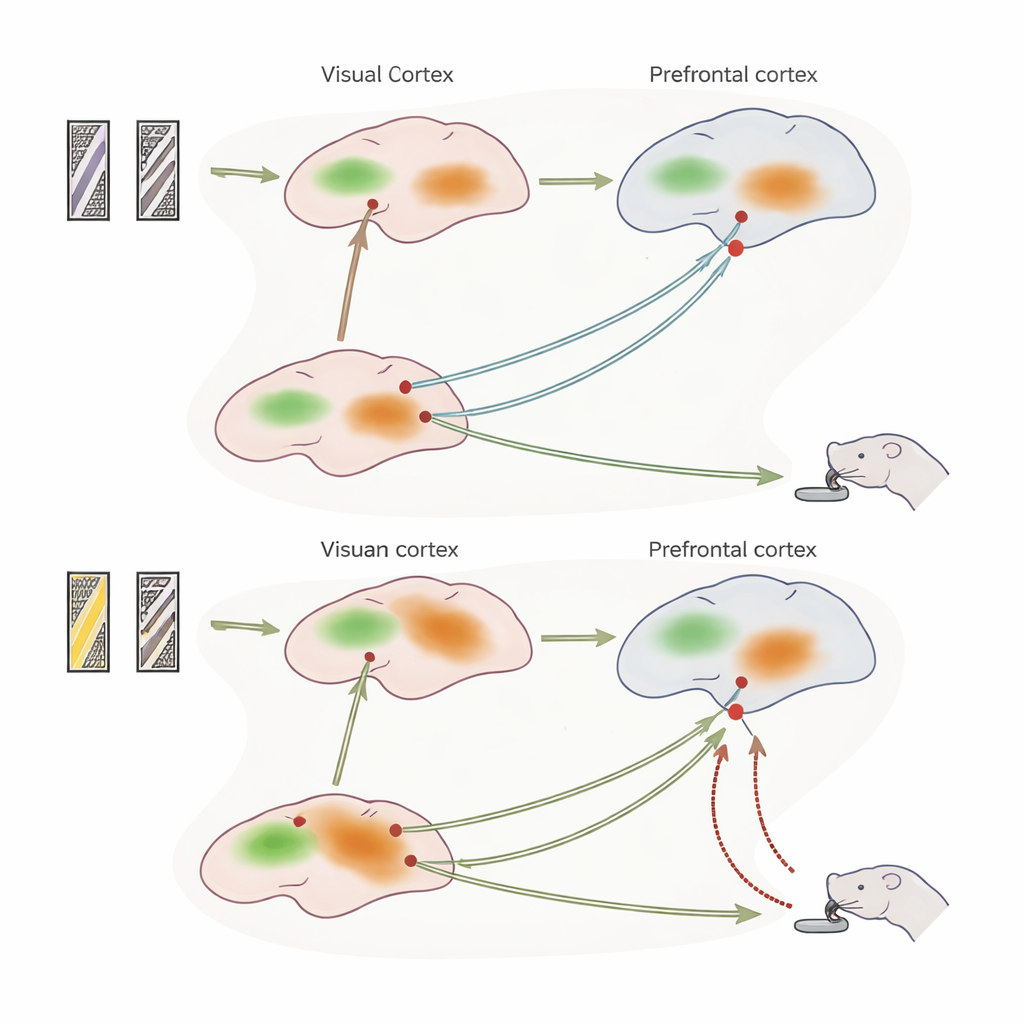
When the mice performed the task, the team recorded from visual cortex cells and separated them into two broad types: regular-spiking cells that likely send information onward, and fast-spiking cells that typically inhibit their neighbors. In preterm mice, both kinds of visual neurons fired more during the task than in term-born animals, suggesting heightened excitability. However, the extra activity did not translate into clearer signals. Regular-spiking neurons in preterm visual cortex were actually less selective for the specific trained cues, particularly for the non-rewarded pattern. This combination—more firing but fuzzier coding—hinted that something upstream or top-down was driving the visual system in a maladaptive way.
Prefrontal Circuits Fail to Represent “Do Not Act” Signals
The investigators then turned to the prefrontal cortex, a front-of-brain region crucial for planning and self-control that sends direct signals down to visual areas. Here, the differences were more striking. In preterm mice, putative pyramidal neurons in prefrontal cortex responded strongly to the rewarded cue but only weakly and irregularly to the non-rewarded cue. Inhibitory interneurons showed the opposite problem: their responses to both cues were blunted. As a result, the overall representation of the “do not act” signal was degraded. Statistical models confirmed that in term mice, prefrontal firing to the non-rewarded cue could reliably distinguish correct rejections from false alarms, whereas in preterm mice this neural prediction of behavior was substantially poorer.
A Brain That Looks Adolescent for Longer
To find out whether this pattern reflected delayed maturation, the team trained and recorded from adolescent term-born mice. Remarkably, their prefrontal responses resembled those of adult preterm mice: the non-rewarded cue had a weak footprint in excitatory cells, and their ability to signal trial outcomes was on par with preterm adults rather than with fully mature term adults. This suggests that preterm birth may freeze aspects of prefrontal function in a more juvenile state. Providing the mice with a rich, toy-filled environment from early life—a common intervention that often helps recovery after early brain insults—did not rescue learning in preterm animals and even dampened performance in some term-born mice, underscoring that not all enrichment is beneficial for all brain systems.
What This Means for Human Preterm Birth
To a lay reader, the main message is that being born early can subtly rewire how the brain weighs “go” and “stop” signals, long after basic vision and movement seem normal. In this mouse model, preterm birth left prefrontal circuits underdeveloped and poorly tuned to cues that should tell the animal not to respond. Those mis-tuned top-down signals in turn altered how sensory areas worked during behavior, leading to more impulsive choices. While mice are not people, the work points to specific front-of-brain networks, and their connections to sensory regions, as key targets for understanding—and eventually treating—cognitive and attention difficulties common in individuals born preterm.
Citation: McCoy, E.M., Pendala, V., Fariborzi, M. et al. Divergent representation and processing of task cues in sensory and prefrontal cortices of preterm-born mice. Nat Commun 17, 2382 (2026). https://doi.org/10.1038/s41467-026-68948-6
Keywords: preterm birth, prefrontal cortex, response inhibition, visual discrimination, mouse model