Clear Sky Science · en
Synergistic MOF-based composite enabling significant solar-to-water generation enhancement in climate-resilient AWH
Turning Air into Drinking Water
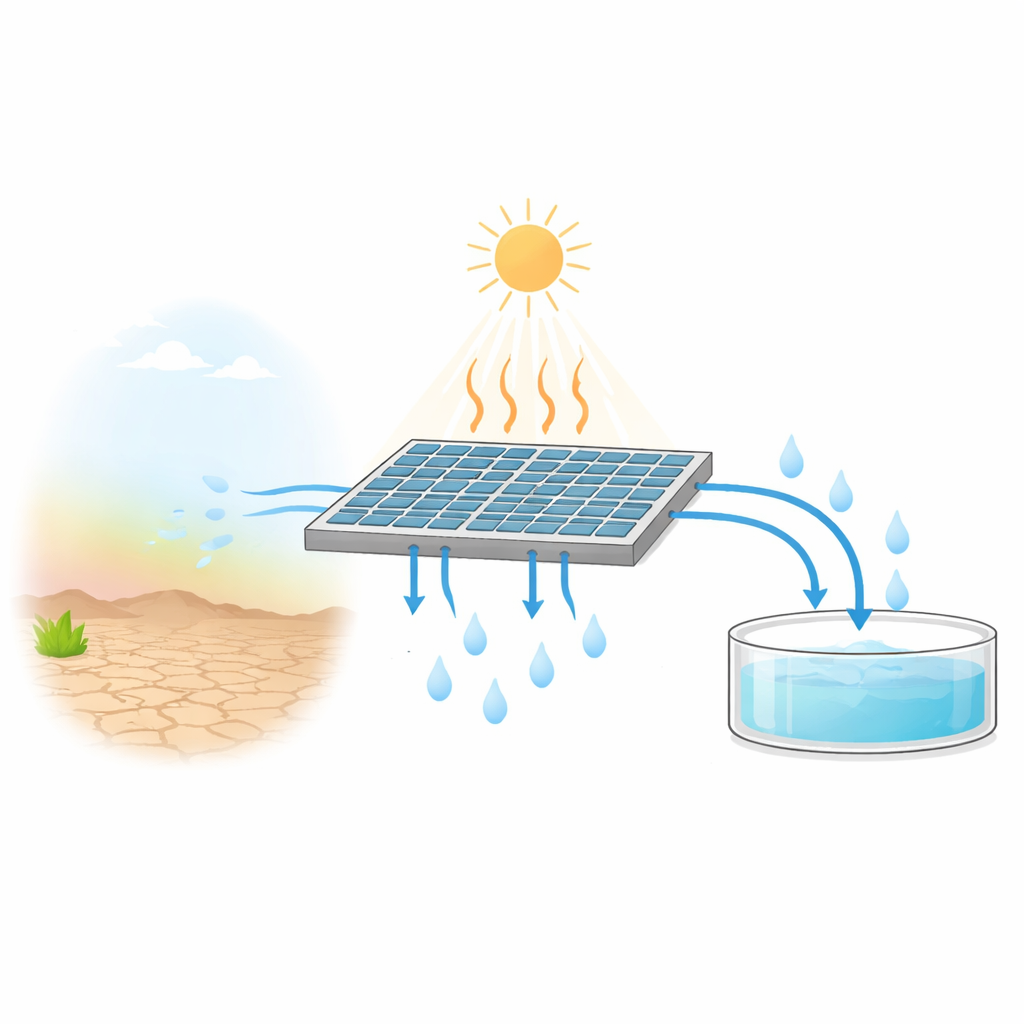
Many parts of the world struggle with chronic water shortages, yet the air above us holds several times more water than all the rivers and lakes on Earth. This study shows how a new material and device design can pull more of that hidden water from the air using only sunlight, even in challenging climates. The work points toward compact, off‑grid machines that could supply clean water without wells, pipes, or electricity grids.
Why Harvest Water from Thin Air?
Billions of people live with unreliable access to fresh water, while the atmosphere constantly carries a vast reservoir of water vapor. Engineers have already built devices that chill humid air to collect dew, snag droplets from fog, or use sponge‑like materials to soak up moisture and later release it. Among these, systems powered by sunlight that use special sorbent materials are especially attractive because they can run in remote places without fuel or batteries. However, many current materials need high temperatures to release the water they have trapped, which is hard to achieve for many hours a day under real outdoor sunlight. As a result, these devices often waste the long, humid nights and underperform during cloudy or mild days.
A Smart Water Sponge Built from Two Ingredients
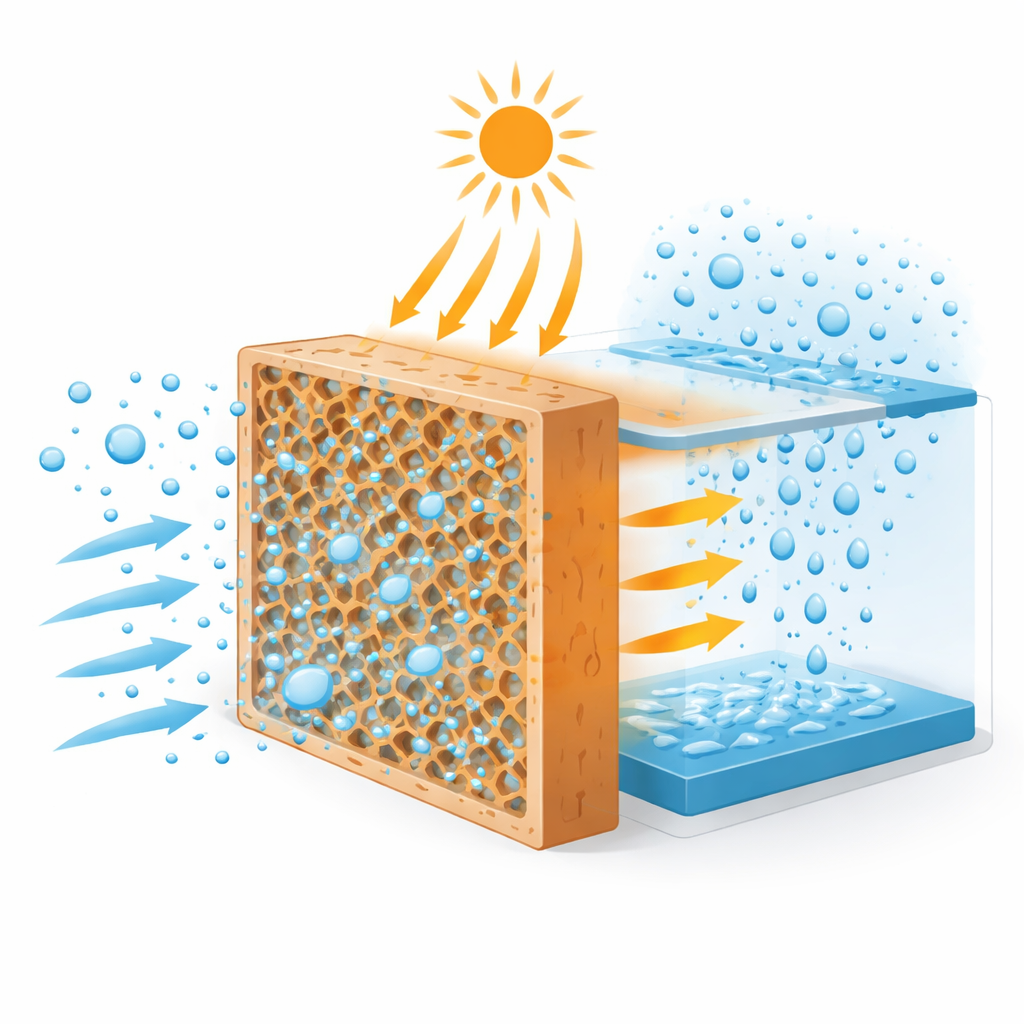
The researchers tackled this problem by combining two well‑known components into a single, carefully engineered “water sponge.” The backbone is a porous crystal framework known as a MOF, which has a huge internal surface area and channels that can rapidly take up water. Into these tiny channels they introduced a common salt, lithium chloride, which naturally pulls in large amounts of water but usually becomes messy and unstable when it liquefies. By soaking the MOF in salt solution and then drying it, they created a thin, even coating of salt on the internal surfaces without clogging the structure. Measurements of pore size, surface area, and chemical makeup confirmed that the salt formed a uniform layer inside the framework rather than clumping on the outside.
Soaking Up Nighttime Humidity, Letting Go Under Gentle Sun
Tests of water uptake showed that this composite can absorb extraordinary amounts of water, especially when the air is fairly humid, such as at night in arid regions. The material captures water in several stages, first binding it strongly to the salt, then allowing the salt to partially liquefy, and finally swelling with absorbed solution. Crucially, almost all of this water can be driven off at relatively low temperatures, around that of hot tap water, instead of the much higher temperatures that many earlier MOF sorbents demand. Repeated cycling experiments confirmed that the material can adsorb and release large amounts of water over and over again without losing capacity or leaking salt.
A Compact Sun‑Powered Device That Manages Heat Wisely
To turn this material into a practical tool, the team built a modular panel made of many small cartridges filled with the composite and covered by a dark, sunlight‑absorbing surface. At night, the exposed cartridges pull moisture from the air. During the day, sunlight warms the panel, heating the sorbent so it releases water vapor into an enclosed chamber where a cooler surface turns the vapor back into liquid water. A special double‑layer transfer plate inside the device helps keep the hot side hot and the cold side cool, simplifying the delicate balance between heating for release and cooling for condensation. In laboratory trials, a panel the size of a tabletop produced over a liter of water per square meter in seven hours and showed about a quarter higher thermal efficiency than the same device using the MOF alone.
Working Across Seasons and Places
Field tests in three Chinese cities with very different climates—humid subtropical Shanghai, hot continental Jinan, and cool high‑altitude Kunming—demonstrated that the composite‑based device consistently outperformed a similar one using only the MOF. Depending on the site, the new system collected roughly 50 to over 90 percent more liquid water under identical outdoor conditions, including days with weaker sunlight and lower temperatures. In some cases, it began producing water earlier in the morning and kept adsorbing moisture longer at night, making better use of the natural day–night humidity cycle. Importantly, chemical analysis of the collected water showed no detectable traces of lithium, nickel, or other metals, indicating that the water is as clean as distilled water and that the salt remains safely locked inside the material.
What This Means for Future Water Solutions
In simple terms, the researchers have built a better “air sponge” and wrapped it in a smarter box. By marrying a porous crystal with a hygroscopic salt, then pairing it with clever heat management, they have created a system that can pull more water from the air while spending less energy to do so. Because it works at lower temperatures and across varied weather conditions, this approach could lead to affordable, solar‑powered devices that supply drinking water in dry, remote, or climate‑stressed regions. The work offers a blueprint for how combining materials with complementary strengths can turn everyday sunlight and humid air into a dependable source of fresh water.
Citation: Shao, Z., Feng, X., Poredoš, P. et al. Synergistic MOF-based composite enabling significant solar-to-water generation enhancement in climate-resilient AWH. Nat Commun 17, 2097 (2026). https://doi.org/10.1038/s41467-026-68946-8
Keywords: atmospheric water harvesting, solar desalination, metal-organic frameworks, hygroscopic salts, off-grid water supply