Clear Sky Science · en
Latitudinal divergence in runoff responses to global forestation due to forest-atmosphere feedbacks
Why Planting Trees Can Change Our Water
Tree planting is widely promoted as a natural way to slow climate change, but adding forests also reshapes how water moves through the air, soil, and rivers. This study asks a deceptively simple question with big implications: if we planted trees wherever the climate and land could reasonably support them, what would happen to freshwater supplies around the world? Using advanced climate models and a classic water-balance framework, the authors find that large-scale forest expansion would not affect all regions equally—some would become effectively wetter, while others could face less runoff and more water stress.
How Forests Pull the Levers of the Water Cycle
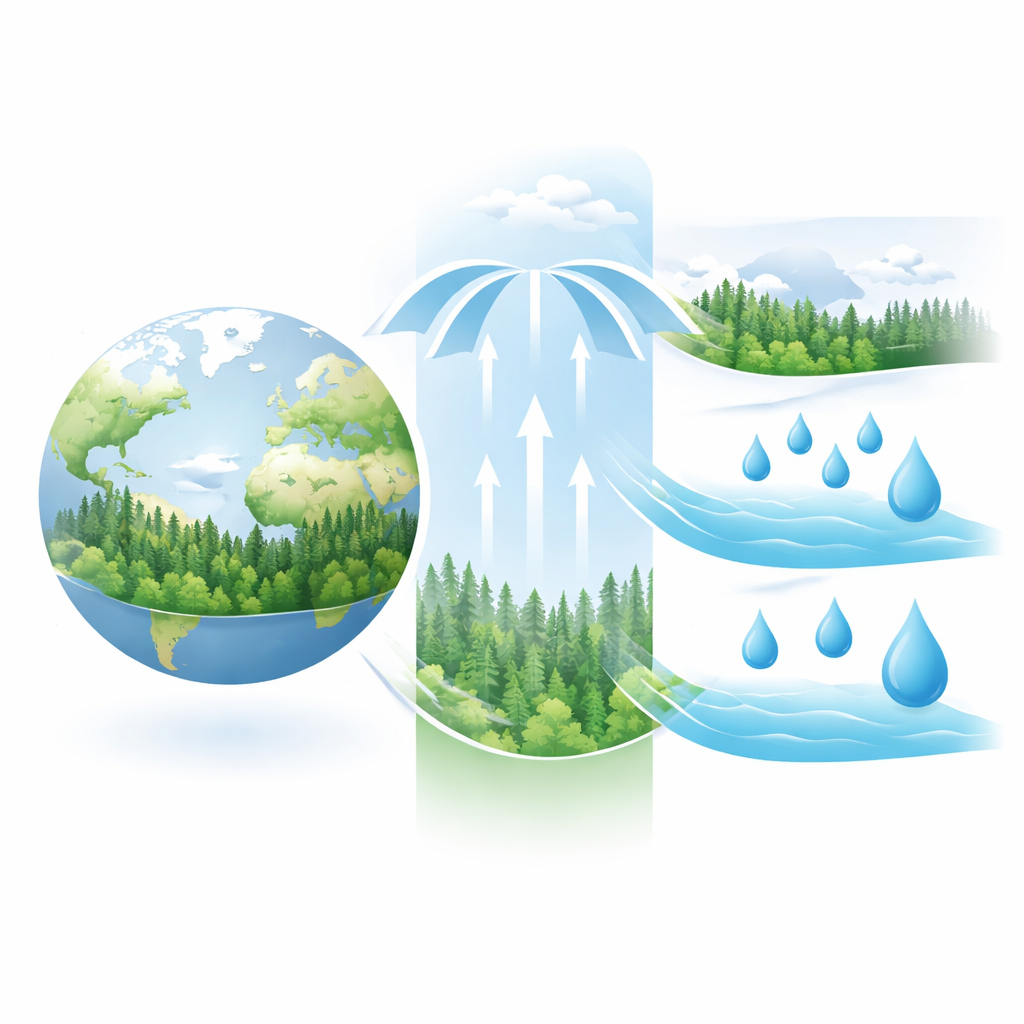
Forests influence water in several ways at once. Compared with grasslands or crops, trees draw more water from the soil and release it to the air through evapotranspiration. Their darker canopies absorb more sunlight, changing local temperatures and humidity. And crucially, the added water vapor can feed clouds and rain, sometimes far from where it was released. To capture these intertwined effects, the researchers ran paired simulations with a land–atmosphere climate model: one with today’s vegetation and one with a “full-potential” map where tree cover is maximized in all suitable areas. They then used the Budyko framework, which links long-term rainfall, evaporation, and runoff, to separate direct effects of more trees on local water use from indirect effects that travel through the atmosphere.
More Trees, More Rain—But Not Everywhere
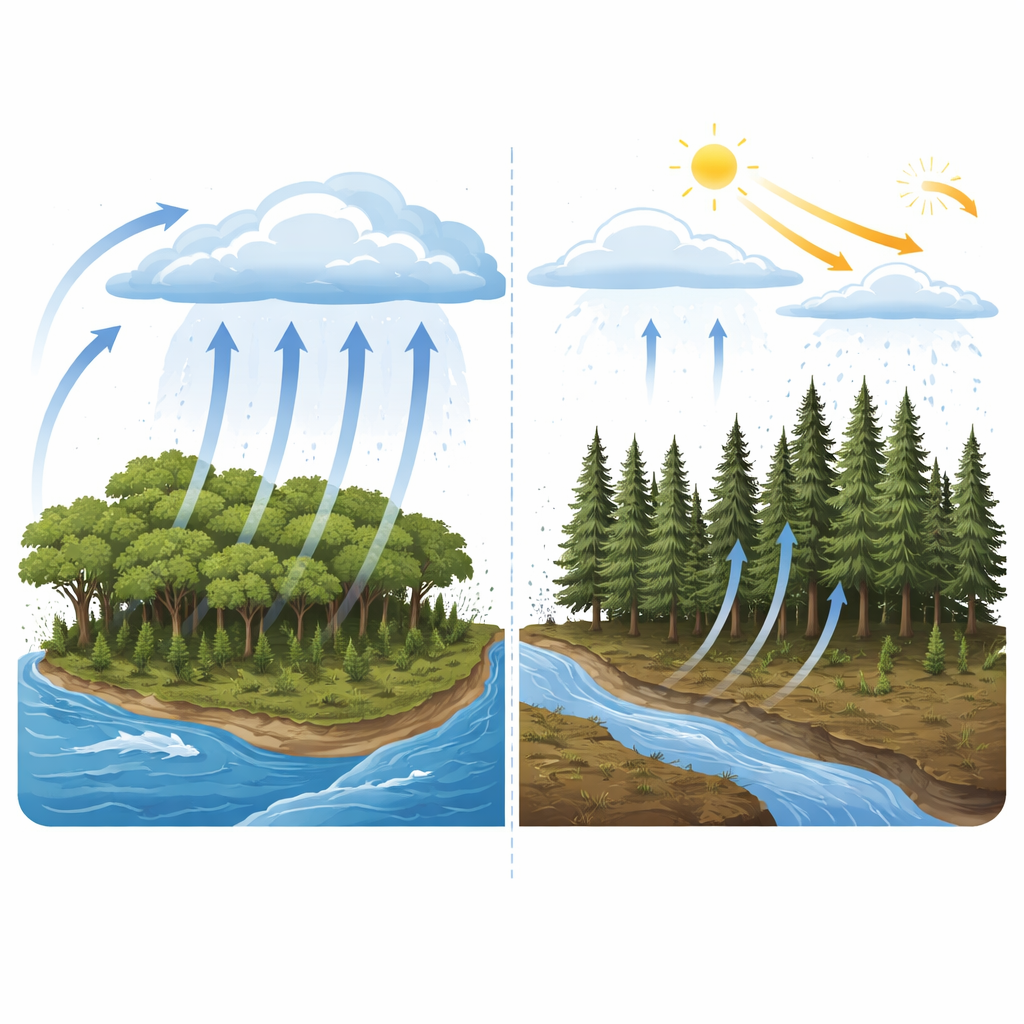
In the global forestation scenario, evapotranspiration increased over most land areas, meaning more water vapor was pumped into the atmosphere. Overall, this intensified the global water cycle: average land precipitation rose by about four percent and river runoff by nearly three percent. Yet this global average hides a striking geographic pattern. In tropical and many temperate regions influenced by monsoon systems—such as the Amazon, Congo Basin, southern Africa, southeastern China, and parts of Australia—increased rainfall more than compensated for the extra water consumed by forests. In these places, runoff generally grew, even though soils tended to dry slightly because trees were using more water.
Why High Latitudes Risk Losing Water
In contrast, northern high-latitude regions like much of Europe, Russia, and parts of North America showed declining runoff under expanded forests. There, new dark canopies replaced brighter, often snow-covered surfaces, boosting net solar energy at the ground. That extra energy raised the atmosphere’s demand for moisture, increasing potential evaporation more than rainfall could keep up with. As a result, even modest gains in precipitation were outweighed by stronger evaporative losses, leading to less water feeding rivers and streams. The models and supporting observational analyses both point to this thermal contrast: warm regions see strong precipitation boosts from enhanced vertical moisture transport and circulation changes, while cold regions see limited rain gains but a marked rise in atmospheric thirst.
Hidden Local Costs Along the Dryness Spectrum
Beyond climate zones, the authors probed how background dryness shapes local outcomes. They found that the direct effect of adding trees—without considering atmospheric feedbacks—is almost always to reduce runoff, because forests retain and use a larger share of incoming rainfall. This suppression is strongest in “in-between” climates that are neither very wet nor very dry, where water and energy limitations balance. In many of the main afforestation hotspots—such as parts of Europe, southeastern North America, and southern Asia—these local land-surface effects can cut runoff by more than 40 percent, even where regional atmospheric feedbacks increase rainfall. This means that, for communities living where the trees are planted, new forests can significantly reduce the water available for rivers and reservoirs, even if neighboring regions benefit from added rain.
What This Means for Future Tree-Planting Plans
The study concludes that large-scale forestation would, on balance, slightly increase global freshwater flows, but with a clear split: tropical and many temperate regions tend to gain runoff, while boreal and other cold regions tend to lose it. These patterns are driven mainly by how forests reshape the atmosphere—changing where and how much it rains, and how thirsty the air becomes—rather than just by trees using more water locally. For policy makers, this means afforestation cannot be planned on carbon benefits alone. In water-scarce or high-latitude regions, extensive tree planting could aggravate water shortages, whereas in warm, humid zones it may help bolster water availability. The authors argue that future tree-planting strategies must be tailored by latitude and climate, jointly weighing carbon storage, temperature effects, and the often-overlooked consequences for rivers and water security.
Citation: Kan, F., Lian, X., Xu, H. et al. Latitudinal divergence in runoff responses to global forestation due to forest-atmosphere feedbacks. Nat Commun 17, 2515 (2026). https://doi.org/10.1038/s41467-026-68945-9
Keywords: afforestation, runoff, hydrological cycle, forest–atmosphere feedbacks, water resources