Clear Sky Science · en
Predicting instabilities in transient landforms and interconnected ecosystems
Why hidden tipping points matter to everyday life
Many landscapes and ecosystems we rely on—like mountain glaciers and the Amazon rainforest—can sit quietly stable for years, then suddenly shift to a very different state. These abrupt changes affect sea-level rise, flood risk, regional climate, and biodiversity. This study introduces a new way to spot such looming tipping points directly in real-world data, without heavy mathematical cleaning, offering a clearer early warning when key parts of the Earth system begin to lose their balance.
Seeing beyond noisy seasonal ups and downs
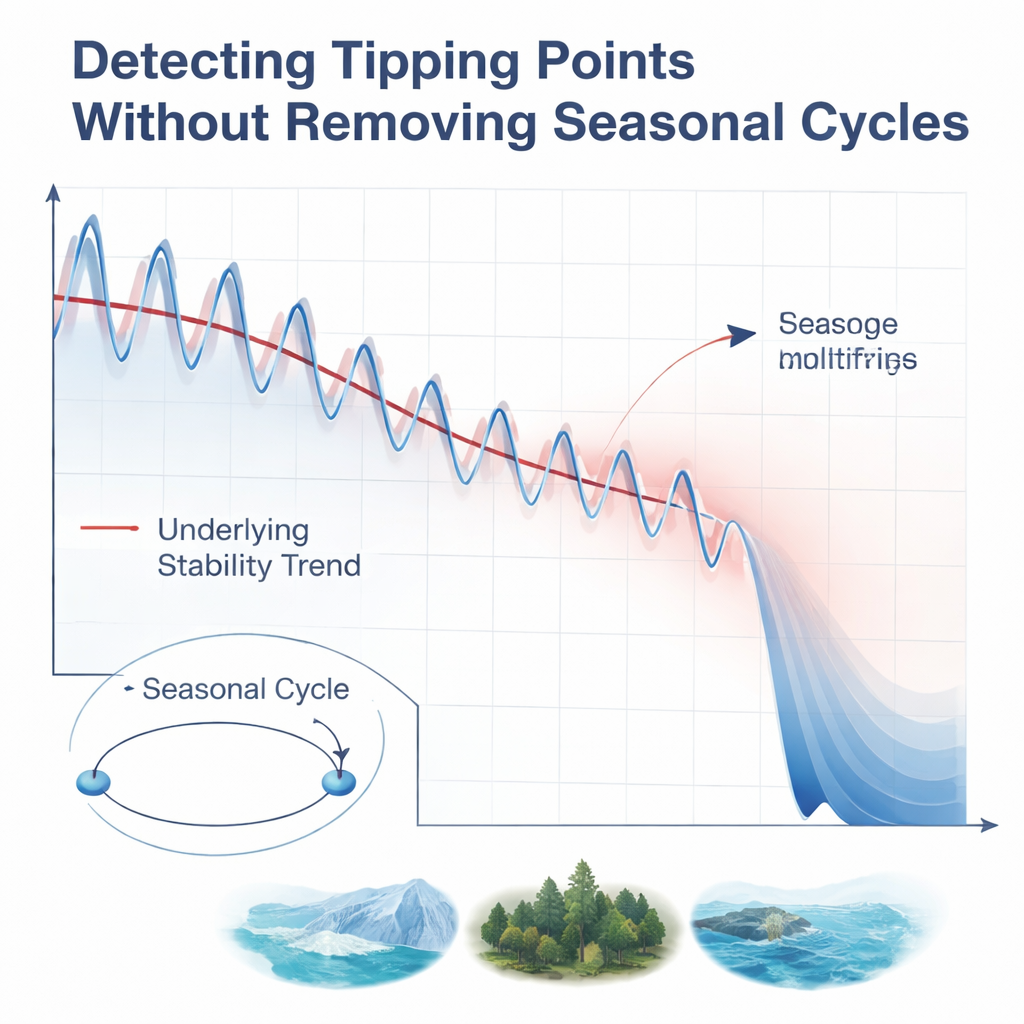
Natural systems rarely behave smoothly. Vegetation, ice, and climate all pulse with strong seasons, trends, and random noise. Traditional warning tools look for “critical slowing down,” where recovery from small disturbances becomes slower as a system nears a tipping point. But these tools assume that the data have been stripped of trends and seasonal cycles, a tricky and error-prone step. Different ways of removing seasonality can give very different answers about whether a forest or ice sheet is becoming less stable. The authors instead borrow a concept from mathematics—Floquet multipliers—which allows them to measure stability in systems that are naturally periodic, such as those driven by the annual cycle of sunlight and temperature, without first subtracting out the seasons.
Following stability through time instead of just averages
The method builds on a technique called Dynamic Mode Decomposition, which looks at how patterns in data evolve from one time step to the next. From this, it estimates a set of numbers—eigenvalues—that describe how disturbances grow or fade. In a stable system, all of these numbers stay below a critical value; when any of them cross a threshold, instability sets in. For seasonally repeating systems, the authors focus on Floquet multipliers, which track stability around the seasonal cycle itself. One multiplier typically represents the regular seasonal rhythm and stays close to one, while another reveals deeper changes that push the system toward a tipping point. By sliding a window through time, they can watch these multipliers move and detect when one approaches or crosses the danger line.
From glaciers on the move to forests under stress
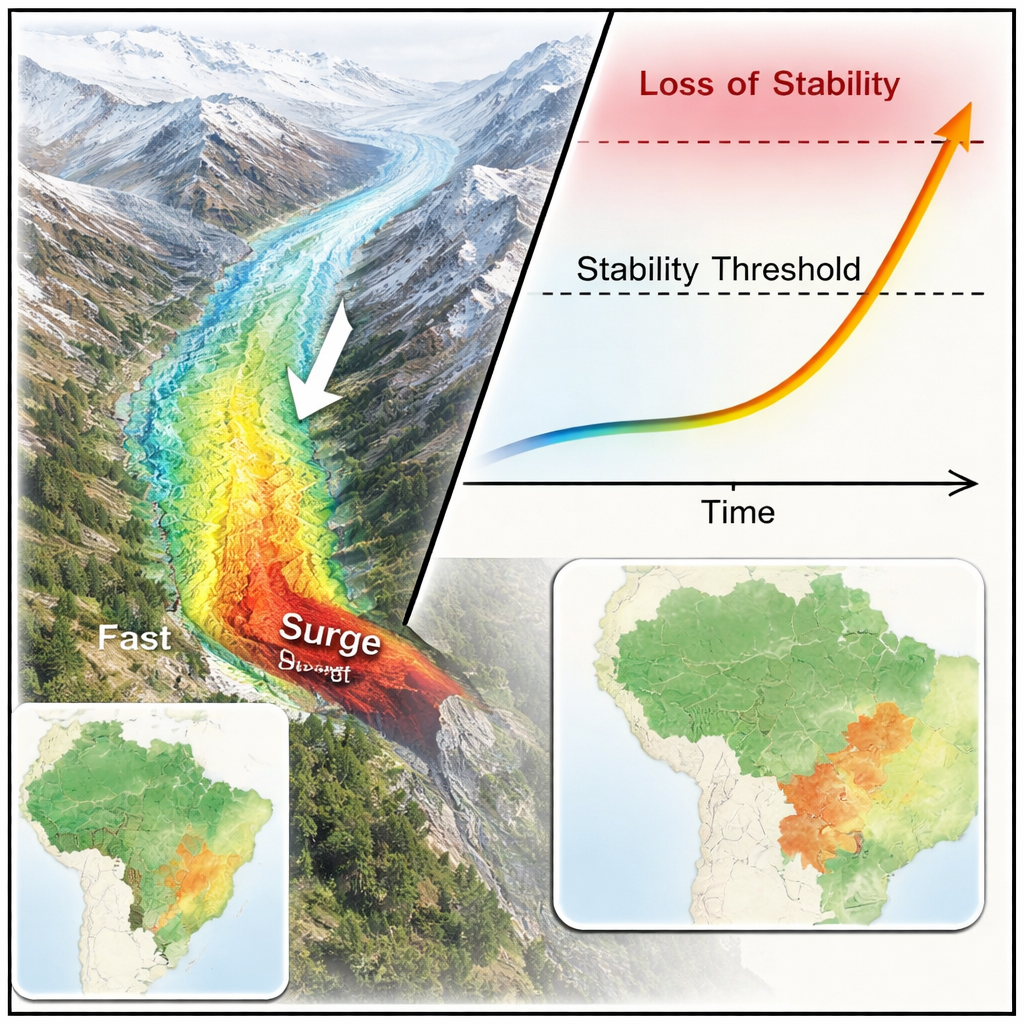
To show how this works in practice, the researchers first test the method on synthetic models of vegetation that gradually shift from lush to barren. Their approach gives earlier and cleaner warnings of the impending collapse than standard indicators like variance or autocorrelation, and it does so without stripping out seasonality. They then turn to real data. For two well-studied glaciers—one in Alaska and one in the Karakoram—they analyze detailed satellite-based measurements of surface speed. Glaciers normally speed up and slow down with the seasons, but can occasionally enter a surge, racing downslope much faster than usual. The Floquet-based analysis detects a clear rise in instability at least a year before each surge begins, both when looking at a single point on the glacier and when treating the glacier as a whole, spatially extended system.
Mapping where instability starts to spread
Because the method works on full maps as well as on single time series, it can reveal where in space a system is destabilizing. For glaciers, the authors find that only certain parts of the ice begin to “light up” in their stability patterns before a surge, pointing to localized patches that drive the overall change. They then apply the technique to satellite observations of vegetation in the Amazon rainforest, using a measure called vegetation optical depth that reflects biomass and canopy moisture. The analysis uncovers a mode of instability that grows strongest in the southern Amazon, an area heavily affected by deforestation and human activity. Although the pattern does not match any single driver perfectly—such as fire, drought, or forest loss alone—it suggests that several pressures together are nudging parts of the forest toward a less resilient state.
What this means for watching Earth’s future
In everyday terms, this work offers a more reliable alarm system for natural tipping points. Instead of wrestling seasonal swings and noisy measurements into an artificially “flat” signal, the new method embraces the periodic rhythms of the Earth and looks at how resilience changes around them. By tracking when certain mathematical fingerprints cross a stability threshold, scientists can better anticipate sudden glacier surges or regional shifts in major ecosystems like the Amazon. While the approach still depends on having good data and careful choices in its setup, it opens the door to monitoring a wide range of climate, ecological, and landscape systems for early signs that they are moving dangerously close to abrupt, and potentially irreversible, change.
Citation: Smith, T., Morr, A., Bookhagen, B. et al. Predicting instabilities in transient landforms and interconnected ecosystems. Nat Commun 17, 1316 (2026). https://doi.org/10.1038/s41467-026-68944-w
Keywords: tipping points, glaciers, Amazon rainforest, early warning signals, ecosystem stability