Clear Sky Science · en
An insect-scale artificial visual-olfactory bionic compound eye
Robot Eyes and Noses in One Tiny Package
Imagine a robot insect that can not only see where it’s going but also “smell” dangerous gases in the air—all using a device no bigger than a real fly’s eye. This paper describes just such a creation: a miniature artificial compound eye that combines vision and smell in a single, ultra-light sensor. By borrowing tricks from fruit flies and other insects, the researchers show how future drones and small robots could navigate cluttered, hazardous environments quickly and safely while using very little power.
What Nature Taught the Engineers
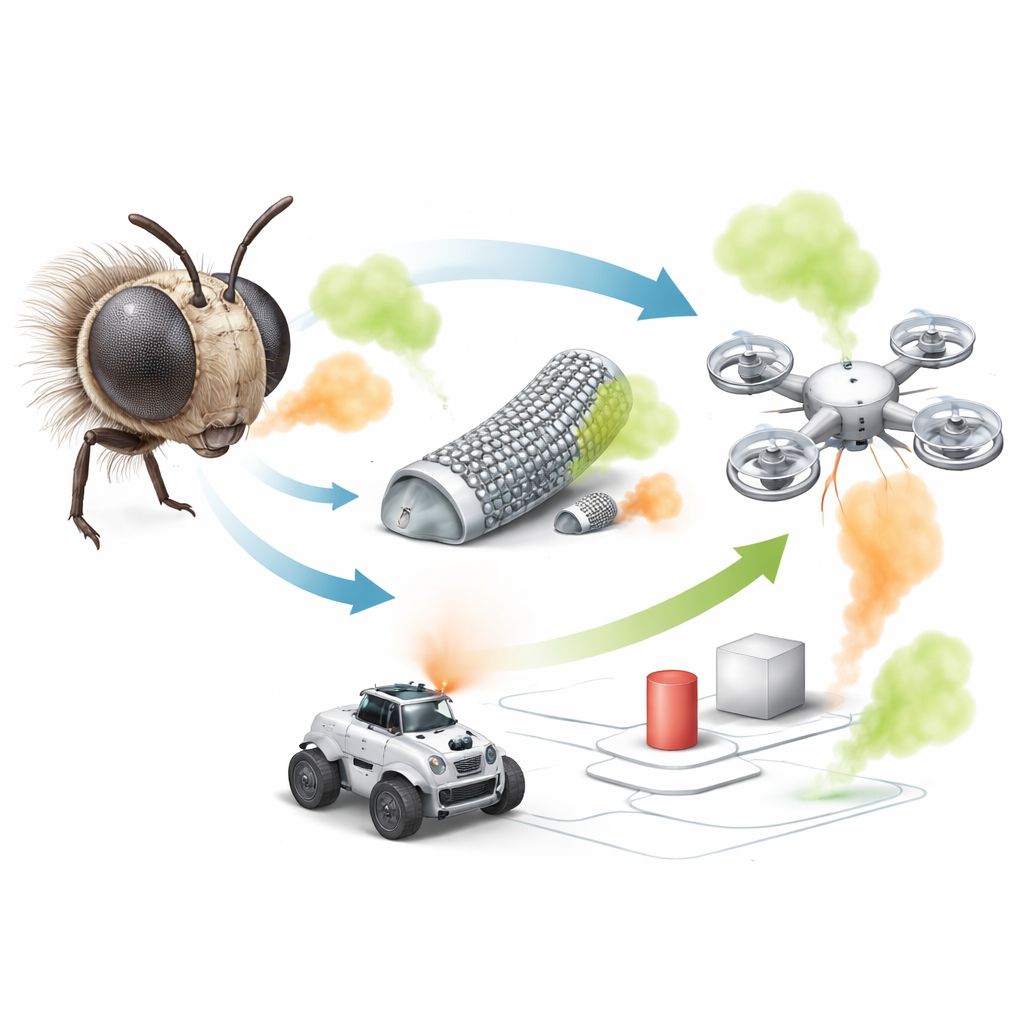
Insects like fruit flies rely on compound eyes—domes packed with hundreds of tiny lenses—to spot motion across a wide field of view, helping them dodge predators and obstacles. At the same time, their antennae provide a keen sense of smell, letting them detect food, mates, or threats in the air. Both streams of information are combined in the insect brain to guide fast decisions. The authors set out to recreate this dual sense in hardware: a single, insect-scale device that mimics the fly’s eye for wide-angle motion detection and integrates a chemical “nose” to read the surrounding air, then fuses both signals for smarter behavior.
Building a Tiny Curved Eye That Really Works
The team built a cylindrical artificial eye about the size of a small insect head, packing 1,027 tiny lenses into a square only 1.5 millimeters across. Using an ultra-precise 3D printing technique, they directly printed a curved microlens array onto a flexible layer of organic light detectors. Each lens lines up with a single detector, forming an individual “pixel” that looks in its own direction, much like an insect’s ommatidium. The lenses are designed with a narrow acceptance angle so that light from one direction does not spill into neighboring pixels, closely imitating the natural optical isolation in real compound eyes. To cope with fog and humidity, the researchers added microscopic hair-like structures between lenses that help prevent droplets from condensing on the surface, similar to the self-cleaning hairs around real insect eyes.
Seeing Motion and Sensing Air in Real Time
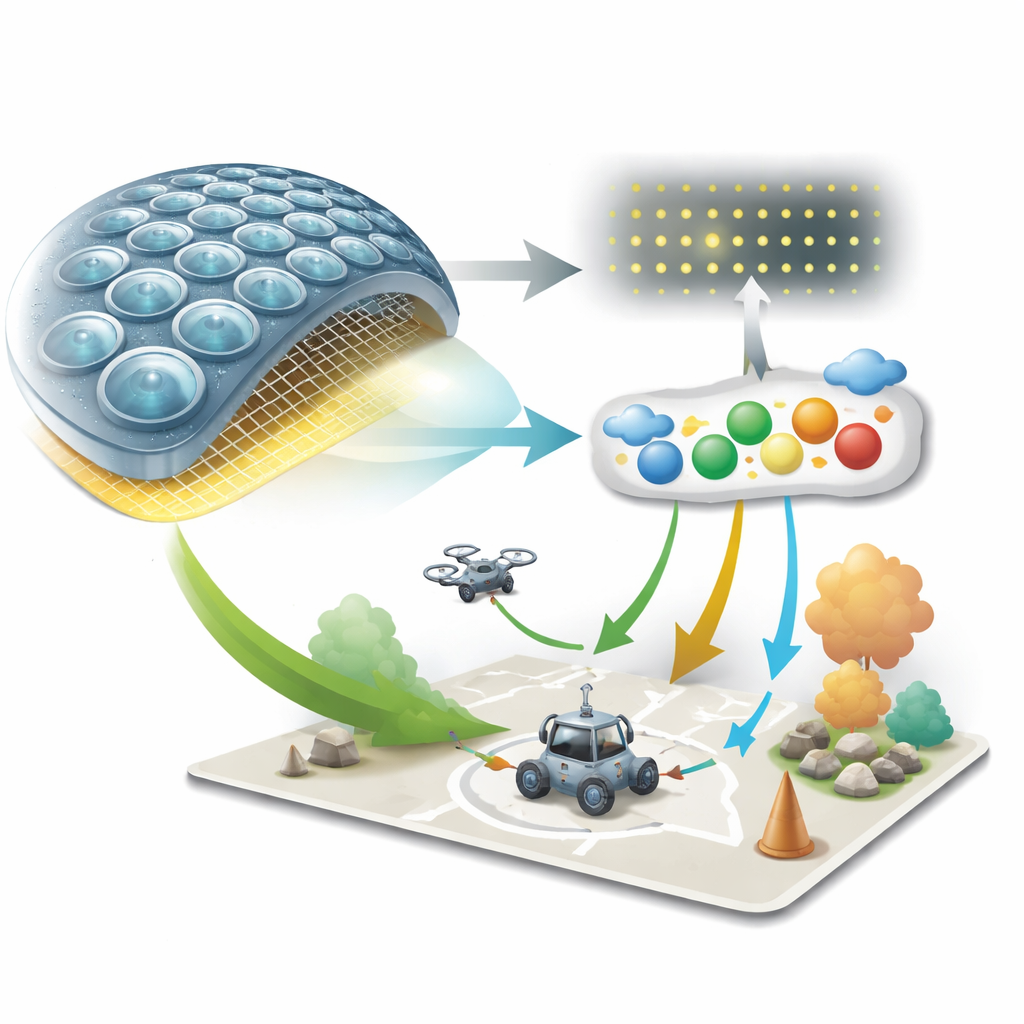
Under the lenses lies a specially engineered light-sensitive layer made from a blend of organic semiconductors and lead sulfide quantum dots. This combination lets the device detect light from ultraviolet through visible to near-infrared wavelengths while responding in about one ten-thousandth of a second—fast enough for a flicker fusion rate of about 1,000 images per second. Rather than forming sharp, detailed pictures, the device records changing bright spots across its wide field of view, which a simple mathematical model converts into information about where objects are, how far away they might be, and how they move. In parallel, an inkjet-printed colorimetric array acts like an artificial nose: tiny spots containing metal complexes and pH-sensitive dyes change color when exposed to specific hazardous gases. A lightweight, fly-inspired hashing algorithm then turns these color changes into gas identity and rough concentration, with about 93% accuracy across ten common toxic vapors.
From Lab Bench to Rolling Robots and Drones
To prove that this insect-scale “eye-and-nose” is useful outside the lab, the researchers mounted it on two small unmanned platforms. On an omnidirectional wheeled robot, the curved eye allowed the system to watch an 180-degree horizontal field and detect motion fast enough to dodge approaching obstacles, even in foggy conditions. Simple, hardware-implemented rules—again inspired by insect escape behavior—let the robot back away from incoming objects or steer around them while cruising. On a small drone, the same device tracked the position of moving lights in three dimensions and, together with the gas sensor, guided autonomous exploration through a test environment containing light sources and plumes of hazardous chemicals. Visual and smell information were combined so that the drone could both follow targets and map dangerous gases in space.
Why This Matters for Future Small Machines
This work shows that it is possible to pack both wide-angle, high-speed vision and chemical sensing into a sensor about as small as a real insect’s eye. The device sacrifices fine image detail in favor of motion sensitivity, broad spectral coverage, and energy efficiency—exactly the trade-offs that matter for tiny drones and robots with limited power and computing resources. By uniting “eyes” and “nose” in one compact system and borrowing fusion strategies from insect brains, the study points toward future swarms of small, low-cost autonomous machines that can dodge obstacles, recognize risky gases, and explore complex environments with the agility of flying insects.
Citation: Wang, J., Wei, S., Qin, N. et al. An insect-scale artificial visual-olfactory bionic compound eye. Nat Commun 17, 2259 (2026). https://doi.org/10.1038/s41467-026-68940-0
Keywords: bionic compound eye, bioinspired robotics, multimodal sensing, micro vision systems, hazardous gas detection