Clear Sky Science · en
Machine learning for microscopy data analytics targeting real-time optical characterization of semiconductor nanocrystals
Why Tiny Crystals and Flickering Light Matter
From smartphone screens to solar panels, modern technologies rely on materials that turn light into electricity and electricity into light with great efficiency. At the heart of many of these devices are semiconductor nanocrystals—tiny crystals thousands of times smaller than a grain of sand. When scientists examine how these crystals glow under a microscope, their light often flickers or “blinks” in complex ways. This new study shows how unsupervised machine learning can rapidly sort and interpret that blinking, turning a messy sea of data into a powerful tool for judging and improving material quality in nearly real time.
Little Crystals with Big Mood Swings
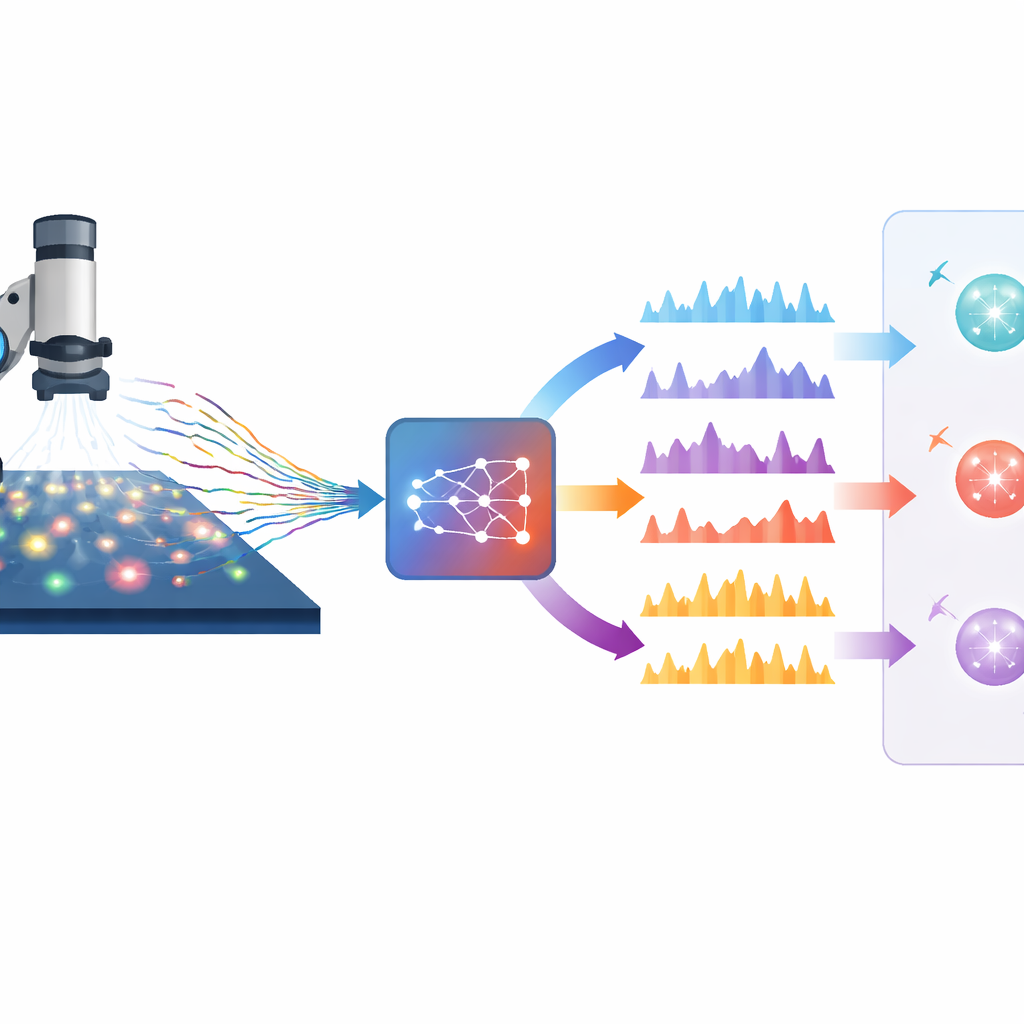
Semiconductor nanocrystals are expected to behave uniformly if they share the same size, shape, and composition. Yet, when viewed one by one through photoluminescence microscopy—watching how brightly they glow over time—they act very differently. Some blink between bright and dark, others slowly brighten before fading, and some show more complicated light patterns. These differences arise from imperfections in the crystals called traps, which temporarily capture charge carriers and send their energy away without light. Because such traps reduce the performance of LEDs, lasers, and solar cells, the exact style of blinking becomes a sensitive fingerprint of material quality.
The Challenge of Too Much Blinking Data
In a typical experiment, a camera records the brightness of hundreds of nanocrystals every few milliseconds for several minutes, producing thousands of data points for each particle. Manually grouping these blinking traces and calculating detailed statistics is time-consuming, prone to bias, and hard to scale to industrial needs. Conventional analyses often rely on setting thresholds—deciding by hand what counts as “on” or “off”—and focus on only one or two types of behavior, leaving other patterns underexplored. As a result, much of the rich information hidden in the blinking is lost, and drawing reliable conclusions about material quality becomes difficult.
A Learning Machine for Flickering Light
The authors introduce a workflow they call UML-PSD, which combines unsupervised machine learning with a type of frequency analysis. First, they feed all the blinking traces into a K-means clustering algorithm. Instead of telling the algorithm what patterns to look for, they let it discover natural groupings based purely on how the brightness changes over time. To make this clustering both faster and more accurate, they smooth the data and compress it by averaging over small time windows, while keeping the essential shape of each blinking pattern intact. A separate “Visual & Logical” module automatically tests different numbers of clusters and degrees of smoothing, using statistical measures to decide how many distinct blinking categories are really present and how well-separated they are.
From Patterns to Physical Insight
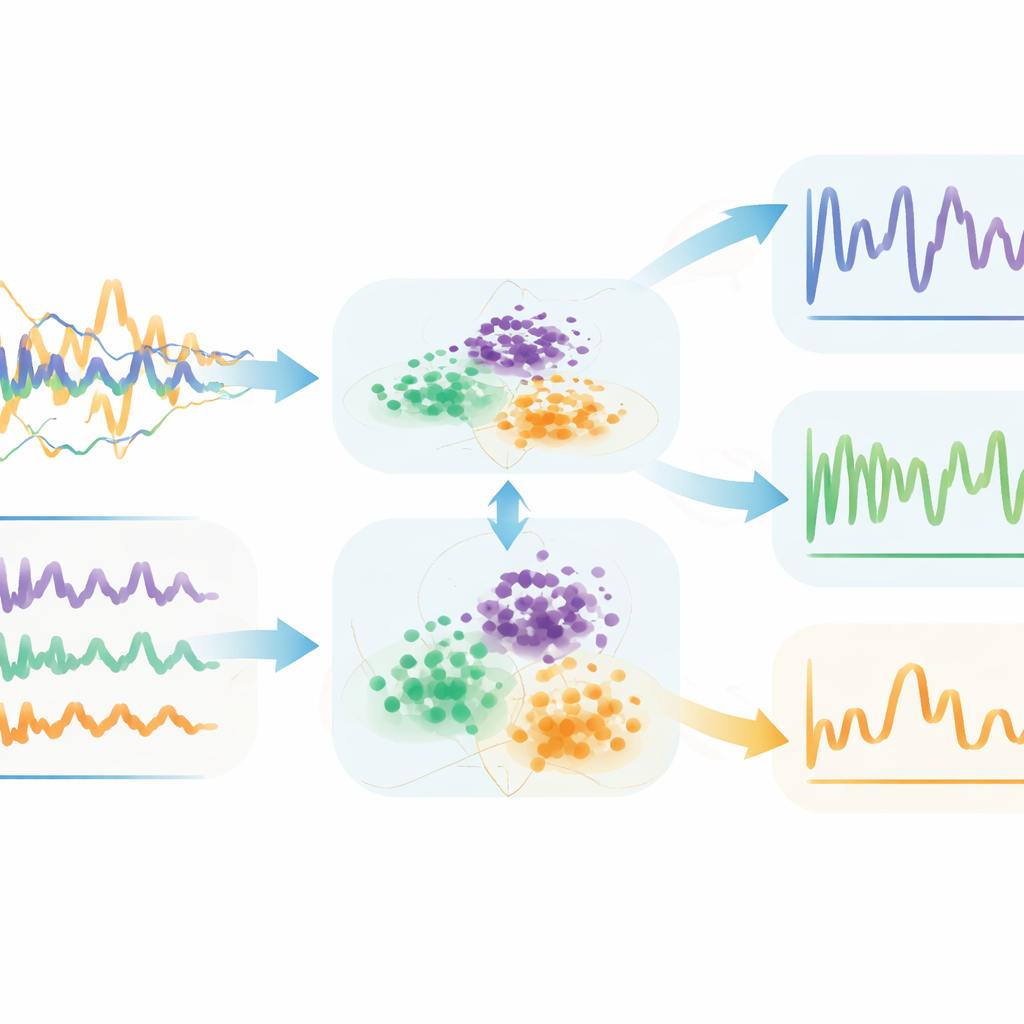
Once the blinking traces are clustered, the researchers pull out the original, full-length data and analyze it in the frequency domain using power spectral density (PSD). This reveals how strongly different timescales contribute to the flickering, and it can be summarized by an exponent that reflects whether slow, deep traps or fast, shallow traps dominate. Comparing this exponent across clusters links each blinking style to a characteristic trap behavior inside the nanocrystals. The same approach is extended from single spots to entire crystal assemblies: by clustering pixels in wide-field images based on how they blink, the method maps out regions that fluctuate together and then builds spatial maps of trap properties across grains and grain boundaries. The authors further demonstrate that the same clustering ideas can cleanly separate useful and biased signals in a completely different experiment, scanning tunneling spectroscopy of molecular networks.
Toward Smarter Microscopes and Better Materials
In practical terms, this study shows that machine learning can transform raw blinking movies into immediate, physically meaningful summaries of trap behavior and charge-carrier motion. The UML-PSD method dramatically reduces analysis time, improves the reliability of identifying distinct blinking types, and produces intuitive maps of where good and bad regions lie in a sample. With future upgrades—such as deep learning, super-resolution imaging, and integration directly into microscope control software—the same ideas could power “smart microscopes” that evaluate batches of nanocrystals on the fly. For industry and research alike, that means faster screening, more consistent materials, and a clearer path to high-performance optoelectronic devices.
Citation: Mukherjee, A., Reynaerts, R., Pradhan, B. et al. Machine learning for microscopy data analytics targeting real-time optical characterization of semiconductor nanocrystals. Nat Commun 17, 2361 (2026). https://doi.org/10.1038/s41467-026-68939-7
Keywords: semiconductor nanocrystals, photoluminescence blinking, unsupervised machine learning, microscopy data analysis, defect trap dynamics