Clear Sky Science · en
GHz dynamic holographic VCSEL chip via current-addressed modes multiplexing
Why ultra-fast tiny holograms matter
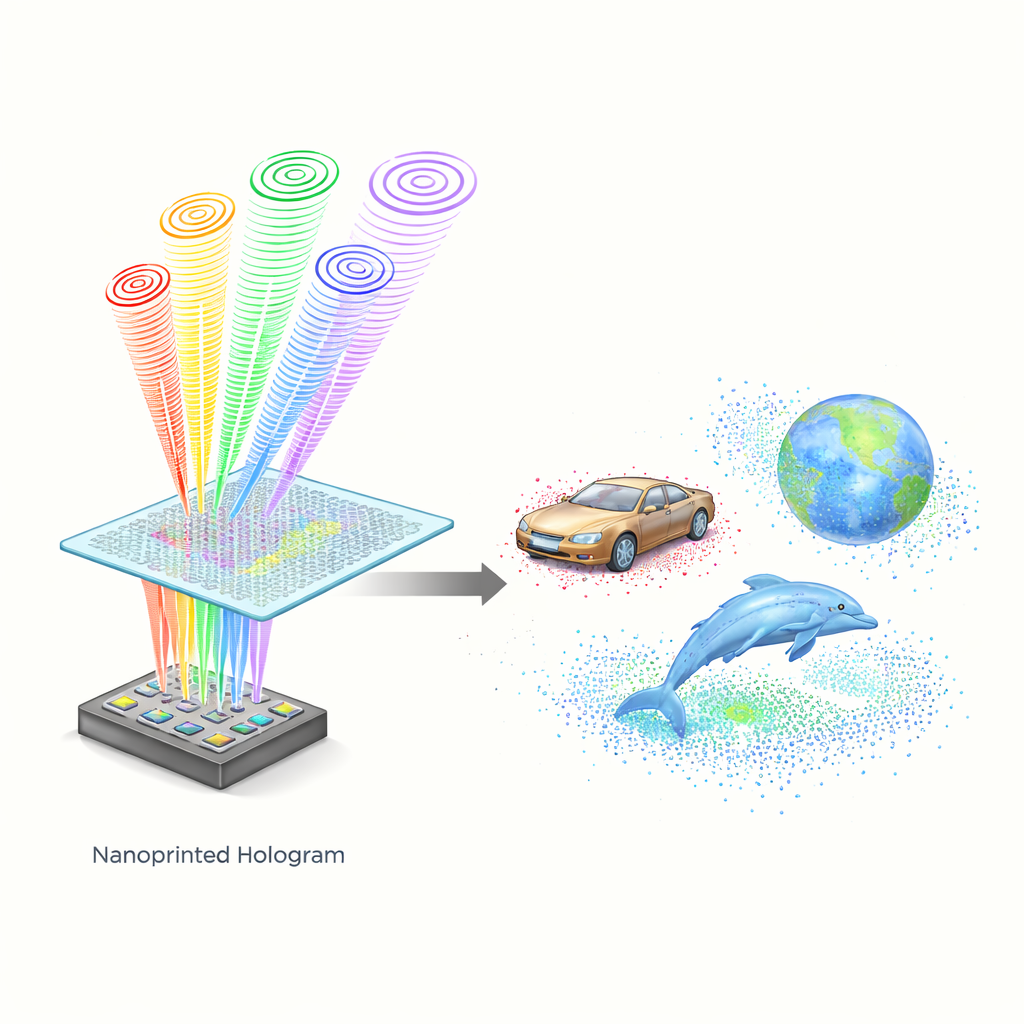
Imagine a holographic display so small it fits on the tip of a pin, yet fast enough to refresh billions of times per second. Such technology could shrink today’s bulky holographic projectors into ultra-thin chips for smart glasses, phones, cars, and high-speed data links. This paper reports a laser chip that can create dynamic three-dimensional holograms at gigahertz speeds, pointing toward future portable and low-latency holographic devices.
Turning a laser problem into a powerful feature
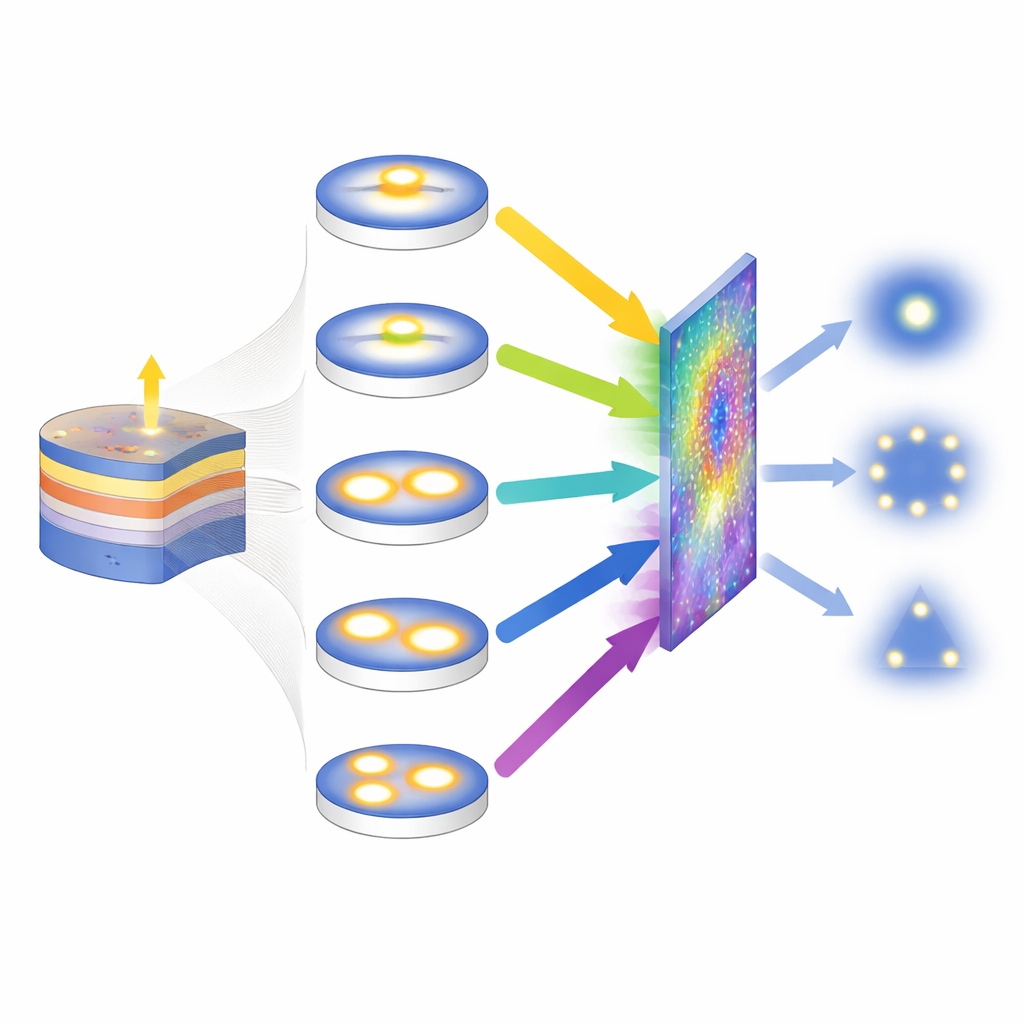
Many tiny semiconductor lasers, called vertical-cavity surface-emitting lasers (VCSELs), naturally support several patterns of light across their circular beam. Traditionally, engineers tried hard to suppress these higher-order patterns to keep the beam clean. The authors flip this logic: instead of treating extra patterns as a flaw, they use them as separate information channels. Each pattern, or “mode,” behaves like a distinct shape of the light wave, which can be selected by simply adjusting the electrical current driving the laser.
Light patterns that respond to a dial
The team first studied how these light patterns evolve as current increases. Inside the laser, current does not flow evenly; it tends to build up in a ring, leaving a “hole” in the center as power rises. This uneven distribution favors different transverse light patterns at different currents. By carefully modeling and measuring the device, the researchers showed that the dominant pattern can switch in a predictable way as they turn the current up or down. In other words, the electrical current acts like a dial that selects which spatial pattern of light leaves the laser.
Encoding moving holograms into a tiny surface
To harness these current-selectable patterns, the authors created specialized holograms that sit directly on top of the VCSEL surface. Using three-dimensional laser nanoprinting, they built microscopic structures—only about 100 micrometers across—that reshape the outgoing light into images in space. Crucially, the hologram is designed so that each selected light pattern reconstructs a different image. By choosing four well-separated patterns with minimal overlap, they can switch cleanly among four holographic frames simply by changing the current over time.
From flat chips to 3D scenes
Integrating these holograms onto several VCSELs in a 2×2 array, the researchers created a chip-scale system that can display multiple holographic symbols and even three-dimensional scenes. By embedding lens-like functions into the hologram design, they placed different images at different depths along the beam, enabling 3D switching: one current combination reveals one set of numbers at a near plane, another reveals a different set farther away. Measurements of how fast the chip can modulate light show that the holographic images can refresh at about 1.93 gigahertz—orders of magnitude faster than conventional holographic displays based on liquid crystal or micromirror devices.
What this means for future devices
For a non-specialist, the key message is that the authors have combined the light source and the hologram into a single microscopic chip and found a simple way—turning an electrical knob—to switch among many holographic images almost instantly. This approach removes bulky optics, shrinks the entire system to a footprint of hundreds of micrometers, and reaches the fastest holographic switching speed reported so far. Such chips could underpin next-generation augmented and virtual reality, ultra-fast short-range optical links, and compact sensors, bringing vivid, low-latency holographic experiences closer to everyday technologies.
Citation: Hu, X., Dong, Y., Shi, J. et al. GHz dynamic holographic VCSEL chip via current-addressed modes multiplexing. Nat Commun 17, 2149 (2026). https://doi.org/10.1038/s41467-026-68938-8
Keywords: holographic display, VCSEL chip, dynamic holography, orbital angular momentum, nanophotonic devices