Clear Sky Science · en
Advancing A(H5N1) influenza risk assessment in ferrets through comparative evaluation of airborne virus shedding patterns
Why this study matters
News about bird flu spilling over into dairy cattle and farm workers has raised an uncomfortable question: could one of these viruses spark the next pandemic? This study uses ferrets—our best stand‑ins for humans in flu research—to probe how much virus recent H5N1 strains release into the air, and how that relates to their ability to spread. The work does not sound the alarm for a new pandemic right now, but it does sharpen the tools scientists use to spot trouble early.
Tracking a changing bird flu
Highly pathogenic H5N1 bird flu has been circulating in wild birds and poultry since the 1990s, occasionally infecting people with severe consequences. In North America, a branch of this virus called clade 2.3.4.4b has now jumped into many species, including dairy cattle and farm workers. Within this branch, two genetic flavors—B3.13 and D1.1—are spreading widely. Human infections have mostly been mild, but there have been rare deaths, and the viruses are slowly picking up changes linked to drug resistance and better growth in mammals. That mix of wide circulation and sporadic severe disease makes it crucial to understand how close these viruses might be to spreading easily from person to person.
Ferrets as stand‑ins for people
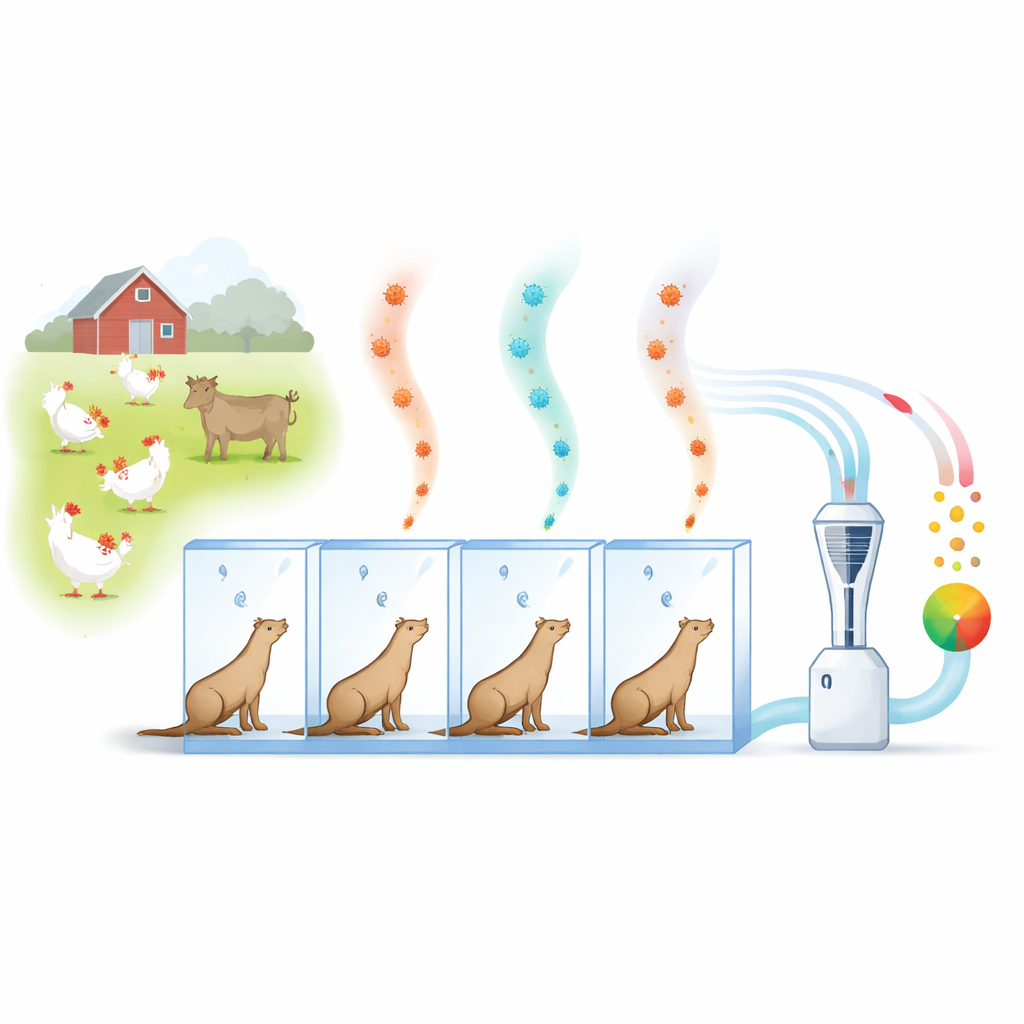
Scientists infected male ferrets with two B3.13 and two D1.1 H5N1 viruses taken from recent human cases in North America. Ferrets develop flu symptoms much like humans and pass virus to one another through contact and the air, making them a powerful model for gauging pandemic risk. In this study, all four viruses caused serious disease: the animals quickly developed fever, weight loss, breathing problems, and often diarrhea. Virus was not only abundant in the nose and lungs but also in organs like the gut, liver, spleen, and brain, showing that these strains can cause widespread infection in a mammal even without being fully adapted to humans.
How well do these viruses spread?
To test contagiousness, each infected ferret was paired either with a cage mate (direct contact) or with a neighbor in an adjacent cage that shared air but not touch (airborne only). A B3.13 virus from Colorado spread efficiently to all three direct‑contact partners, and every infected ferret in those pairs became severely ill. A D1.1 virus from Washington State showed only limited spread: one contact ferret clearly became infected and very sick, and another showed immune signs of exposure without detectable virus. None of the four H5N1 strains, whether B3.13 or D1.1, spread through the air‑only setup. That contrasts with earlier work showing that some B3.13 viruses can occasionally travel between ferrets by air, underscoring that even closely related viruses can behave differently.
Measuring virus in the air
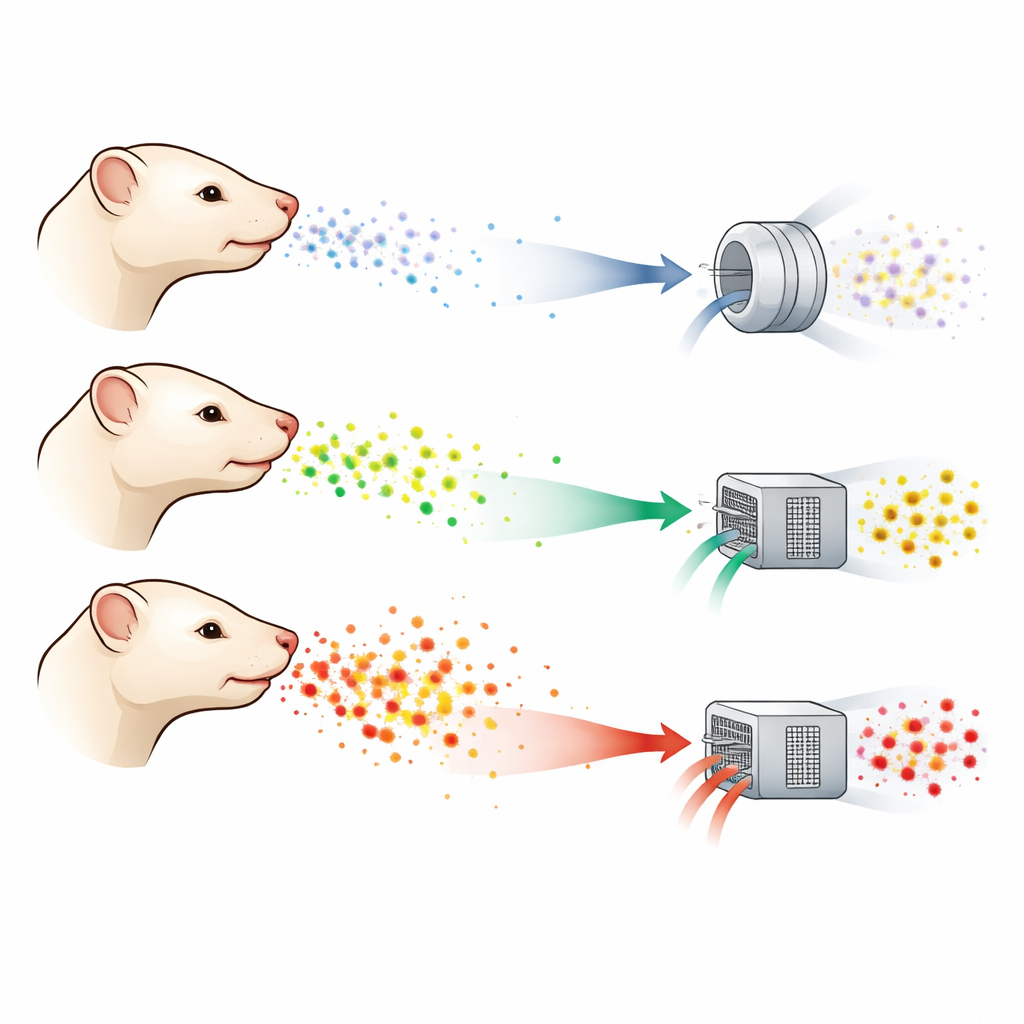
Because virus in the air is a key driver of respiratory pandemics, the team focused on how much virus infected ferrets actually exhaled. They used two kinds of air samplers: a cyclone device known as BC251 that pulls in large volumes of air and splits particles by size, and a newer water‑based “SPOT” sampler that gently captures particles into liquid. Both could detect genetic material from the virus and live, infectious particles. Overall, BC251 picked up virus more often and at higher levels, especially for strains that are good at airborne spread. SPOT tended to preserve the virus’s infectivity better, even though it collected somewhat less. When the researchers compared many flu viruses ranging from non‑transmissible to highly transmissible, they found that strains that spread well between ferrets consistently produced higher levels of virus in nasal washes and in the surrounding air than strains that did not spread.
Linking shedding to transmission risk
To move beyond simple yes‑or‑no transmission outcomes, the team added up virus levels over the first three days of infection, capturing both how high and how long the animals shed. Using these “area under the curve” values from air samples, they built a statistical model that predicts the chance a virus will spread through the air between ferrets. Seasonal H1N1 and an H9N2 bird flu adapted to mammals landed in the high‑risk zone, with predicted airborne transmission probabilities above 80 percent. Classic, non‑spreading H5N1 strains and the newer D1.1 viruses fell at the low end, under about 16 percent. The B3.13 viruses tested here did not actually spread by air in the experiment, but they produced more airborne virus than D1.1 and earned intermediate to high predicted transmission probabilities, overlapping with viruses known to spread inefficiently through the air.
What this means for future outbreaks
For non‑specialists, the key message is that today’s cattle‑associated H5N1 viruses remain poorly suited for easy airborne spread between mammals, at least in the ferret model. However, some B3.13 strains already cause severe systemic disease and shed more virus into the air than other non‑spreading viruses, putting them closer—though not yet over—the line toward efficient transmission. By refining how scientists measure airborne virus and linking those measurements to actual spread in animals, this study strengthens early‑warning tools for detecting flu strains that are creeping toward pandemic potential.
Citation: Pulit-Penaloza, J.A., Kieran, T.J., Brock, N. et al. Advancing A(H5N1) influenza risk assessment in ferrets through comparative evaluation of airborne virus shedding patterns. Nat Commun 17, 2266 (2026). https://doi.org/10.1038/s41467-026-68931-1
Keywords: H5N1 bird flu, airborne transmission, ferret model, zoonotic influenza, pandemic risk