Clear Sky Science · en
Variation in pathogen load and the pathogen load–infectiousness relationship broaden avian malaria’s distribution
Why bird malaria in Hawaii matters to everyone
On the Hawaiian Islands, a tiny parasite carried by mosquitoes is helping to push unique native birds toward extinction. This study asks a deceptively simple question with big implications: how does the amount of parasite in a bird’s blood affect its ability to infect mosquitoes, and how does that, in turn, shape where avian malaria can spread? The answers reveal why this disease is so widespread across Hawaii and offer clues for understanding other mosquito-borne illnesses that threaten wildlife and people.
How infection intensity shapes mosquito risk
When a mosquito bites an infected bird, it does not always become capable of spreading malaria. The researchers focused on a parasite called Plasmodium relictum, which causes avian malaria, and on the common mosquito Culex quinquefasciatus. In controlled experiments, they let hundreds of mosquitoes feed on canaries carrying different amounts of the parasite in their blood, then checked the insects days later to see how many developed infections that had spread beyond the gut—an indicator that they could transmit the disease. They also varied temperature and the time since the blood meal, two key factors that influence parasite development inside mosquitoes. 
A gentle curve with big consequences
One of the central findings is that the relationship between parasite load in birds and mosquito infectiousness is gradual rather than all-or-nothing. As parasite levels in the blood rose across a span of 100,000-fold, the chance that a mosquito became infectious only increased from about one in five to a little under one in two. Warmer temperatures and more time after feeding made infections more likely, but there was no sharp threshold below which birds were completely safe to bite. Instead, a wide range of parasite levels made birds at least partly infectious. This gentle curve means that even birds with low to moderate infections can still contribute to malaria spread, especially in warm areas where mosquitoes live long enough for the parasite to mature.
Chronic infections and many bird species keep the parasite circulating
To move from the lab to the forest, the team measured parasite levels in more than 4,000 wild birds from 34 species across Hawaii, finding infections in over 1,200 individuals. Within each species, parasite loads varied enormously, with heavily infected and very lightly infected birds of the same kind. Native birds tended to have higher average parasite levels than introduced species, but the ranges overlapped strongly. Importantly, long-lasting, low-level “chronic” infections turned out to produce far more infectious mosquitoes over a bird’s lifetime than short, intense “acute” phases. This pattern means that seemingly healthy, chronically infected birds silently fuel mosquito infection for months or years. 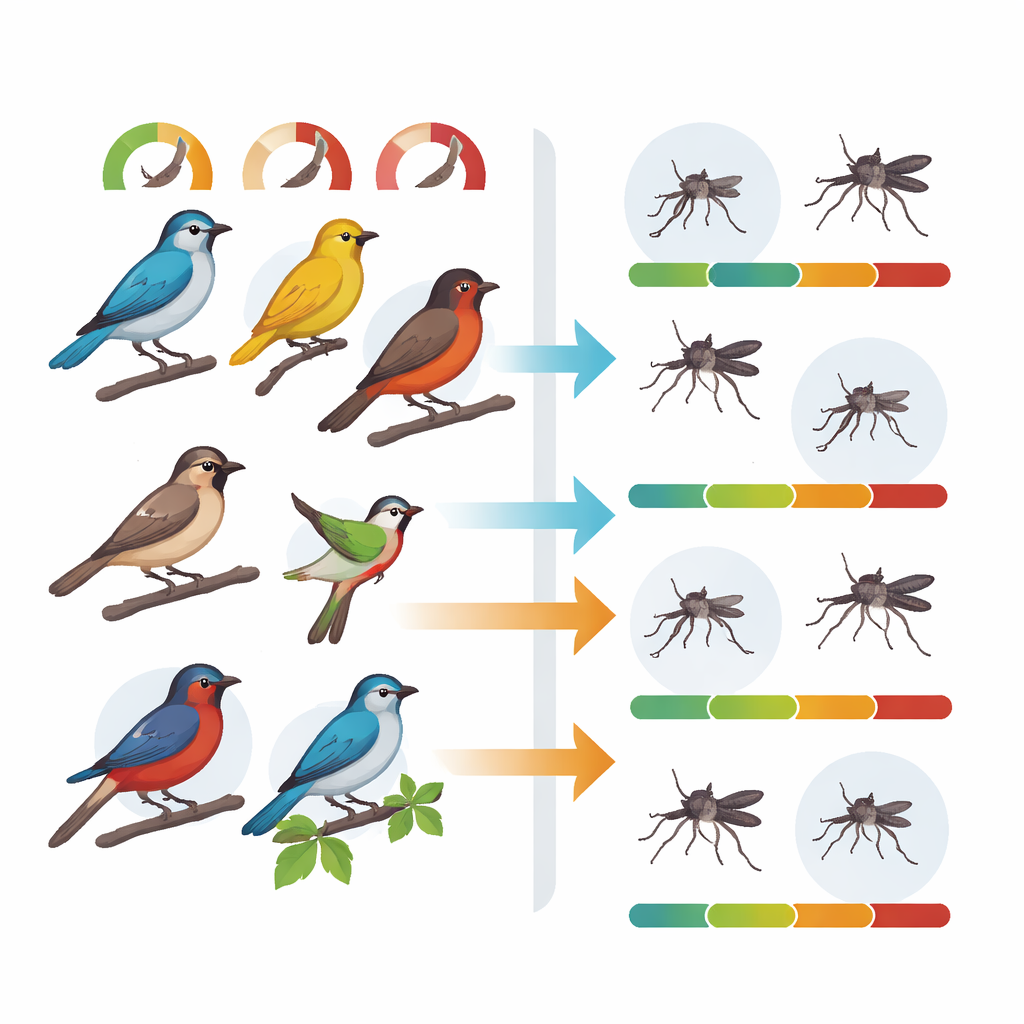
Mosquito tastes, not just bird abundance, decide who matters most
The impact of a bird species on malaria transmission depends not only on how infectious it is, but also on how often mosquitoes feed on it. By comparing infection rates among species at dozens of sites, the researchers inferred which birds are bitten more than expected from their abundance. House Finches, for example, were relatively rare yet heavily infected, suggesting mosquitoes disproportionately fed on them; they emerged as major contributors to transmission at many sites. In contrast, Warbling White-eyes were among the most common birds but had relatively low infection rates, implying they were less frequently bitten and therefore played a smaller role in spreading malaria. At most locations, just two or three species dominated the infection of mosquitoes, even though many species were somewhat infectious.
Why avian malaria is everywhere in Hawaii
By combining bird density, inferred mosquito feeding preferences, and the parasite load–infectiousness relationship, the authors estimated an overall “community infectiousness” for 11 bird communities on Hawaii Island. Despite having very different mixes of native and introduced species, these communities had surprisingly similar overall potential to infect mosquitoes. The broad overlap in infectiousness among species—and the fact that mosquitoes readily become infected even from birds with modest parasite levels—help explain why avian malaria is found almost everywhere on the islands, including in areas dominated by introduced birds. For conservation, this means that many bird communities, not just those rich in natives, can sustain malaria, making it harder for vulnerable Hawaiian species to find disease-free refuges. More broadly, the study shows how variation in pathogen load within hosts and the shape of the load–infectiousness curve can control which species matter for transmission and how widely vector-borne diseases can spread.
Citation: Seidl, C.M., Parise, K.L., Ipsaro, I.J. et al. Variation in pathogen load and the pathogen load–infectiousness relationship broaden avian malaria’s distribution. Nat Commun 17, 1213 (2026). https://doi.org/10.1038/s41467-026-68927-x
Keywords: avian malaria, Hawaii birds, mosquito-borne disease, parasite load, wildlife conservation