Clear Sky Science · en
Strain-invariant omnidirectional stretchable MXetronics
Electronics That Stretch Like Skin
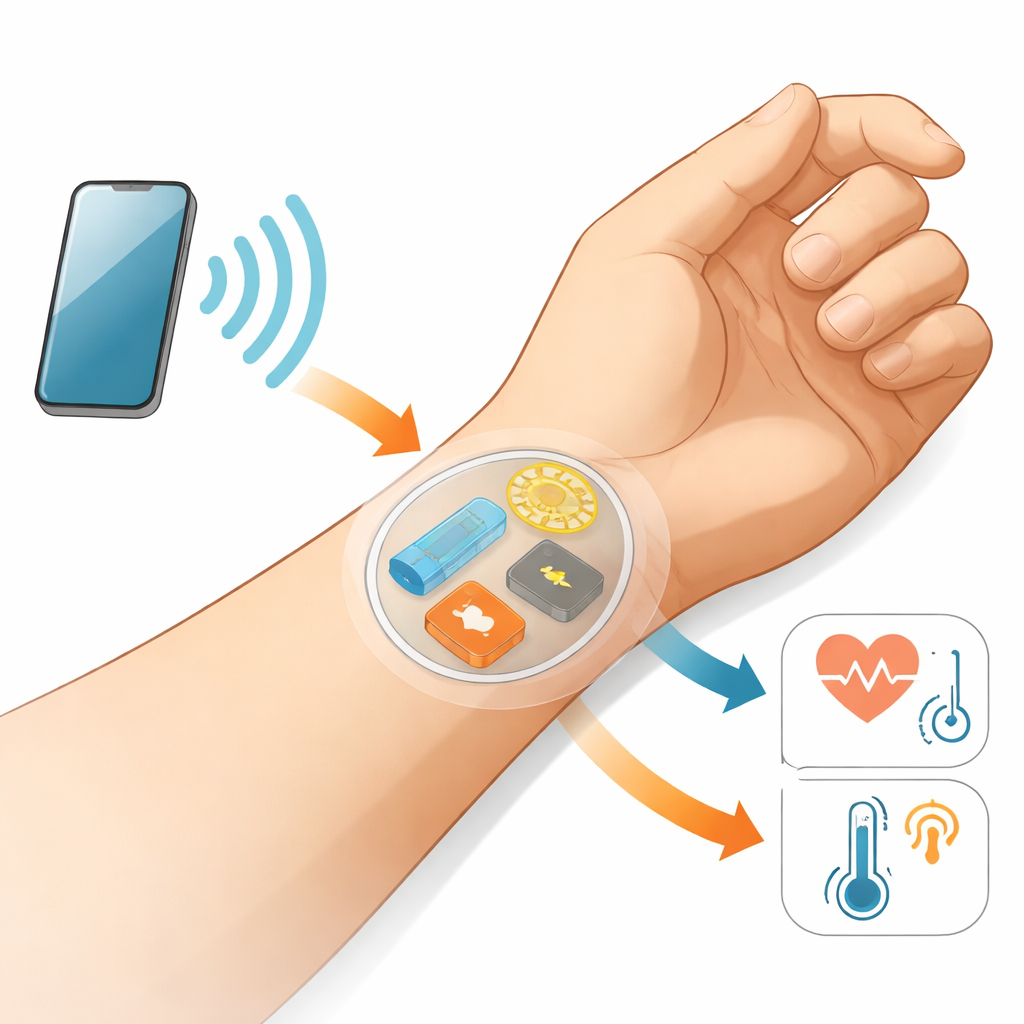
Imagine a soft, nearly weightless electronic patch that moves and bends with your skin yet keeps measuring your pulse and blood pressure as reliably as a clinic device. This paper describes just such a system: a circular, stretchable “electronic skin” that can power itself wirelessly from a smartphone while tracking vital signs, all without losing accuracy when the body twists, bends, or stretches.
Why Soft Gadgets Usually Fail on Moving Bodies
Our skin is constantly in motion: it stretches when we bend a wrist, twists as we turn a doorknob, and creases when we grip objects. Most flexible gadgets tolerate only gentle bending; when strongly stretched, their tiny metal lines crack or their radio antennas drift off tune. That leads to dropped wireless connections, misread sensors, and sometimes complete failure. Today’s wearable systems also tend to mix many different materials—one for wiring, another for energy storage, others for sensors—making them harder to build and less reliable when every piece is pulled in different directions.
A New Kind of Stretchable Electronic Skin
The authors tackle these problems with a unified platform they call strain-invariant, omnidirectionally stretchable MXetronics. At its heart is a thin disk, just 3.3 centimeters in radius, that conforms to the wrist like a second skin. Inside this disk, the team packs a near-field communication antenna powered by a smartphone, eight tiny energy-storage units, and several sensors that read pressure and temperature. All of the key electronic parts are made from the same family of two-dimensional materials, known as MXenes, which conduct electricity extremely well yet can be processed from water-based inks. By relying on a single material system, they simplify integration while keeping electrical performance uniformly high.
Using Hidden Stiffness to Control Stretch
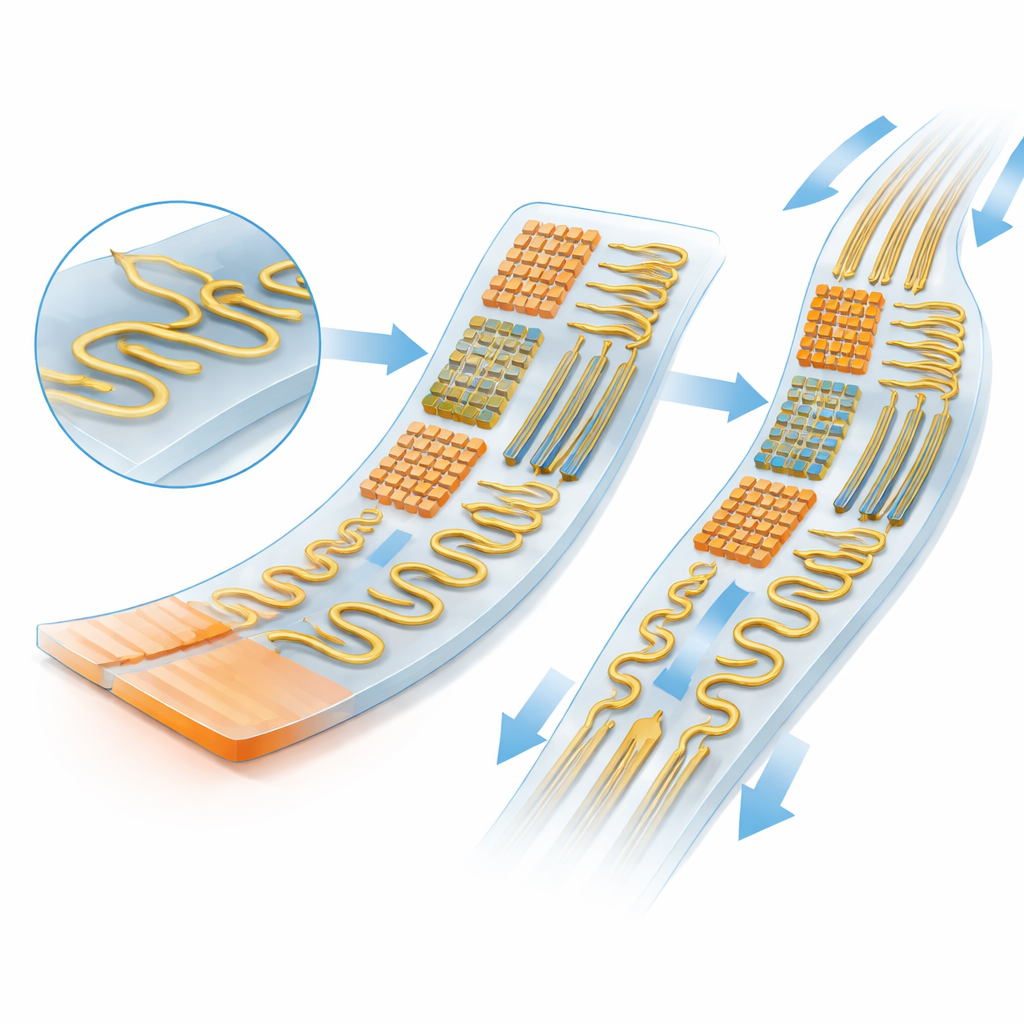
To keep the system working under up to 40 percent stretching in any direction, the researchers designed a clever mechanical backbone. They embed the MXene circuits on thin plastic “islands” that are much stiffer than the surrounding soft rubber. These stiff islands sit inside a patterned microgrid of a silicone called PDMS, all supported by an ultrasoft base layer. When the whole patch is pulled, most of the stretching is absorbed by the soft regions and by wavy, serpentine interconnects between islands. The active areas that contain antennas, supercapacitors, and sensors barely deform, so their electrical behavior changes by less than five percent. At the microscopic level, the MXene flakes slide slightly past one another instead of opening long, destructive cracks, preserving continuous pathways for current.
Power, Sensing, and Wireless Links Working Together
Building on this mechanical design, the team engineers each function for real-world use. They develop a high-conductivity MXene film by exchanging bulky organic ions for lithium ions, boosting electrical performance while using a rapid, scalable synthesis. With this material, they create a coil antenna shaped in a sine-wave pattern so that it stretches evenly in any direction and barely changes its radio behavior when pulled. A smartphone energizes this coil over distances up to 3.5 centimeters, delivering several milliwatts of power. That power charges MXene-based micro-supercapacitors, which act as on-board energy reservoirs, and runs an ultralow-power control chip. Pressure sensors with finely patterned, sponge-like surfaces pick up tiny changes in pulse and blood flow, while temperature sensors track skin warmth. Even under repeated bending, twisting, and thousands of stretching cycles, the readings stay nearly unchanged.
What This Means for Everyday Health Monitoring
When volunteers wore the patch on their wrists, it continuously streamed pulse waves and temperature to a phone, without losing connection during normal arm movements. The clean pulse signals could be fed into a deep learning model, which estimated blood pressure with accuracy comparable to a standard cuff. Because the electronics are thin, soft, and battery-free, they can be worn comfortably for long periods, and the outer rubber layer helps protect the sensitive MXene material from sweat and air. In simple terms, this work shows how to build a soft, body-hugging electronic system that keeps working—and keeps reporting trustworthy health data—even as life in the real world tugs and stretches it in every direction.
Citation: Wang, S., Deng, W., Huang, H. et al. Strain-invariant omnidirectional stretchable MXetronics. Nat Commun 17, 2471 (2026). https://doi.org/10.1038/s41467-026-68925-z
Keywords: wearable health monitoring, stretchable electronics, MXene materials, wireless skin sensors, blood pressure tracking