Clear Sky Science · en
Allylrhodanine-processed all-small-molecule organic solar cell achieves an 18.43% efficiency breakthrough
Smarter Solar Cells for Everyday Use
Solar panels are appearing on rooftops, backpacks, and even windows—but many are still heavy, rigid, and costly to make. This study explores a different kind of solar technology built from tiny organic molecules that can be printed like newspaper ink onto thin, flexible sheets. By carefully tweaking how these molecules arrange themselves as they dry, the researchers push a promising type of organic solar cell to record-breaking efficiency, bringing ultralight, bendable solar power closer to practical reality. 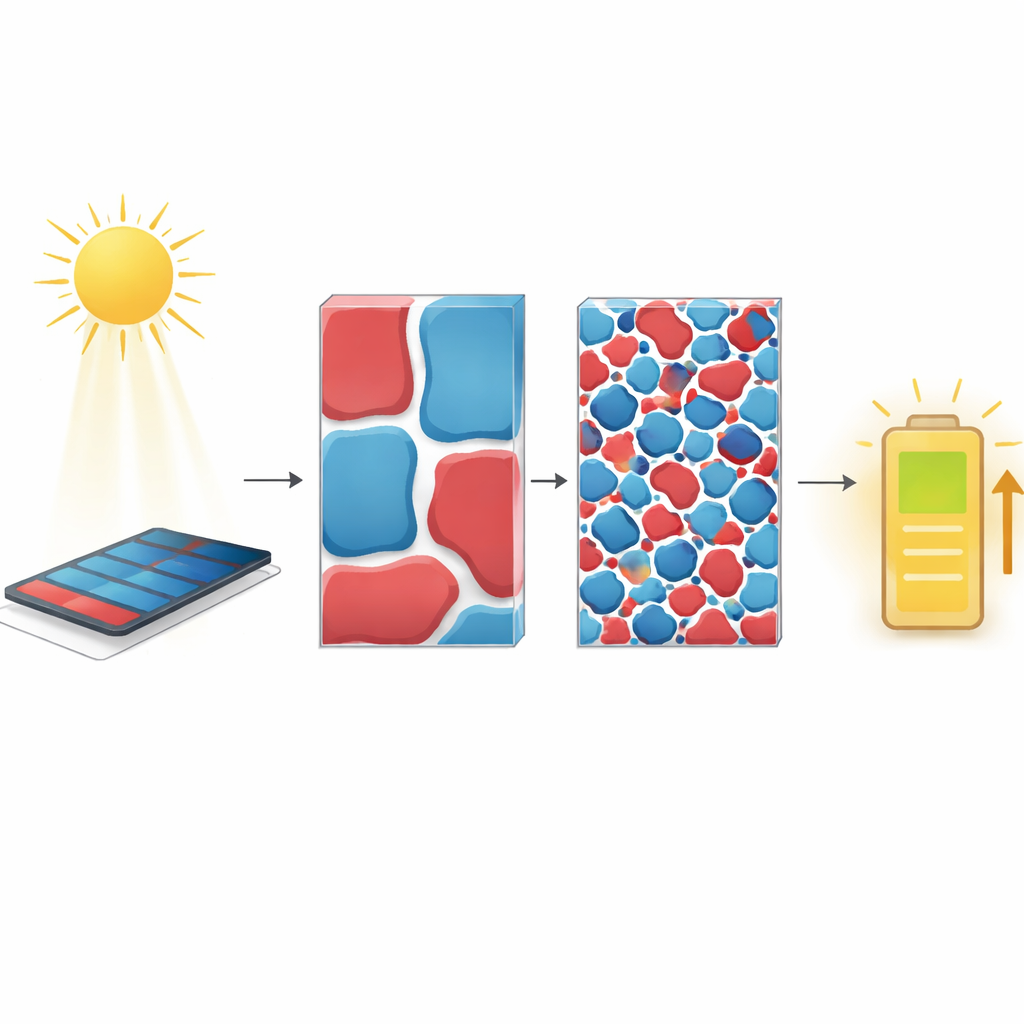
Why Flexible Solar Panels Are Hard to Perfect
Unlike the silicon panels on most roofs, organic solar cells use carbon-based molecules dissolved in liquid and spread into a thin film. All-small-molecule versions offer big advantages for mass production: their structure is well-defined, they can be purified easily, and they behave consistently from batch to batch. But there is a catch. These small molecules like to crystallize strongly and separate into big “islands” inside the film. Because the electric charges created by sunlight can only move a short distance before they disappear, overly large islands mean many charges never reach the electrodes, limiting current and overall efficiency.
A Tiny Helper Molecule Steps In
The team tackles this problem by adding a minute amount of a helper compound called 3-allylrhodanine to a mixture of a donor molecule (MPhS-C2) and an acceptor molecule (N3). This helper is a “volatile solid additive”: it temporarily joins the blend during coating and then evaporates completely during a brief heating step, leaving no residue in the finished device. Although its structure resembles part of the donor, detailed computer calculations and nuclear magnetic resonance experiments show that it actually prefers to interact more strongly with the acceptor. These selective attractions allow the helper to steer how both components arrange themselves while the wet film dries.
Guiding the Film as It Dries
Using time-resolved optical measurements, X-ray scattering, atomic force microscopy, and electron microscopy, the researchers watch the film take shape in real time. Normally, the donor starts to crystallize first and drives the acceptor into large, coarse regions. When the additive is present, it subtly changes the timing: it shortens the window in which the donor can overgrow, delays and moderates the acceptor’s crystallization, and improves how both materials spread across the underlying contact layer. The end result is a smoother film with much smaller, more evenly distributed domains and a more uniform vertical structure from top to bottom—a finely interwoven network rather than clumps and gaps. 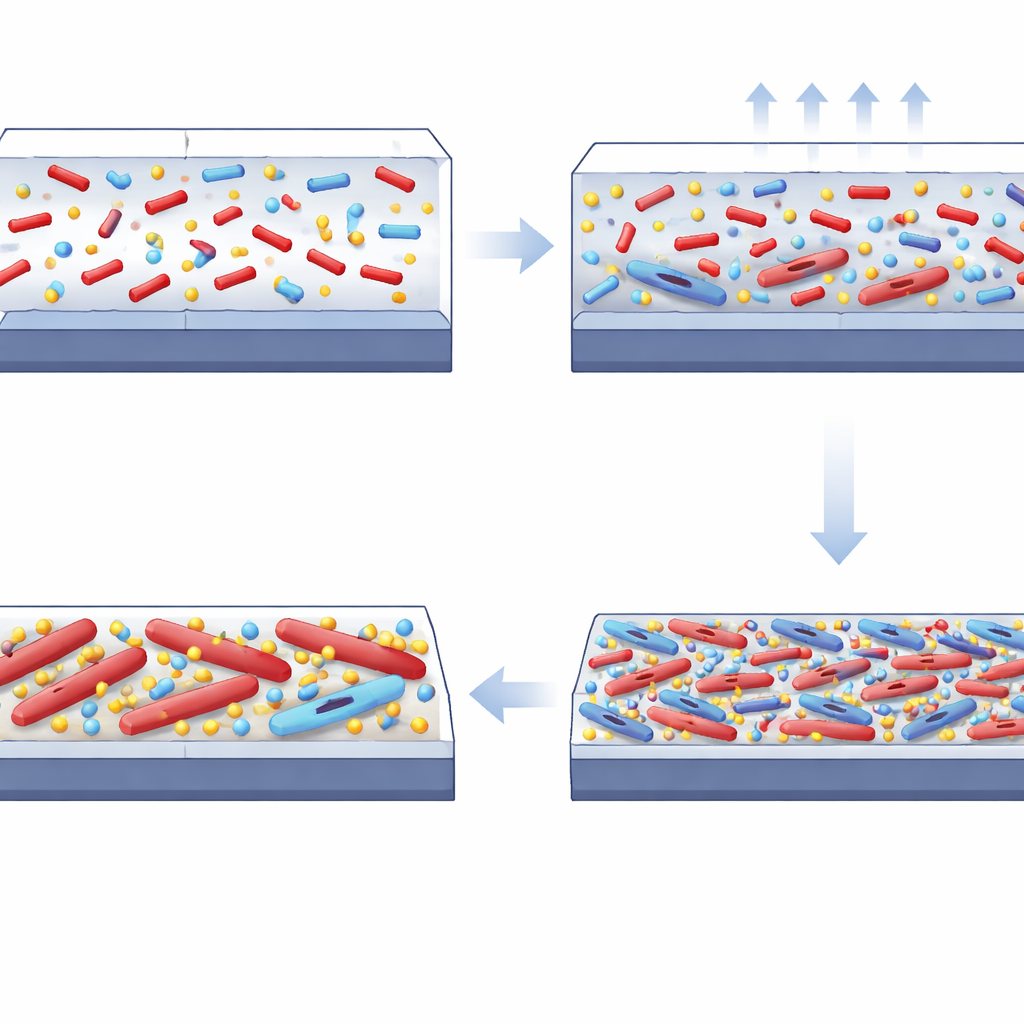
Longer-Lived Charges and Higher Power
This refined inner structure has clear electrical advantages. Measurements of how light is absorbed through the film depth reveal that excitons—bound pairs of charges created by light—are generated more uniformly and closer to the electrodes, so they travel shorter distances before being separated. Tests of charge flow show higher and more balanced mobilities for electrons and holes, fewer traps where charges get stuck, and less recombination where they annihilate each other. Ultrafast laser spectroscopy confirms that charges separate more quickly and live longer before recombining. Together, these effects raise the current and, especially, the fill factor, leading to a power conversion efficiency of 18.43 percent—independently certified at 18.16 percent—the highest yet for this class of two-component small-molecule organic solar cells.
What This Means for Future Solar Films
To a non-specialist, the key message is that a carefully chosen temporary additive can act like a “construction foreman” for the active layer in a flexible solar cell. 3-allylrhodanine does not stay in the device, but while it is present it guides how the building blocks fall into place, producing a finer internal texture that helps light-generated charges escape and be harvested as electricity. The study also overturns the simple assumption that an additive mainly works with the material it most resembles; instead, its effectiveness depends on a subtle balance of attractions to all components. This design insight should help researchers craft even better additives and push printed, lightweight organic solar panels toward the efficiencies needed for everyday power generation.
Citation: Cao, D., Zhong, L., Sun, Z. et al. Allylrhodanine-processed all-small-molecule organic solar cell achieves an 18.43% efficiency breakthrough. Nat Commun 17, 2105 (2026). https://doi.org/10.1038/s41467-026-68924-0
Keywords: organic solar cells, small-molecule photovoltaics, morphology control, solid additives, flexible solar panels