Clear Sky Science · en
The disappearing quasi-biennial oscillation under sustained global warming
Winds in the High Sky That Shape Our Weather
Far above our heads, in a layer of air that jetliners barely touch, a slow rhythm of winds quietly helps shape weather and climate down at the surface. This study asks a stark question: as global warming continues, could that rhythm simply vanish? Using state-of-the-art climate models that extend well beyond the year 2100, the authors explore how a key wind pattern in the tropical stratosphere might fade away — and what that would mean for the reliability of our 2–3-year climate outlooks.
A Hidden Wind Clock Over the Equator
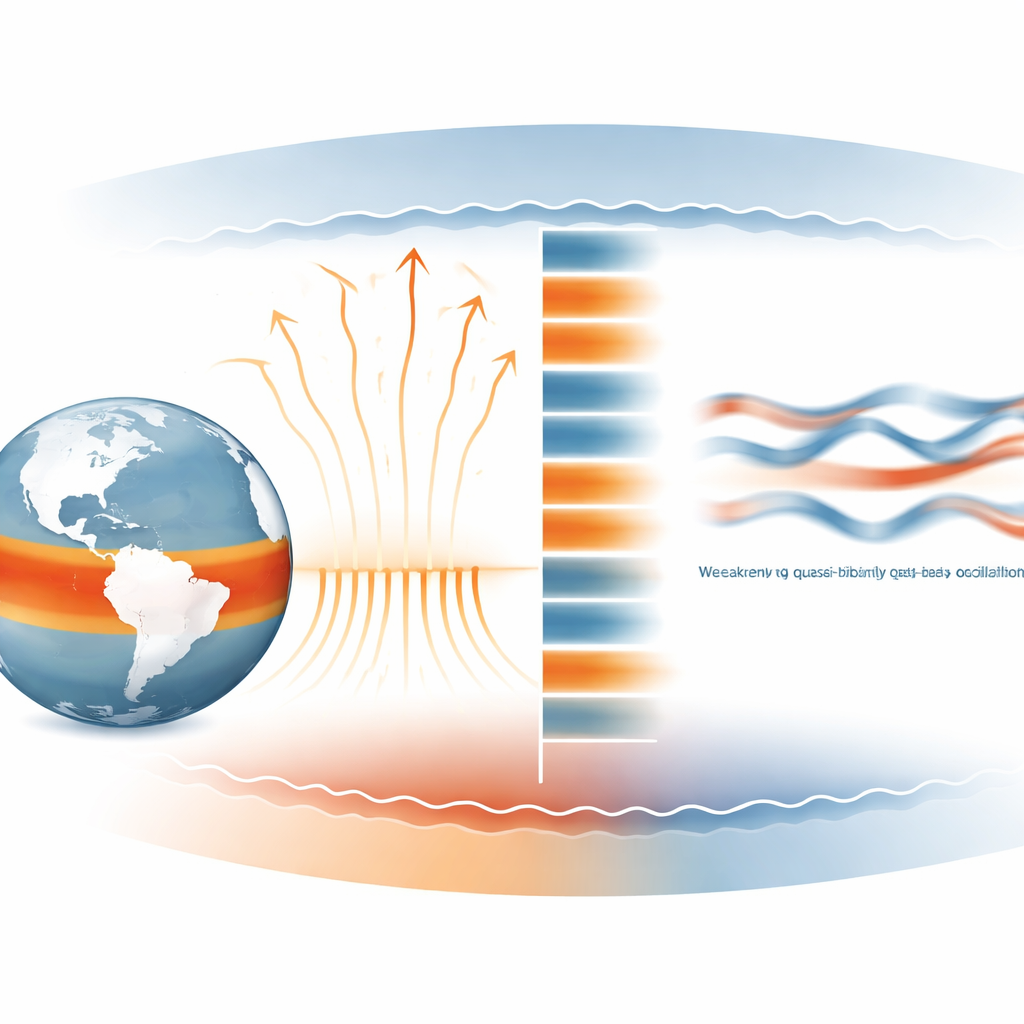
In the tropical stratosphere, about 20–30 kilometers above Earth, winds naturally flip direction roughly every two to three years. This back-and-forth pattern, called the quasi-biennial oscillation, acts like a slow-moving “wind clock.” Its alternating eastward and westward phases help steer air currents that connect the tropics and the poles, subtly influencing monsoons, winter storms, and even the strength and position of the jet streams. For decades, forecasters have leaned on this regular rhythm to improve seasonal and multi-year climate predictions.
What Happens to This Wind Clock in a Hotter World
The authors draw on four advanced climate models from the CMIP6 project, each run under a high-emissions pathway where greenhouse gases keep rising through the 2100s and beyond. In these simulations, the familiar two-to-three-year signal in the lower stratosphere grows weaker and its cycle speeds up, until the pattern at around 50 hPa — a key level for this oscillation — effectively disappears. In different models this loss occurs between roughly 2075 and the late 2200s, but the storyline is consistent: the regular rhythm breaks down into shorter, annual or even half-year pulses, and the once-clear two-year beat fades from the record.
How Ocean Warming and Rising Air Undermine the Rhythm
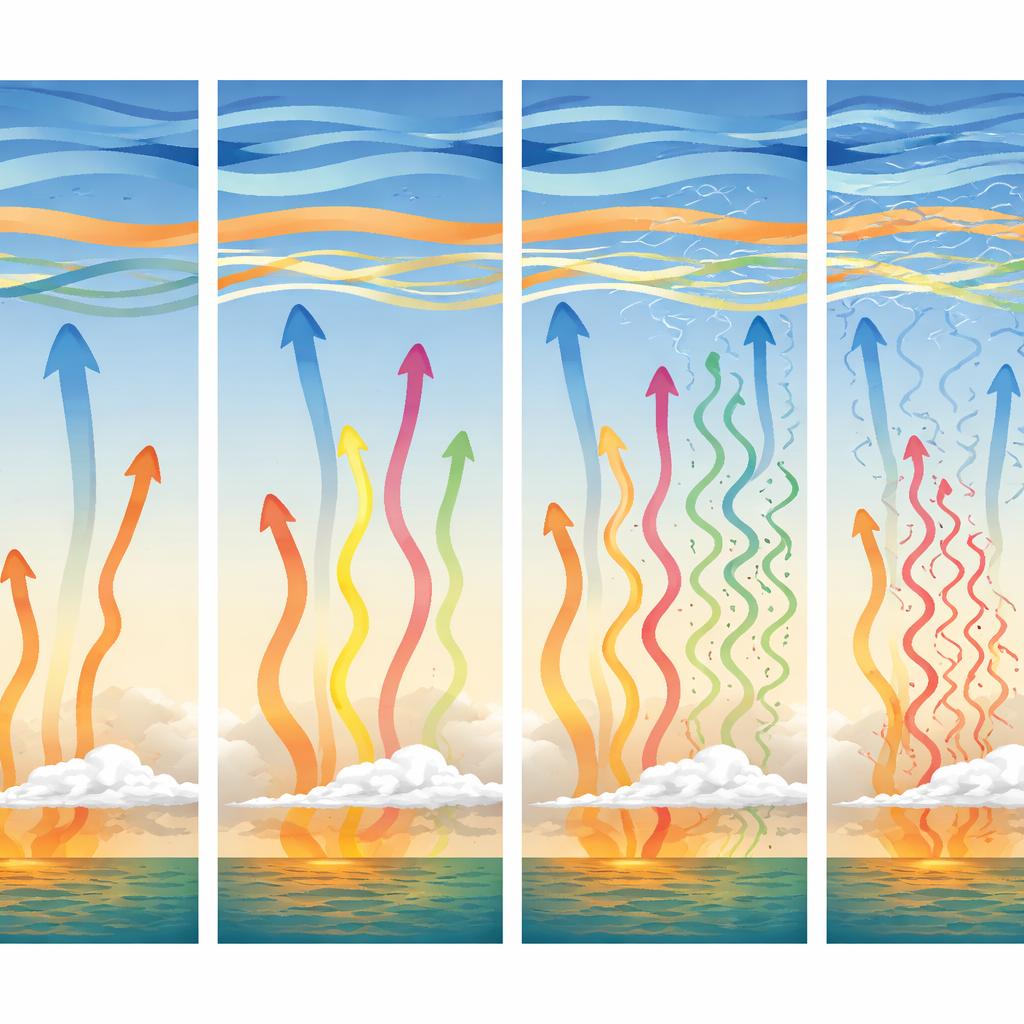
The study then digs into the “how.” As the oceans warm, especially in the central and eastern tropical Pacific, convection — rising columns of warm, moist air — intensifies. This boosts the large-scale upward motion of air in the tropics and stirs up more atmospheric waves that can travel into the stratosphere. Normally, a mix of these waves drives the gentle downward drift of the alternating wind bands, sustaining the oscillation. But under strong warming, two things happen together: the upward motion of air strengthens, which tends to hold the oscillation higher up and weaken it below, and the wave activity intensifies, which speeds up the flipping of the winds. Simple idealized models in the study show that, as the wave-driving becomes stronger and the upward flow increases, the oscillation’s period shortens step by step from about two years toward one year, then roughly half a year, until the classic slow cycle is no longer distinct.
Different Futures Under High and Low Emissions
To test whether this is driven by carbon dioxide itself or by the warmth it causes, the authors run targeted experiments where they separately adjust CO₂ levels and sea-surface temperatures. The results point to ocean warming as the main culprit: the oscillation also disappears when the oceans are heated as in a six-times-CO₂ world, even if CO₂ in the air is kept at pre-industrial levels. In sharp contrast, under a low-emissions pathway that keeps global warming below about 2 °C, the models show no long-term weakening or loss of the oscillation. In that gentler future, the stratospheric wind clock keeps ticking much as it does today.
Ripples Reaching Down to Everyday Weather
Because this high-altitude wind pattern nudges weather systems lower down, its disappearance has consequences for predictability. The authors examine how the familiar two-to-three-year signal appears in jet-stream winds in both hemispheres. When the oscillation is strong, that signal stands out clearly from background “noise,” giving forecasters a firmer handle on how the subtropical jets might shift. As the oscillation weakens and vanishes in the high-emissions simulations, this signal in the troposphere also fades, and its strength relative to noise drops. Carefully designed experiments that compare model worlds with and without the oscillation confirm the message: without this stratospheric rhythm, the multi-year swings in key wind belts become weaker and harder to predict.
What a Vanishing Wind Clock Means for Us
In plain terms, the study suggests that if greenhouse gas emissions remain very high, a long-lived “metronome” of the climate system could fall silent sometime between the late 21st and 23rd centuries. Its loss would not trigger instant catastrophe, but it would erode one of the tools scientists use to anticipate weather and climate patterns a few years ahead — including the behavior of jet streams that influence storms, heat waves, and droughts. Under strong climate action that limits warming, this hidden wind clock appears likely to survive. The findings therefore add another, less obvious cost to unchecked warming: not just more extreme events, but a future in which our ability to foresee them becomes dimmer.
Citation: Luo, F., Xie, F., Zhou, T. et al. The disappearing quasi-biennial oscillation under sustained global warming. Nat Commun 17, 2138 (2026). https://doi.org/10.1038/s41467-026-68922-2
Keywords: quasi-biennial oscillation, stratospheric winds, climate predictability, global warming, jet stream