Clear Sky Science · en
Spatial-chromatic encoding cosmetic contact lenses for enhanced natural eye tracking
Smarter Contacts for Smarter Screens
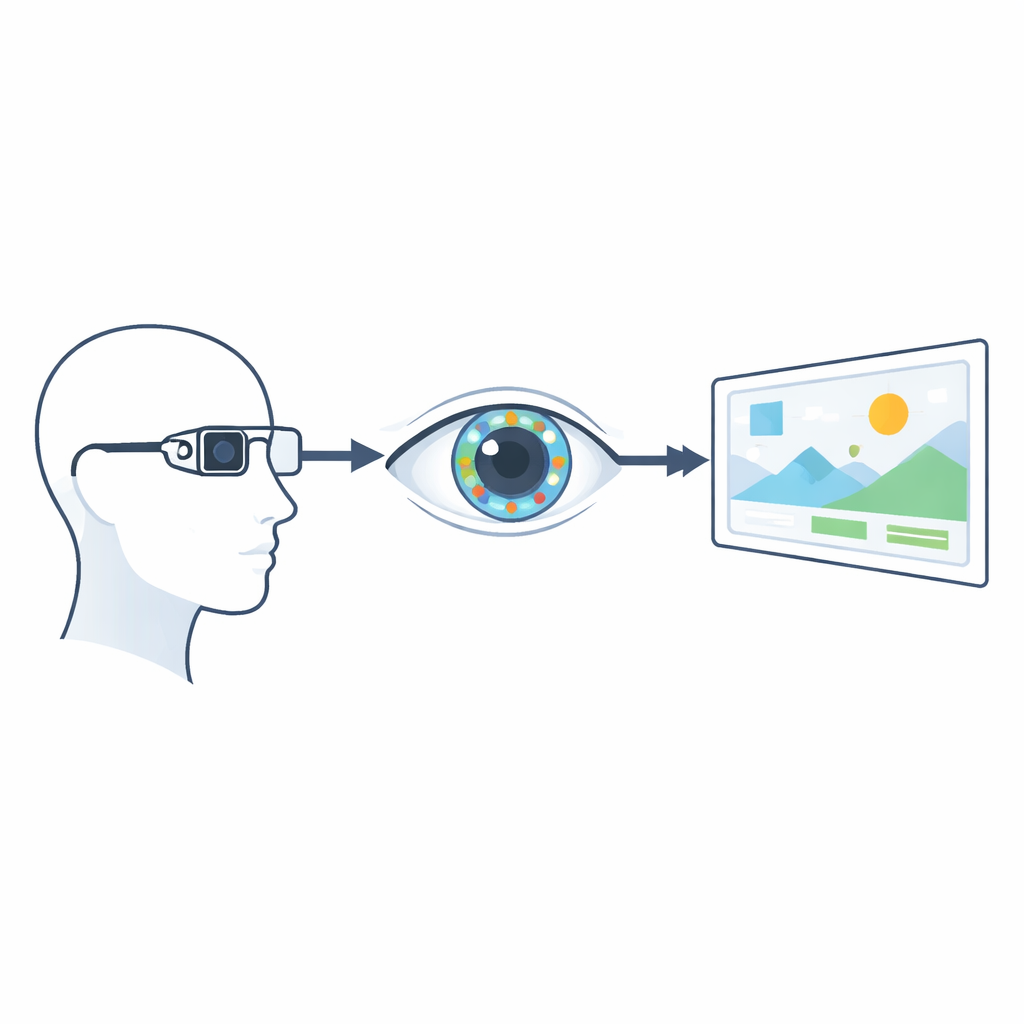
Every time you read a sentence, scan a street, or glance at your phone, your eyes perform tiny, intricate movements. Devices that can track these movements promise more natural virtual reality, hands-free control for people with disabilities, and new tools for doctors and psychologists. But today’s eye trackers often fail in everyday life, especially outdoors or when eyelids and eyelashes get in the way. This study introduces a surprisingly simple solution: specially printed cosmetic contact lenses that turn the eye itself into a clear, colorful target for cameras, making eye tracking more accurate, more robust, and easier to use in the real world.
Why Following the Eyes Is So Hard
Modern eye trackers usually work like high-tech cameras that watch the dark pupil and reflections on the eye’s surface. In theory, these features reveal where you are looking; in practice, they are fragile. Sunlight, room lights, and reflections from windows or trees clutter the image. Eyelids and eyelashes partially hide the pupil. Natural eyes also vary in color and contrast from person to person. As a result, software often struggles to find the pupil reliably, especially with simple, low-cost cameras. This fragility is a major obstacle for everyday applications, from virtual reality headsets to driver monitoring systems and clinical tools.
A Decorative Lens with a Hidden Purpose
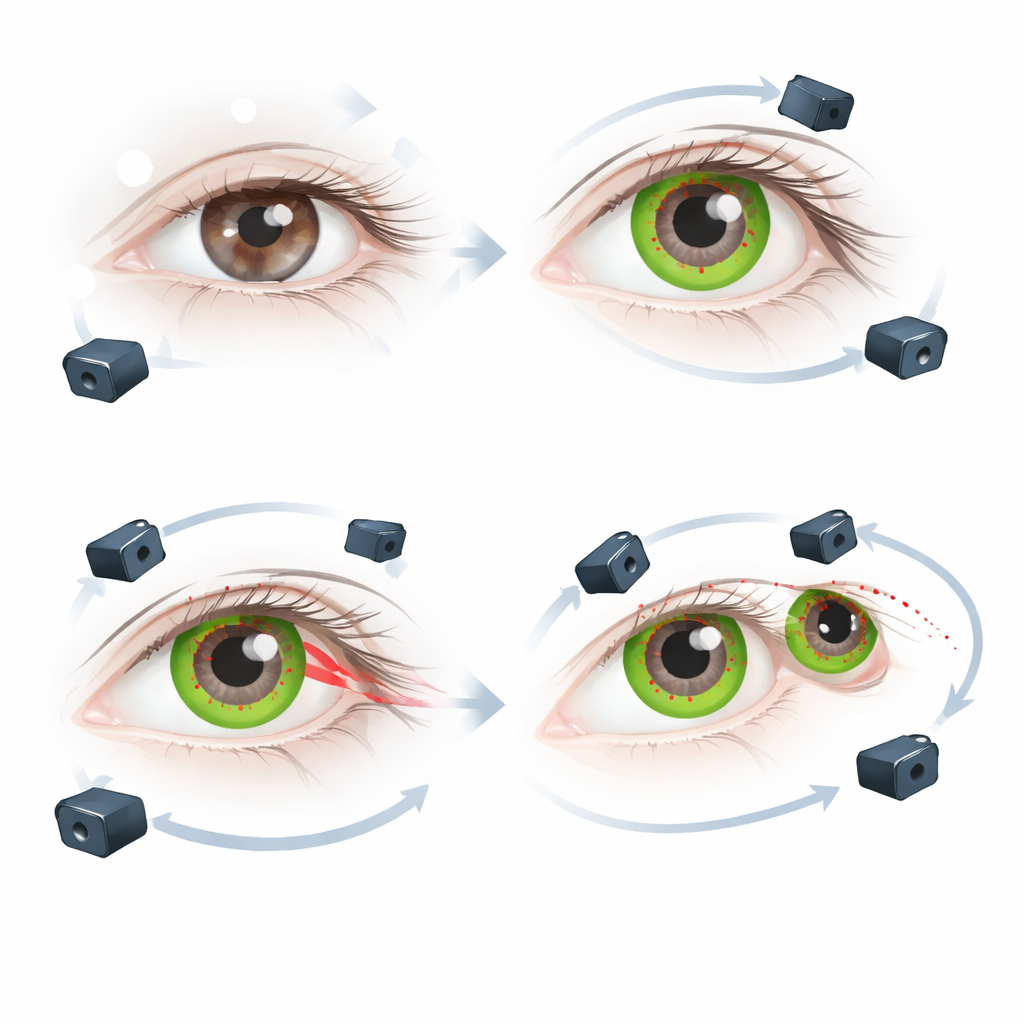
The researchers realized that instead of forcing algorithms to cope with the quirks of the bare eye, they could gently redesign what the camera sees. They took widely used cosmetic contact lenses—inexpensive lenses people already wear to change the apparent color of their eyes—and printed a precise ring of colored shapes around the iris. The ring uses the three basic light colors: a blue band carries twelve bright green circles, each separated by a tiny red dot. Because red, green, and blue are far apart in color, even a cheap RGB camera can pick them out easily. The pattern sits at the edge of the visual zone, so it does not block vision but remains visible to cameras, even when they look from the side. The lens material itself is thin, oxygen-permeable, and water-loving, with lab tests showing high cell survival and no dye leakage, indicating that the lenses are safe and comfortable for extended wear.
Turning Color Patterns into Precise Gaze
Once someone wears these patterned lenses, eye tracking becomes a geometry and color problem rather than a fragile pupil-detection task. Simple image-processing steps first isolate the bright green circles on the blue ring, then compute the centers of these circles in each frame. Because the circles have known size and spacing, the software builds a mapping between their positions in the image and the actual direction of gaze. In tests with a mechanical eye model, this mapping achieved an angular error of less than one degree, even when calibrated using only a small set of reference points. The red dots serve a different role: when the eye moves quickly and the camera cannot freeze the motion, those dots smear into red streaks. By tracing the skeleton of these streaks and combining them with information from nearby still frames, the system recovers the missing portions of the eye’s path, providing continuous tracking even during rapid movements.
Reliable Tracking in Real People and Real Places
Human tests showed that this approach works well beyond the lab. Volunteers wore the special lenses and a lightweight head-mounted tracker with two off-axis cameras watching the eyes and a third recording the scene. In varied lighting—indoors, by windows, and outdoors—the green-circle features were recognized in about 93 percent of images, versus under 55 percent for traditional pupil-based methods on bare eyes. Eye position could be measured with accuracy and precision better than one degree across multiple people with different eye characteristics, and this performance was stable over at least six hours of continuous wear. The system could also detect and largely correct shifts of the camera relative to the eye by using the three-dimensional arrangement of circles, reducing large errors caused by slippage to only a few degrees. Practical demonstrations included picking out which image on a grid contained a bicycle, analyzing how someone’s gaze moved across lines of text, and tracking a moving marker outdoors across changing scenes and sunlight.
What This Means for Everyday Eye-Based Interaction
To a non-specialist, the core message is straightforward: by adding a carefully designed, colorful pattern to an otherwise ordinary contact lens, the researchers made the eye dramatically easier for cameras to read. Instead of fighting with faint natural features, the system locks onto bright, carefully spaced landmarks that move exactly with the eye. That change boosts reliability, keeps accuracy within the tiny angle covered by the eye’s sharpest vision, and works in realistic settings, from offices to city squares. These enhanced cosmetic lenses could help bring eye-controlled interfaces, more natural virtual and augmented reality, and refined tools for studying attention and cognition out of specialized labs and into everyday devices.
Citation: Zhu, H., Huang, H., Yang, H. et al. Spatial-chromatic encoding cosmetic contact lenses for enhanced natural eye tracking. Nat Commun 17, 2289 (2026). https://doi.org/10.1038/s41467-026-68918-y
Keywords: eye tracking, smart contact lenses, human-computer interaction, gaze estimation, augmented reality