Clear Sky Science · en
Nanotwin architecture and ultra-high valley degeneracy lead to high thermoelectric performance in GeTe-based thermoelectric materials
Turning Waste Heat into Useful Power
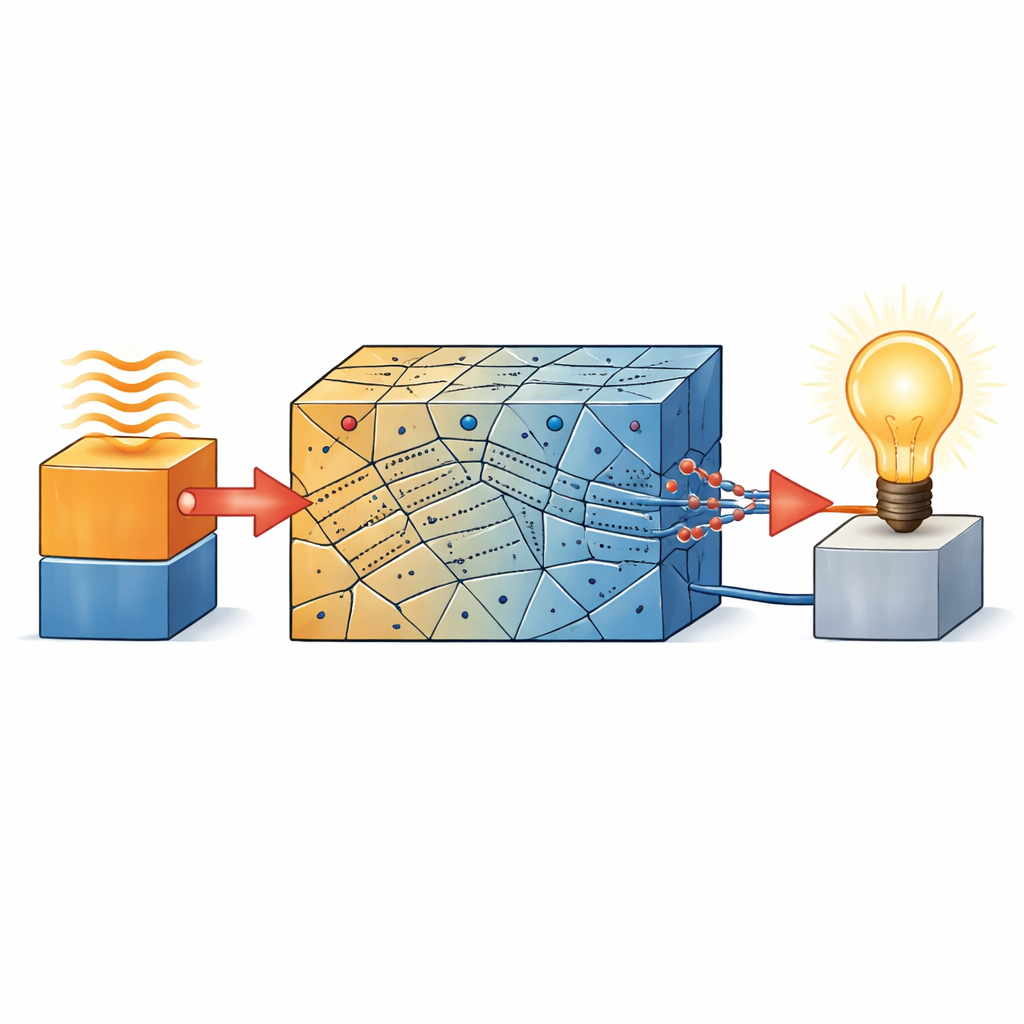
Every time a car engine runs, a factory operates, or a computer chip heats up, valuable energy is lost as waste heat. Thermoelectric materials promise to capture some of that heat and turn it directly into electricity, offering silent, solid-state generators and coolers with no moving parts. This study explores a lead-free material based on germanium telluride (GeTe) and shows how careful atomic-scale engineering can dramatically improve both its power-conversion efficiency and its mechanical toughness, bringing practical thermoelectric devices a step closer to widespread use.
Why This Material Matters
Many of today’s best thermoelectric materials contain lead, which raises environmental concerns for large-scale deployment. GeTe is attractive because it is more environmentally friendly and already has good performance. However, its natural structure carries too many charge carriers and conducts heat too well, which limits its ability to generate electricity from a temperature difference. It is also not mechanically robust enough for long-term use in devices that experience thermal cycling and stress. The challenge is to redesign GeTe so it blocks heat flow, carries electrical charge efficiently, and resists cracking, all at the same time.
Shaping the Crystal Like a City of Mirrors
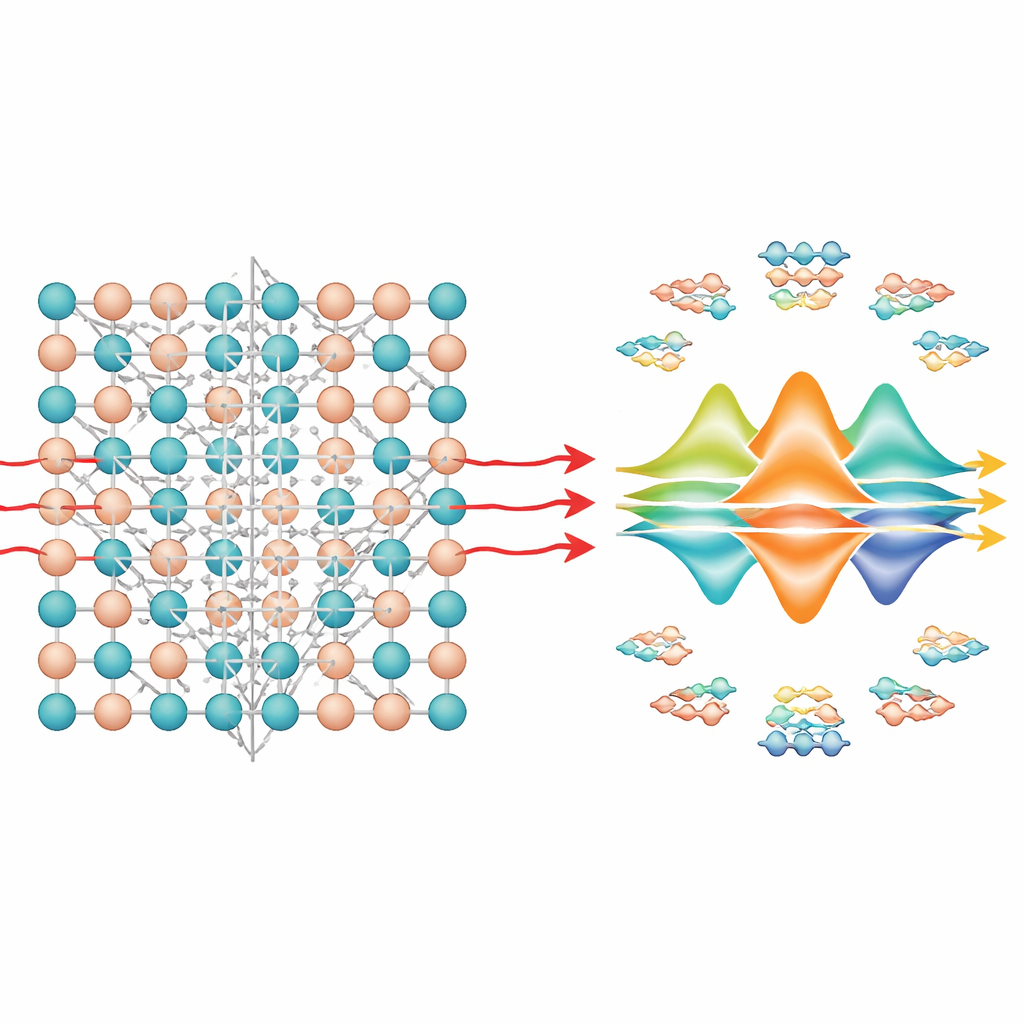
The researchers tackled the heat-flow problem by reshaping the internal landscape of the crystal. Inside their GeTe-based material, they created dense “nanotwins” – mirror-like boundaries only a few billionths of a meter apart – along with ordered chains of missing atoms and scattered point defects. These features act like speed bumps and roadblocks for vibrations of the crystal lattice, which are the main carriers of heat. Advanced electron microscopy shows mirror-symmetric regions separated by sharp boundaries, as well as regular lines of atomic vacancies. Modeling of heat transport confirms that this complex network of defects scatters vibrations across a wide range of frequencies, pushing the lattice thermal conductivity down close to the theoretical minimum for GeTe.
Reworking the Energy Landscape for Charge Carriers
Simply adding more defects could easily harm electrical performance by hindering the motion of charge carriers. To avoid this, the team used a second design lever: they subtly altered the electronic structure of GeTe by alloying it with a small amount of a compound called CuBiS₂. Quantum mechanical calculations reveal that this addition reshapes the material’s energy landscape, bringing three separate “valleys” at the top of the valence band to nearly the same energy. This ultra-high valley degeneracy – many equivalent routes that holes can take through energy-momentum space – boosts the Seebeck coefficient, a measure of how well a material converts a temperature difference into a voltage. As a result, the material achieves an unusually large power factor over a broad temperature range.
Balancing Power, Heat, and Strength
By combining the twin-boundary architecture with the tuned electronic valleys, the optimized composition (GeTe)₀.₉₃(CuBiS₂)₀.₀₇ reaches a peak value of the standard thermoelectric quality metric, ZT, of about 2.5 near 723 K and maintains an average ZT of 1.9 between 400 and 823 K. These numbers place it among the very best p-type thermoelectric materials for medium temperatures and, importantly, they are achieved without toxic elements. Just as crucial for real-world use, the same nanotwins that scatter heat vibrations also strengthen the material. They block the motion of crystal defects called dislocations, which are responsible for plastic deformation, leading to nearly doubled hardness and greatly improved resistance to compressive stress compared with pure GeTe.
What This Means for Future Devices
For non-specialists, the bottom line is that the authors show a way to make a cleaner thermoelectric material that not only converts heat to electricity very efficiently but is also tough enough to survive demanding operating conditions. By deliberately patterning the crystal on the nanoscale and fine-tuning its electronic energy landscape, they simultaneously mastered heat flow, charge transport, and mechanical strength. This design strategy could guide the development of next-generation thermoelectric generators and coolers that help harvest waste heat from engines, industrial plants, and electronics, turning otherwise lost energy into useful power.
Citation: Li, S., Yang, Y., Fei, X. et al. Nanotwin architecture and ultra-high valley degeneracy lead to high thermoelectric performance in GeTe-based thermoelectric materials. Nat Commun 17, 2205 (2026). https://doi.org/10.1038/s41467-026-68908-0
Keywords: thermoelectric materials, germanium telluride, waste heat recovery, nanotwins, band engineering