Clear Sky Science · en
Probing Majorana localization of a phase-controlled three-site Kitaev chain with an additional quantum dot
Why tiny chains of matter could protect future quantum bits
Quantum computers promise to solve problems far beyond today’s machines, but their basic units of information—qubits—are notoriously fragile. This study explores an unusual way to make more robust qubits by engineering exotic zero-energy states, called Majorana modes, in a deliberately simple structure: a short chain of three tiny electronic islands carved into a semiconductor wire and coupled to a superconductor. By adding a fourth island as a probe, the authors test how well these special edge modes stay put, a key requirement for storing quantum information reliably. 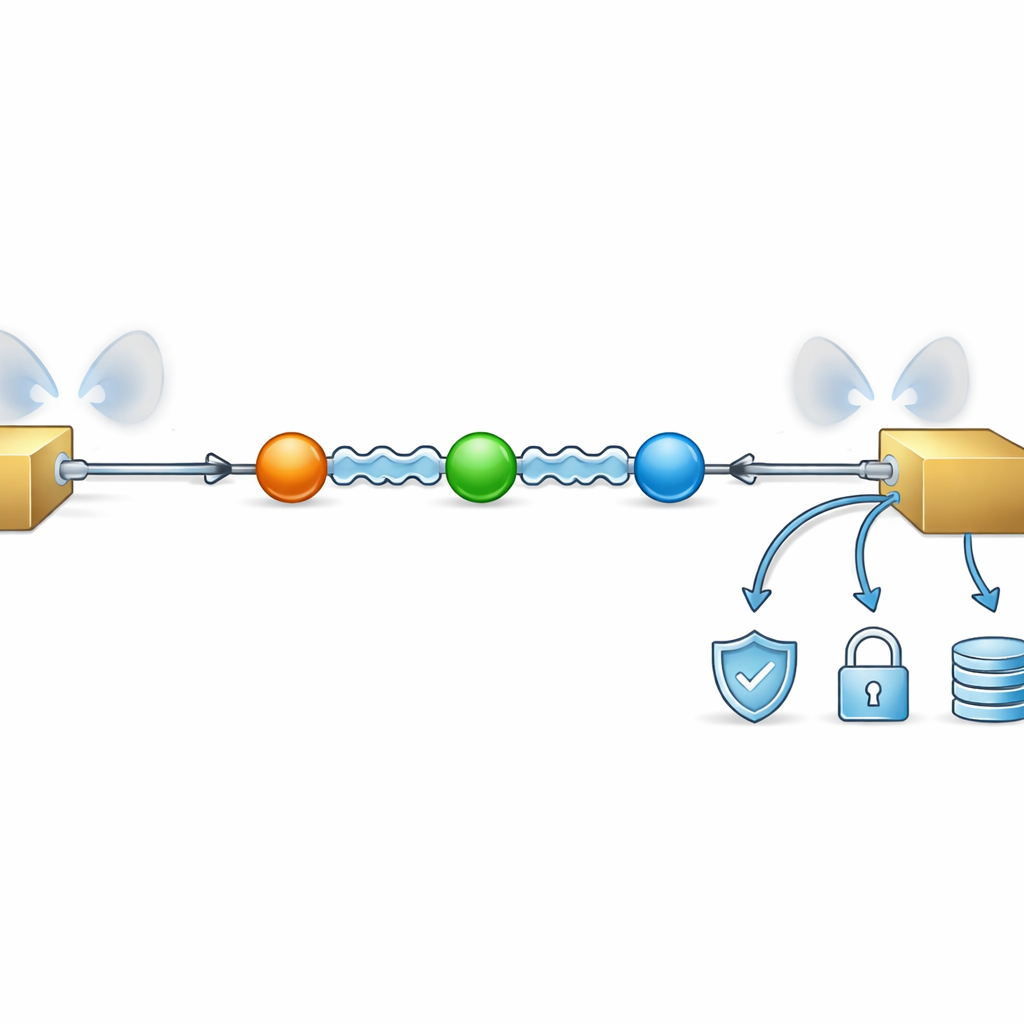
Building a designer quantum chain
The researchers construct their system in an indium antimonide nanowire decorated with aluminum, which makes parts of the wire superconducting at very low temperatures. Using buried metal gates, they form three quantum dots—small regions that can hold individual electrons—separated by superconducting segments. This layout is a physical realization of a “Kitaev chain,” a theoretical model where carefully tuned couplings along a one-dimensional chain can host Majorana modes at its ends. By adjusting voltages on the gates, the team can independently control each dot’s energy and the strength of the links between neighboring dots, creating either a two-dot or three-dot chain within the same device.
Finding the sweet spots where edge modes appear
Majorana-like modes appear only when the chain is tuned to special operating points, or “sweet spots,” where dot energies and couplings obey precise relations. The team identifies these points using tunneling spectroscopy: they gently probe the chain from metallic contacts at each end and measure how easily electrons pass through as they vary energy. At the sweet spots, they observe a pronounced peak at zero energy separated by a gap from higher-energy states, consistent with theory for a minimal Kitaev chain. In the three-dot version, the relative phase of the superconducting links becomes important. By threading magnetic flux through a loop that connects the superconducting segments, the authors map out how the spectrum changes with phase and show that, for many sweet spots, the desired phase condition is naturally realized without fine magnetic control.
Testing how well the edge modes stay put
Seeing a zero-energy peak is not enough to guarantee that the Majorana modes are well localized at the chain ends; in short systems they can overlap and spoil their protective properties. To probe localization directly, the researchers introduce an additional quantum dot on one side of the device, acting as a controllable external disturbance. By sweeping its energy, they can let this dot couple more or less strongly to the chain’s end. If the edge mode significantly leaks into the first site of the chain, the extra dot can “feel” both halves of the Majorana pair and causes the supposedly stable zero-energy peak to broaden or split into two features. If the mode is well confined to the ends with little overlap, the peak should stay put even as the extra dot is tuned. 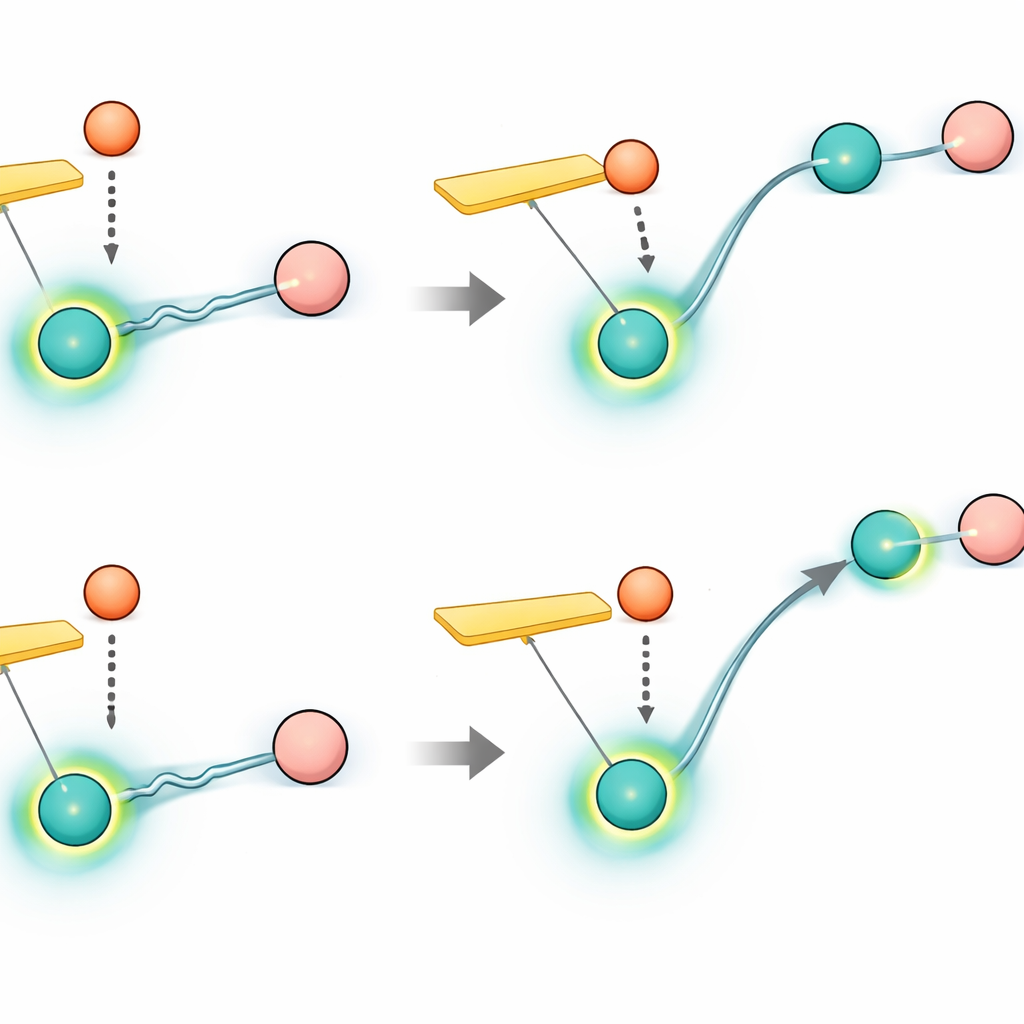
What the probe dot reveals about two-dot and three-dot chains
When the researchers deliberately detune their chains away from the sweet spots, the additional dot does indeed split or distort the zero-energy peak, producing characteristic “bow-tie” and “diamond” patterns in the spectra that match theoretical predictions. This confirms that the probe dot is sensitive to Majorana overlap. However, when the chains are carefully tuned, the behavior changes dramatically. For both the two-dot and three-dot chains at their optimal settings, scanning the extra dot’s energy fails to produce any measurable splitting of the zero-bias peak within the experimental resolution, even though the coupling between the probe and the chain is strong. In the three-dot case, the peak remains robust not only at the exact sweet spot but also when a single dot in the chain is detuned, indicating a higher resilience than in the two-dot “poor man’s” version.
Why this matters for future quantum devices
These experiments show that, despite comprising only a handful of sites, phase-controlled three-dot Kitaev chains can host edge modes that behave very much like ideal, well-localized Majorana states. The ability to set the required superconducting phase mostly through gate tuning, and the demonstration that an added quantum dot cannot easily disturb the zero-energy modes at the sweet spot, point toward practical strategies for building longer, more reliable chains without intricate magnetic control. In simple terms, the work suggests that carefully engineered, gate-defined nanowire structures can already realize “high-quality” Majorana-like states that are promising ingredients for future quantum memories and qubits.
Citation: Bordin, A., Bennebroek Evertsz’, F.J., Roovers, B. et al. Probing Majorana localization of a phase-controlled three-site Kitaev chain with an additional quantum dot. Nat Commun 17, 2313 (2026). https://doi.org/10.1038/s41467-026-68897-0
Keywords: Majorana modes, Kitaev chain, quantum dots, topological qubits, semiconductor nanowires