Clear Sky Science · en
Hydrocyclone-enhanced scalable photocatalytic hydrogen generation, from macroscale turbulence to nanoscale reaction dynamics
Turning Turbulence into Clean Fuel
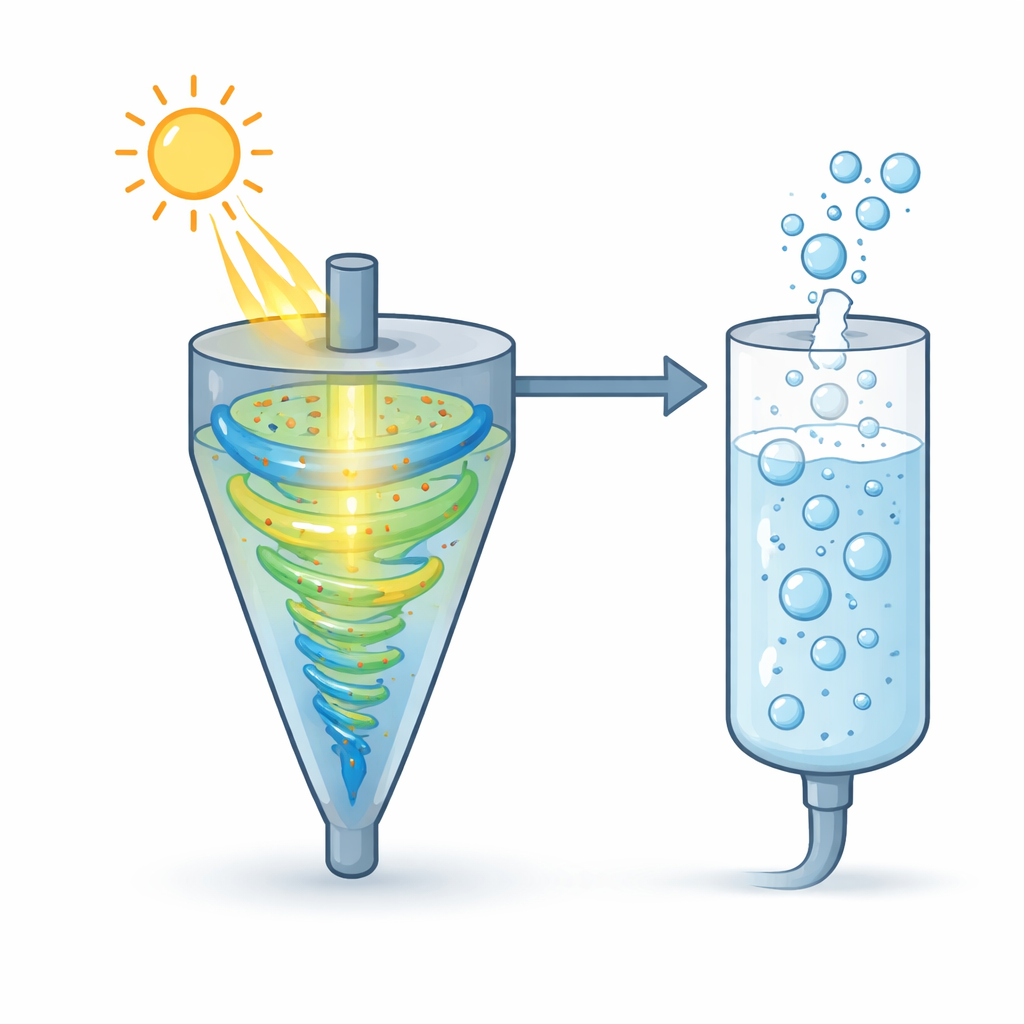
Imagine making clean hydrogen fuel directly from sunlight and water, but on a scale big enough to matter for the world’s energy needs. This study shows how a clever use of swirling water flows inside a device called a hydrocyclone can dramatically boost the performance of solar-powered hydrogen production. By linking what happens in a reactor the size of a barrel to subtle shifts in atoms inside a catalyst, the researchers outline a path toward practical, large-scale "green" hydrogen.
Why Scaling Up Solar Hydrogen Is So Hard
Laboratory setups for photocatalytic hydrogen—where light-activated powders split water—have improved steadily, but turning them into industrial systems is tricky. When small reactors are simply enlarged, light doesn’t penetrate as well, fresh reactants don’t reach the catalyst efficiently, and the catalyst particles can clump and degrade. Traditional scale-up rules that keep the same shape but make everything bigger fail because flows of heat, chemicals, and momentum do not grow in a simple, linear way. As a result, many promising lab results lose their edge when tested at larger sizes, slowing the transition to commercial solar hydrogen technologies.
Swirling Reactors That Work with, Not Against, Scale
The team tackles this challenge using hydrocyclones—cone-shaped vessels where liquid is injected sideways to create a strong vortex. Instead of just using these devices to separate particles, they repurpose them as active reactors. In their system, a stainless-steel hydrocyclone holds 18 liters of water containing tiny photocatalyst spheres made of a covalent organic framework (TpPa-COF) decorated with platinum nanoparticles. A bright xenon lamp mimics sunlight from the center of the vessel, while pumped flow generates intense swirling motion. Under these conditions, hydrogen production rises 4.5-fold compared with a non-rotating, "static" system, reaching 270 milliliters per hour and a solar-to-hydrogen efficiency of 5.26%—a level viewed as a key economic threshold by energy agencies.
How Flow Shapes the Catalyst from Micro to Nano
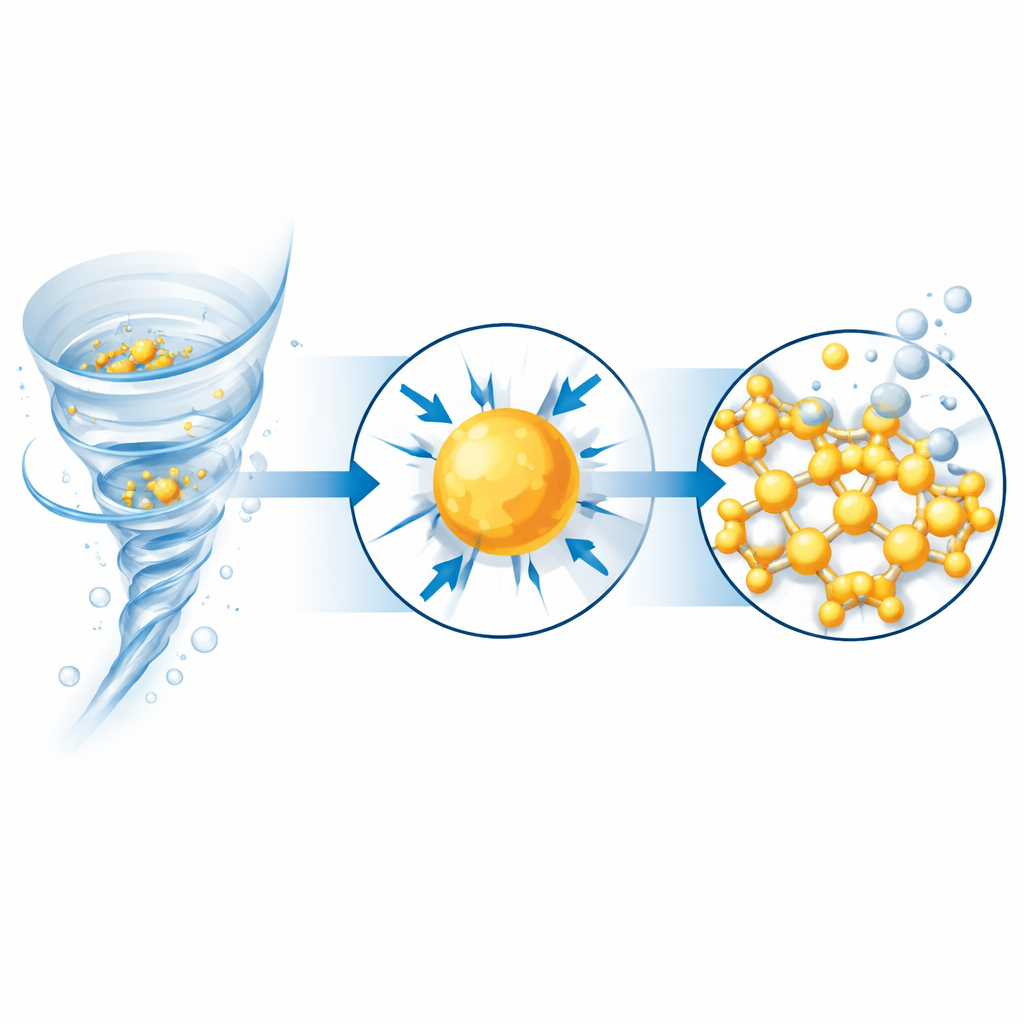
To understand why turbulence helps so much, the researchers followed the forces from the scale of the reactor down to the atoms in the catalyst. First, they used transparent model devices and soft tracer beads to show that particles are stretched as they move from the wider cylinder into the conical section where the vortex is strongest. They then built a linked set of computer models: computational fluid dynamics to map fluid speeds and pressures, discrete element simulations to track clumps of particles, and solid mechanics calculations to see how these clumps deform. Finally, quantum-level simulations described how tiny shifts in atomic positions—on the order of a couple of angstroms—change the electronic structure of the platinum-decorated catalyst surface.
Strained Atoms, Better Charge Separation, More Hydrogen
The multiscale analysis reveals that shear forces in the swirling flow create controlled strain in the catalyst’s crystal lattice. As the flow rate increases, the particles experience stronger stretching up to an optimal range. At this sweet spot, bonds between platinum atoms and the surrounding organic framework subtly rearrange, encouraging electrons excited by light to move onto the platinum while leaving positively charged holes behind in the framework. This improved separation of charges reduces energy-wasting recombination and fine-tunes how strongly hydrogen atoms stick to platinum. When the strain is just right, hydrogen binds strongly enough to form, but not so strongly that it cannot let go, leading to a sharp jump in hydrogen production between 20 and 30 liters per minute of flow.
From Laboratory Insight to Industrial Promise
By proving that large-scale swirling flows can deliberately "tune" catalysts at the atomic level, this work reframes turbulence from a nuisance into a design tool. The authors show that hydrocyclone reactors can match or surpass the performance of the best flat-panel systems while being easier to stack in parallel and potentially powered by existing industrial pressure sources. In simple terms, they demonstrate that you can use carefully engineered whirlpools of liquid not just to mix or separate, but to squeeze more performance out of photocatalysts themselves, bringing solar hydrogen a practical step closer to fueling a low-carbon future.
Citation: Yang, D., Yang, Y., Zhou, F. et al. Hydrocyclone-enhanced scalable photocatalytic hydrogen generation, from macroscale turbulence to nanoscale reaction dynamics. Nat Commun 17, 2170 (2026). https://doi.org/10.1038/s41467-026-68895-2
Keywords: photocatalytic hydrogen, hydrocyclone reactor, solar fuels, strain engineering, multiscale modeling