Clear Sky Science · en
Nested spatiotemporal theta–gamma waves organize hierarchical processing across the mouse visual cortex
How the Brain’s Waves Shape What We See
Every moment, your brain turns streams of light into meaningful scenes—spotting a friend in a crowd, or noticing that a light has just changed. This study asks a deceptively simple question: how does the brain’s electrical activity, unfolding as waves at different speeds and scales, coordinate to make this kind of flexible vision possible? By watching activity across much of the mouse visual cortex at once, the researchers uncover a hidden choreography of slow and fast brain waves that work together to route information and guide behavior.
Slow and Fast Brain Rhythms Working Together
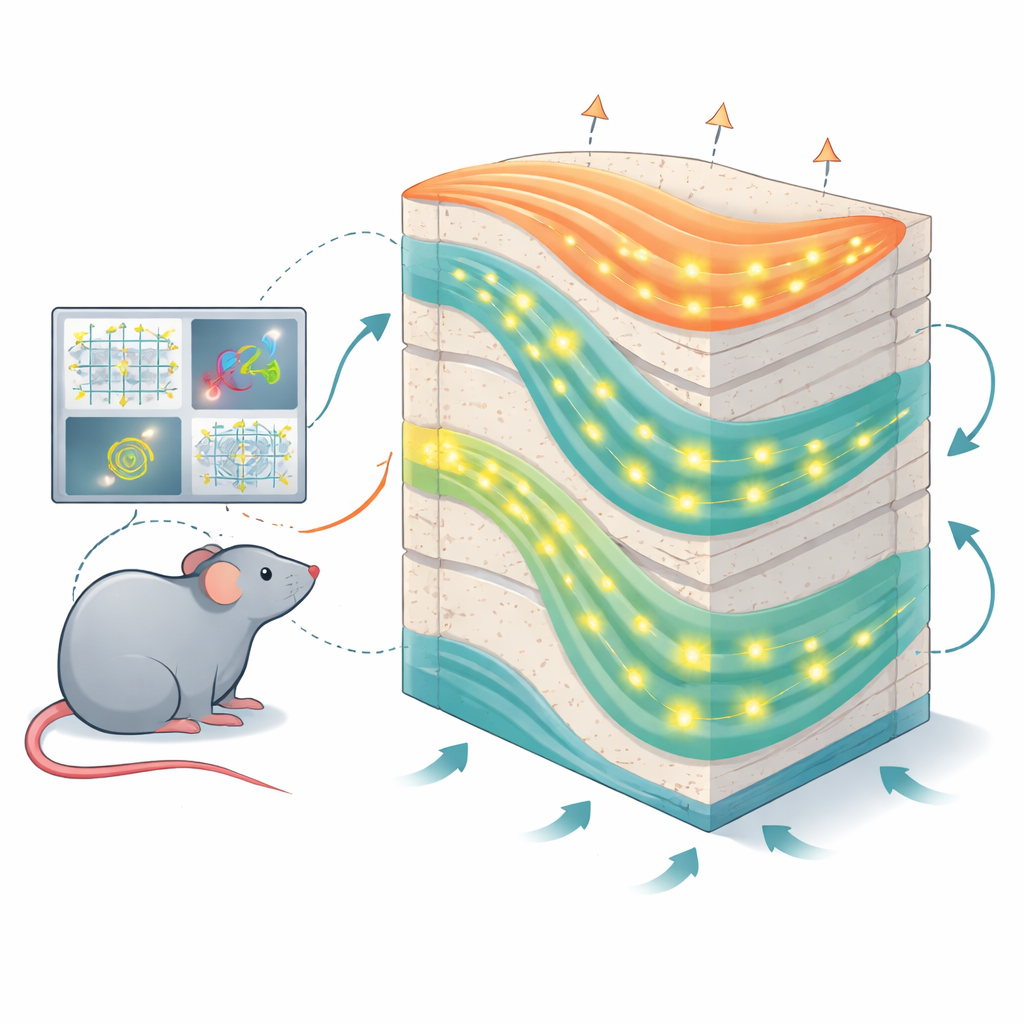
When groups of brain cells are active, they generate tiny electrical signals that often rise and fall rhythmically, like waves on water. The authors focused on two kinds of waves in the mouse visual cortex. Slow "theta" waves undulate a few times per second and span large stretches of tissue, while fast "gamma" bursts flicker dozens of times per second in small, localized patches. Analyzing detailed recordings from thin probes that sample all layers of the cortex in six visual areas, they found that these rhythms are not random background noise: theta and gamma stand out clearly from the brain’s usual "1/f" background activity and are arranged systematically across layers and regions. Deep layers of higher visual areas show especially strong theta, whereas gamma power is concentrated higher up, near the brain’s input layers.
Traveling Waves That Switch Direction
To see how slow waves move through the cortex moment by moment, the team tracked the phase of theta—the position of each wave in its crest‑to‑trough cycle—across layers and regions on single trials. During a task in which mice had to detect changes in natural images, theta behaved like a traveling sheet of activity that could reverse direction depending on what was happening on the screen. Right after an image appeared, theta tended to move from deep layers toward the surface and from higher visual areas down to lower ones, a pattern consistent with top‑down signals carrying expectations or task engagement. After the image disappeared, the same kind of wave flipped direction, moving from surface to deep layers and from lower to higher areas, matching the path of bottom‑up sensory signals. Remarkably, the pattern and direction of these waves before the mouse responded helped predict whether it would correctly detect the image change.
Sharp Bursts of Local Processing
Fast gamma activity looked very different. Instead of broad waves, gamma appeared as brief, compact "packets"—tight islands of high‑frequency oscillations that lasted only a few tens of milliseconds and spanned a few hundred micrometers of cortex. These packets became sharper and more localized when an image was present, especially in layers that send feedforward information to higher areas. Their size and distribution shifted across the visual hierarchy and across different task moments, suggesting that gamma packets act as focused processing units that represent specific visual features in space and time, like bright patches or edges in the scene.
Nesting: How Slow Waves Time Fast Bursts and Spikes
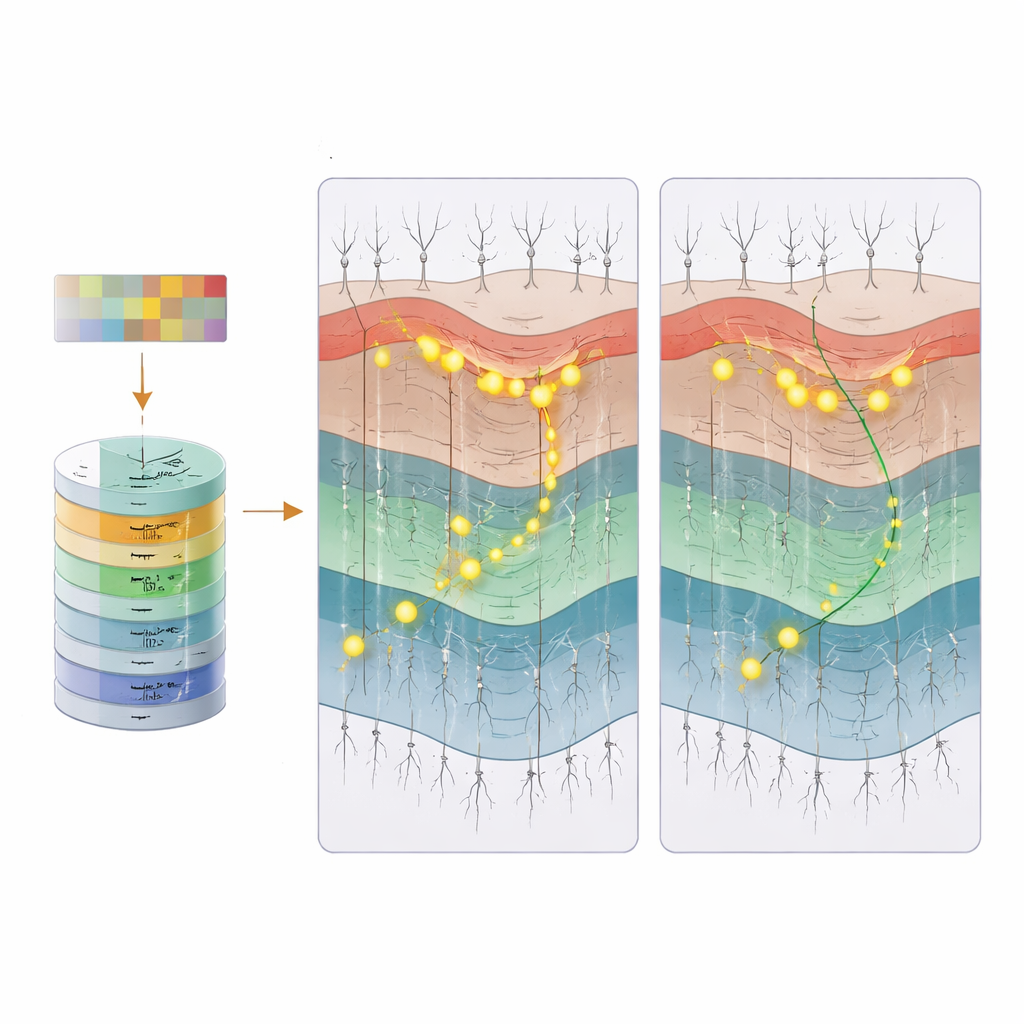
The key finding is that these two scales are tightly intertwined. The authors showed that gamma packets tend to occur at particular phases of the theta cycle, and that this preferred timing changes systematically with cortical depth and with position in the visual hierarchy. In lower visual areas, packets in upper layers clustered around theta troughs, whereas deeper layers and higher areas aligned more with peaks or falling edges. A similar nesting applied to individual neurons: spikes were more likely during specific phases of theta and during periods of strong gamma, especially in upper layers. During successful change detections, spikes in these layers shifted closer to the theta trough and their firing rates rose shortly after image onset, just when deep‑to‑surface theta waves were strongest.
A Flexible Code for Bottom‑Up and Top‑Down Vision
Taken together, these results support the idea of a "spatiotemporal theta–gamma code" for vision. In this code, slow traveling theta waves provide a moving scaffold that can switch between two modes. At image onset, a theta wave arriving from deeper, higher regions carries top‑down context—such as attention or expectation—that lands in surface layers just as gamma packets and spikes there encode fine‑grained details of the new image. At image offset, a reversed theta wave synchronizes outgoing bottom‑up signals, possibly creating brief windows when higher areas can process information from other senses or internal goals with less interference. For a lay observer, the message is that perception is not just about which neurons fire, but when and where their activity rides on slow and fast waves that crisscross the brain’s visual hierarchy to flexibly combine what we see with what we expect.
Citation: Harris, B., Gong, P. Nested spatiotemporal theta–gamma waves organize hierarchical processing across the mouse visual cortex. Nat Commun 17, 2629 (2026). https://doi.org/10.1038/s41467-026-68893-4
Keywords: neural oscillations, visual cortex, theta gamma coupling, traveling brain waves, mouse neuroscience