Clear Sky Science · en
Observation of topological braiding and dynamical criticality in time reflection and refraction
Shaping Waves by Switching Materials in Time
Most of us are used to waves bouncing off walls or bending when they pass from air into water. But what if, instead of changing space, we suddenly changed the material in time? This study shows that flipping a material’s properties at a precise instant can split waves into a “time-reflected” part and a “time-refracted” part—and that this process secretly follows the same kind of topological rules that describe knots and links. The result is a new way to control waves using time itself, with robustness guaranteed by deep mathematical structure.
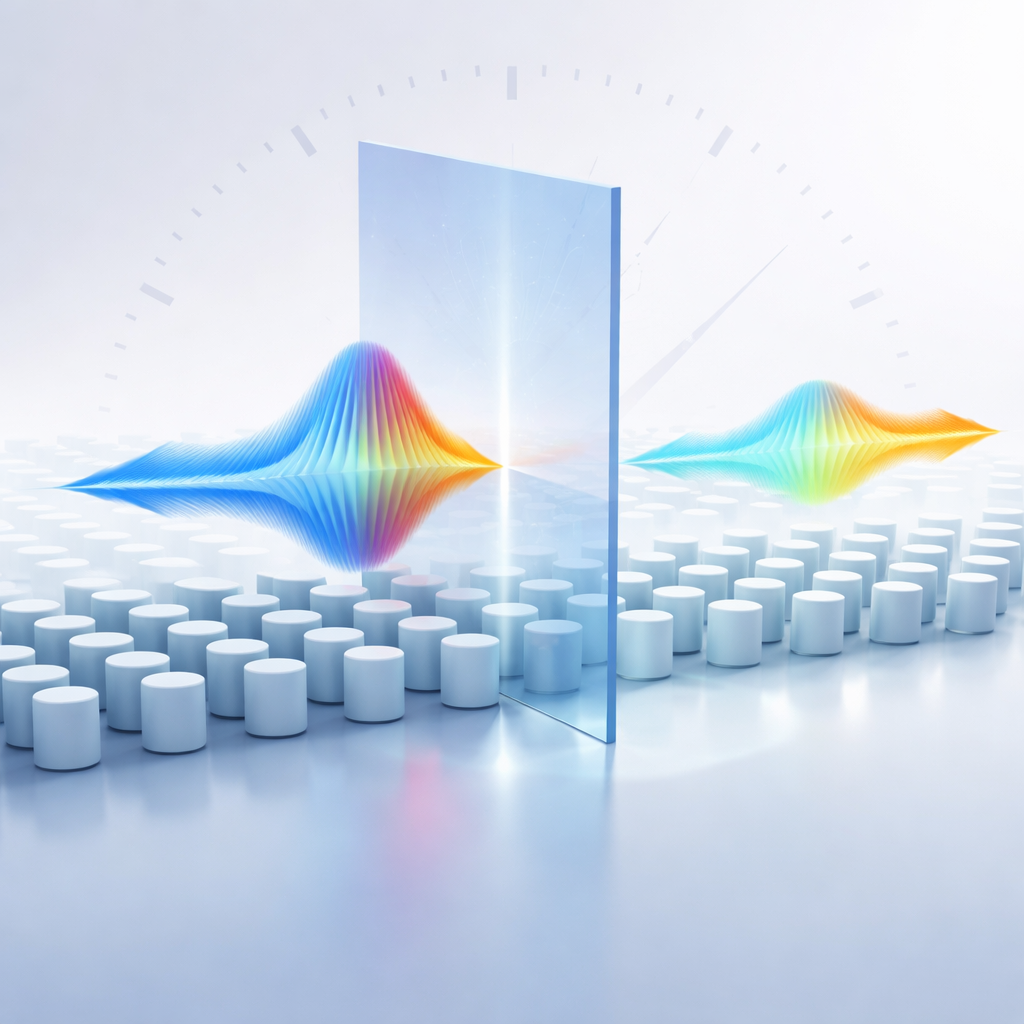
When the Medium Changes in Time, Not Space
In familiar optics, sound, and water waves, an interface is a boundary in space—like air meeting glass—that causes reflection and refraction. In time-varying materials, the boundary instead appears at a specific moment: the material everywhere is suddenly switched. This “temporal boundary” doesn’t change the wave’s momentum; instead it changes the wave’s energy, creating a forward-going component (time refraction) and a backward-in-time analog (time reflection) in the evolution. The authors use a special class of artificial electrical materials called circuit metamaterials to create and precisely control such temporal boundaries, allowing them to watch how waves respond in real time.
Turning Circuits into Quantum Wave Simulators
The team builds a carefully designed electrical circuit that faithfully mimics the Schrödinger equation—the same equation that governs quantum particles. They do this by encoding the real and imaginary parts of a quantum wavefunction in two interwoven sets of circuit nodes, and by using active components to produce effective couplings between them. This architecture realizes a “long-range SSH lattice,” a chain with tunable connections that can host several distinct topological phases, labeled by an integer called the winding number. By adjusting resistors and switches, the researchers can jump the system from one topological phase to another at a chosen time, thereby creating a temporal boundary with a well-defined change in topology.
Knotted Paths from Reflected and Refracted Waves
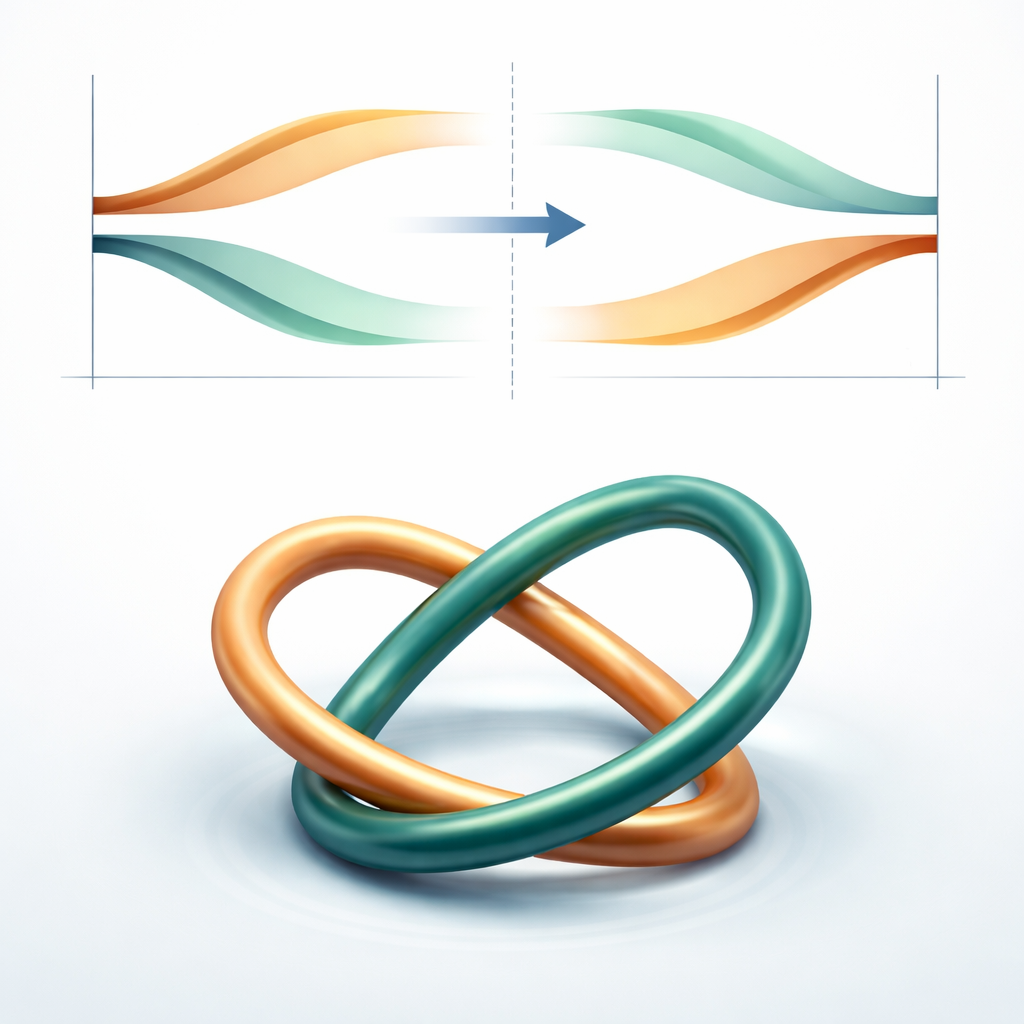
When the temporal boundary is switched on, an initially prepared wave packet splits into time-reflected and time-refracted parts. For each momentum value, the amplitudes of these two components can be thought of as complex numbers, with real and imaginary parts that vary smoothly across the allowed momenta. Plotting these amplitudes across all momenta produces continuous strands in a three-dimensional space of parameters. The striking discovery is that these strands do not simply weave past each other: they form linked loops—such as Hopf links and Solomon links—whose linking number is exactly equal to the difference between the topological winding numbers before and after the temporal boundary. In other words, the amount and handedness of the “topological knotting” in the scattering data are directly dictated by how the material’s topology changes in time.
Sudden Dynamical Transitions Marked in Time
Beyond these geometric links, the authors uncover a second, more dynamical topological effect. By tracking how closely the evolving state resembles the initial state, they construct a quantity analogous to a free energy in time, called a rate function. This function typically changes smoothly, but when the initial and final topological phases differ, it develops sharp features at specific critical times. At exactly these instants, a “dynamical topological invariant” that counts the winding of a certain geometric phase jumps by whole numbers. These quantized jumps signal a dynamical topological phase transition—a nonequilibrium analogue of an ordinary phase change, but unfolding in time rather than as a function of temperature or pressure.
Why This Matters for Future Wave Technologies
To a lay reader, the key message is that waves in materials that are switched quickly in time can behave in surprisingly structured and robust ways. The reflected and refracted components do not vary arbitrarily; instead they trace out knotted shapes that encode how the system’s underlying topology has changed, and they pass through sharp, predictable dynamical transitions marked by quantized jumps. Such time-based, topologically protected control of waves could enable new devices that steer light, sound, or other signals in powerful and reconfigurable ways—using sudden changes in time, rather than static structures in space, as the main design tool.
Citation: Li, Y., Kou, Y., Xu, H. et al. Observation of topological braiding and dynamical criticality in time reflection and refraction. Nat Commun 17, 2068 (2026). https://doi.org/10.1038/s41467-026-68887-2
Keywords: time-varying metamaterials, topological phases, temporal reflection and refraction, circuit metamaterials, dynamical phase transitions