Clear Sky Science · en
Anthropogenically-driven escalating impact of soil-based compound dry-hot extremes on vegetation productivity
Why hotter, drier soils matter to everyday life
When we think about heatwaves and droughts, we usually picture scorching air temperatures and empty reservoirs. This study flips the view and looks underground, asking a simple but crucial question: what happens when the soil itself becomes both very hot and very dry at the same time? By examining conditions across China, the researchers show that these soil-based dry–hot extremes are spreading and hitting plants harder than traditional heatwaves or droughts measured only in the air. Their findings matter for food production, forest health, carbon storage, and ultimately for our ability to soften climate change.
Hidden stress beneath our feet
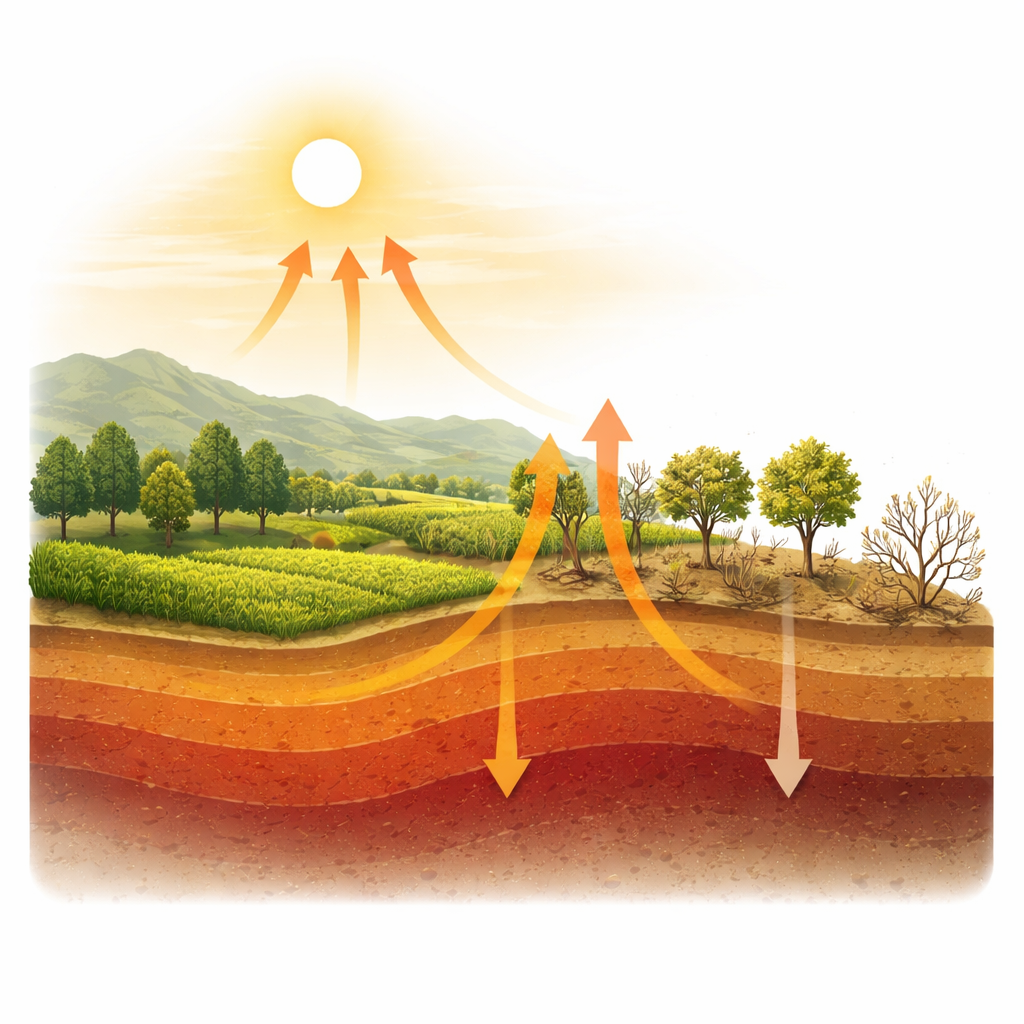
Plants live with their roots in a world that most of us rarely consider. Soil temperature and soil moisture together control how easily roots can take up water and nutrients, how active soil microbes are, and how quickly plants can grow. The authors define “soil-based compound dry–hot extremes” as days when the top 10 centimeters of soil are both unusually hot and unusually dry for that time of year. Using carefully corrected soil temperature records and a satellite-informed soil moisture dataset for China, they map where and when these underground extremes strike during the warm growing season, from May to September.
Plants hit harder by soil extremes than by air extremes
To see how plants respond, the team used three independent measures of plant productivity: gross primary production (the carbon plants capture through photosynthesis), solar-induced fluorescence (a faint light signal linked to photosynthesis), and net primary production (plant growth after accounting for respiration). Across most of China’s vegetated land, all three drop noticeably during soil-based dry–hot extremes. The losses are especially strong in northern and southwestern regions. In a few cold, moist northeastern areas, warmer soils can briefly benefit plants, but these are exceptions. When the authors compared these underground extremes with more familiar “meteorological” events defined by hot air and dry atmosphere, they found that the air-based events caused much smaller declines in plant productivity. In other words, roots feel the pain of compound heat and dryness more than leaves do.
More frequent and more widespread soil shocks
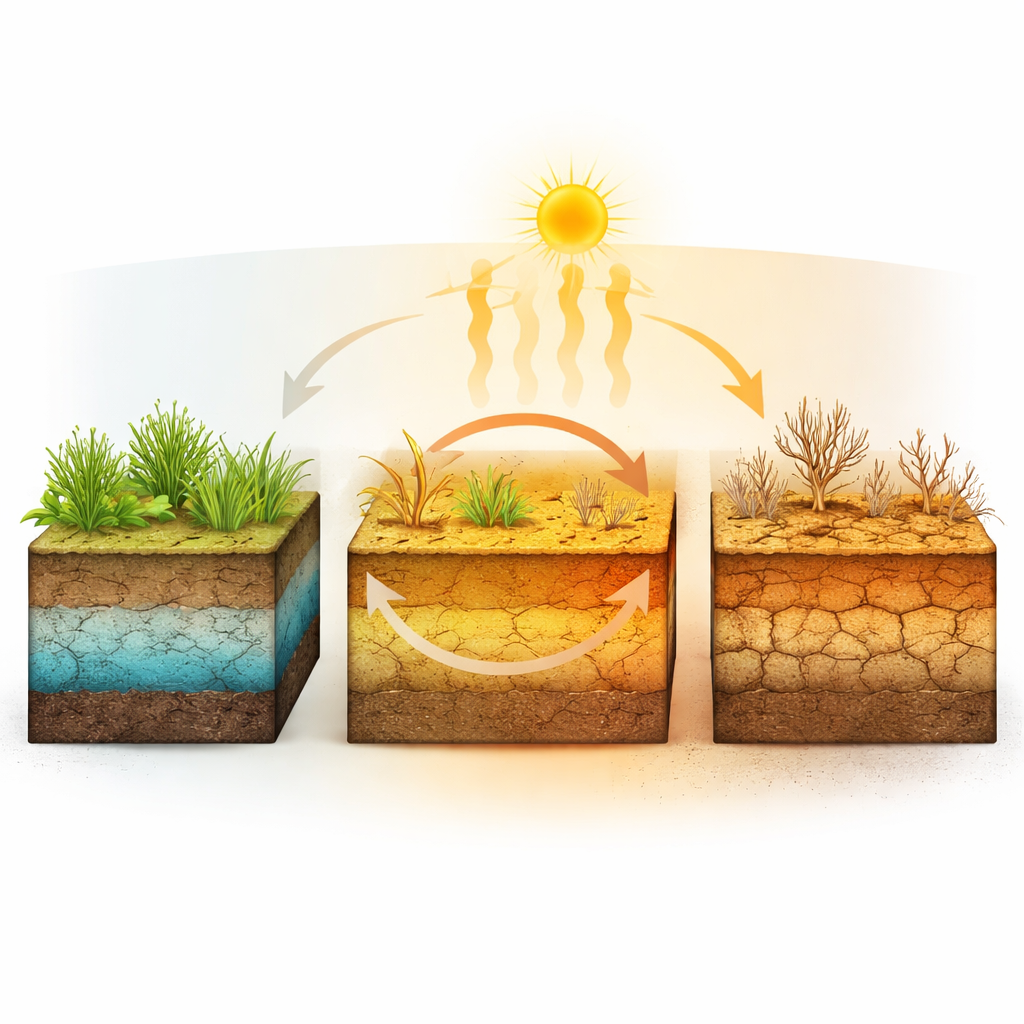
From 1980 to 2017, days with soil-based dry–hot extremes became more common and covered larger areas in China. On average, each location gained about three extra extreme days per warm season, and the total area affected each year expanded dramatically, particularly in northern China and parts of the Tibetan Plateau. The study links this surge to two main physical drivers: broad patterns in the atmosphere and a stronger two-way link between soil moisture and soil temperature. Persistent high-pressure systems favor clear skies and strong sunshine, which heat soils and dry them out. Once the soil is dry, it warms even faster because there is less evaporative cooling, further intensifying heat at the surface. This feedback is especially strong in regions that are shifting from relatively moist to more arid conditions.
Human fingerprints in warming soils
To separate human influence from natural climate swings, the researchers combined observations with climate model experiments. These models simulate how soil temperature and moisture would have changed under natural drivers alone (such as volcanoes and solar variations) versus under the combined effect of natural and human-made greenhouse gases and aerosols. The results are clear: the pattern and strength of soil warming across China closely match the simulations that include human influence, and not those with natural factors only. By adjusting the observational data to remove the modelled human contribution, the team estimated that natural climate variability increased the frequency of soil-based extremes only modestly. In contrast, anthropogenic soil warming alone added roughly five extra extreme days per season and greatly expanded the affected area, while changes in soil moisture partly offset this increase in some regions.
What the future holds for crops and forests
Looking ahead, the authors used a large ensemble of climate projections to estimate how often these soil-based dry–hot extremes may occur under different greenhouse gas pathways. Even under a low-emissions path where warming eventually levels off, such extremes become more frequent by mid-century before easing slightly. Under a medium path, they continue to rise and then stabilize late in the century. Under a fossil-fueled, high-emissions future, they grow steadily and sharply, with China seeing on average about 13 additional extreme days per warm season by 2071–2100 compared with 1981–2010. Croplands, forests, and shrubs in central, southern, and northeastern China are especially exposed, and the associated drop in plant carbon uptake could reach about 0.025 billion tons of carbon per year. That means weaker natural carbon sinks and higher pressure on human efforts to balance the carbon budget.
What this means for food and climate
For non-specialists, the key message is that climate risk is not just about hotter air or less rain—it is also about how heat and drought combine underground, where roots, microbes, and nutrients interact. This study shows that human-driven soil warming is already making these harsh soil dry–hot spells more common and more damaging to plant growth in China, and that continued high emissions would further erode the land’s ability to support crops, forests, and carbon storage. By highlighting the crucial role of soils in connecting weather extremes to food security and climate, the work underscores that cutting greenhouse gas emissions can protect not only the air above us but also the life-supporting world beneath our feet.
Citation: Liang, Y., Wang, J., Hao, Z. et al. Anthropogenically-driven escalating impact of soil-based compound dry-hot extremes on vegetation productivity. Nat Commun 17, 2303 (2026). https://doi.org/10.1038/s41467-026-68878-3
Keywords: soil moisture, climate extremes, vegetation productivity, drought and heat, carbon cycle