Clear Sky Science · en
Safeguarding climate-resilient mangroves requires only a moderate increase in the global protected area
Why these coastal forests matter to you
Mangrove forests fringe tropical shorelines around the world, quietly shielding coastal towns from storms, storing vast amounts of carbon, and supporting fisheries that feed millions. Yet they are under pressure from rising seas, stronger storms, and human development. This study asks a crucial practical question: can we redesign global protection for mangroves so they are better able to withstand climate change—without needing to fence off huge new areas of ocean and coast?
Hidden defenders on the shoreline
Mangroves are remarkable trees and shrubs that grow where land meets the sea. Their tangled roots blunt waves, limit flooding, and lock away carbon in waterlogged soils. But they are squeezed from both sides. On the seaward edge, rising seas and erosion can drown them. On the landward side, farms, roads, sea walls, and cities often block the forests from migrating inland as water levels rise. Add in stronger cyclones and more frequent droughts, and the risk is that large stretches of mangroves could die back, releasing stored carbon and exposing coasts to greater damage.
Planning for tomorrow, not yesterday
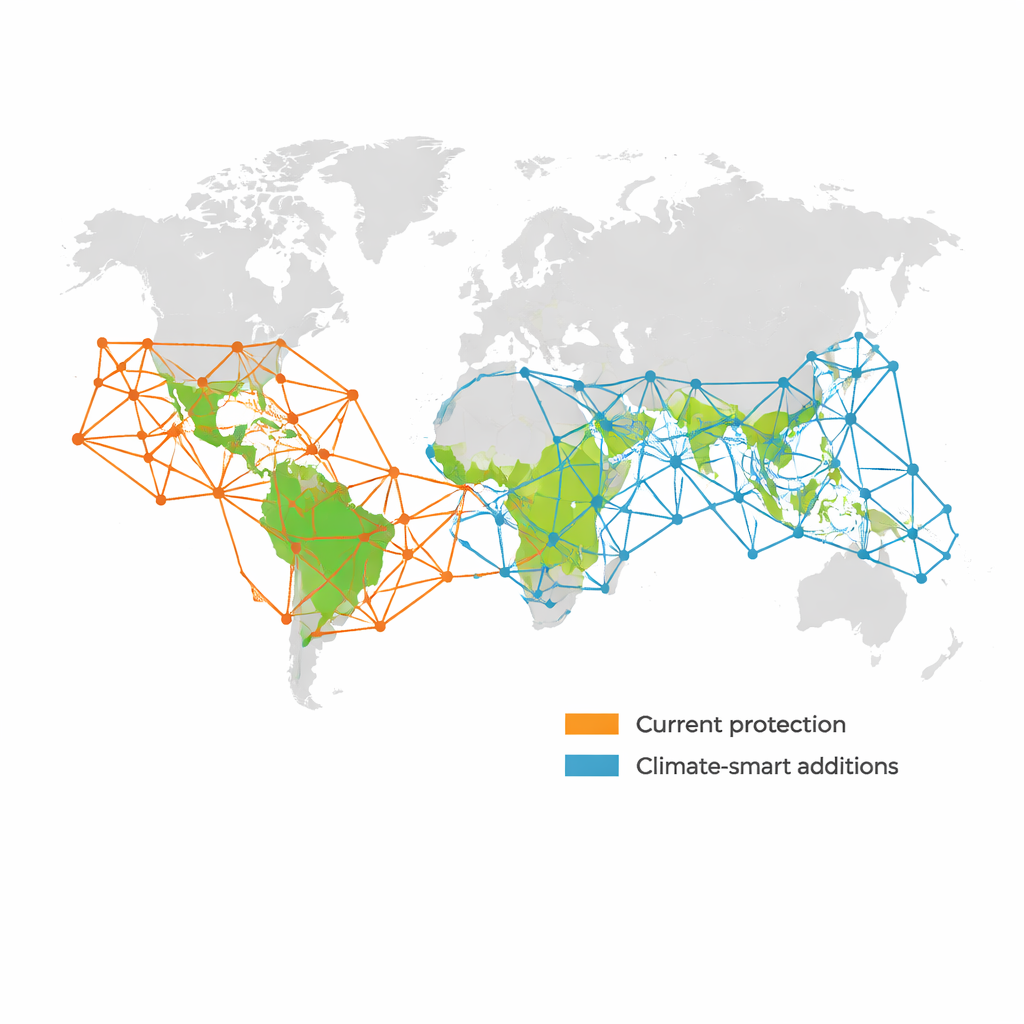
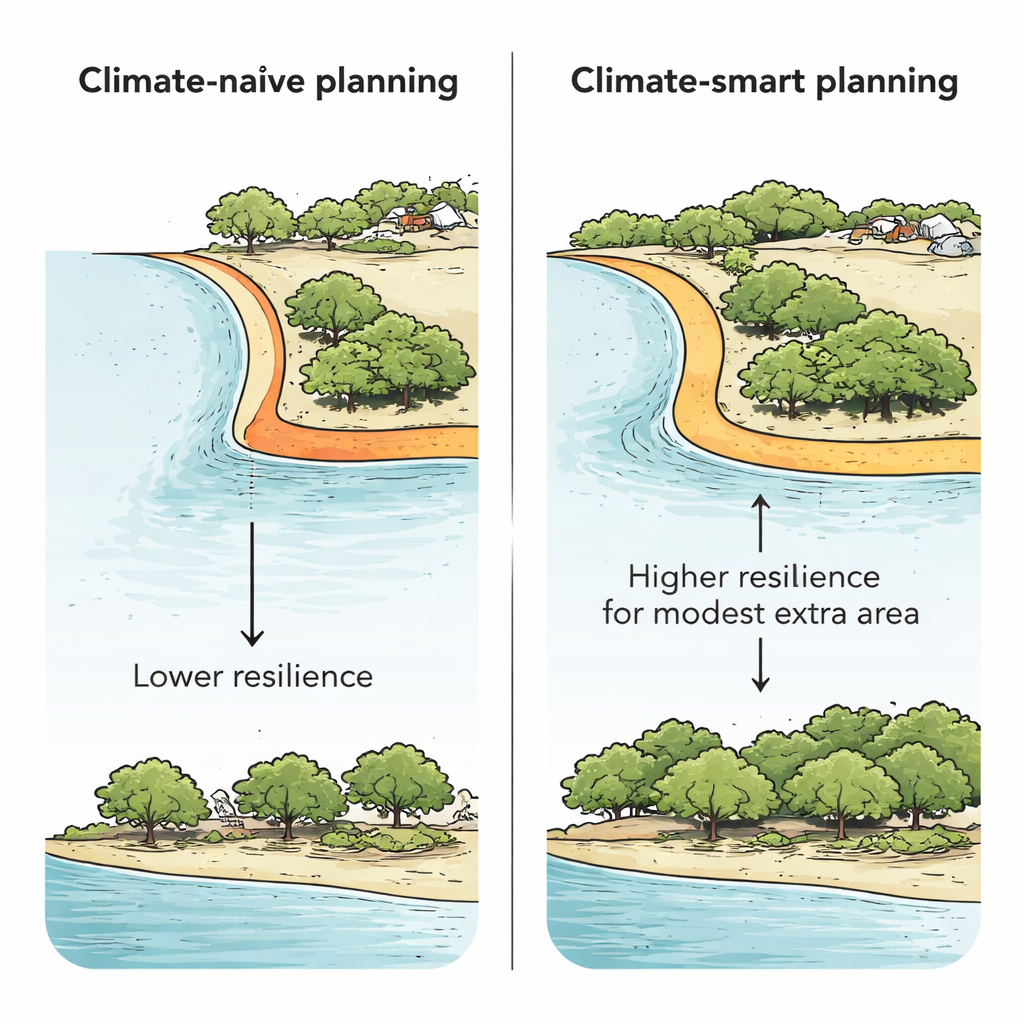
Conservation maps and protected areas have traditionally been drawn using a “climate-naïve” approach: they aim to capture species and habitats where they are now, without fully accounting for how climate change will reshape coastlines. The authors instead tested a “climate-smart” strategy. Using a global ecological model, they estimated how likely each mangrove area is to remain stable or expand under a high-emissions climate scenario by mid-century. They then asked where protected areas could be placed so that they still meet biodiversity goals—protecting many species and habitat types—while favoring those stretches of coast that are most likely to endure future changes.
More resilience for a modest price
When the team compared climate-naïve and climate-smart designs worldwide, they found a surprisingly encouraging result. A global climate-smart network that prioritizes more resilient mangroves would increase the total area to be protected by only about 7 percent, yet would boost overall climate resilience by more than 13 percent. In other words, a relatively small expansion and reshuffling of protected zones can deliver a much sturdier safety net for these forests and the communities that depend on them. The biggest gains come from international, or “transboundary,” planning: when countries coordinate rather than act alone, the resulting network is smaller and better targeted than the sum of many separate national plans.
Different edges, different futures
The study also reveals that not all parts of a mangrove forest face the same future. The seaward edge is generally more at risk of net loss than the landward edge, but it also offers more opportunities to highlight especially resilient stretches for protection. In many countries, the best places to safeguard on the landward side of mangroves are very different from those on the seaward side. That means coastal managers may need two complementary toolkits: one focused on opening up space inland so mangroves can migrate, and another aimed at stabilizing and nurturing the forests that can still hold their ground at the water’s edge.
Rethinking what “protected” really means
Today, about 43 percent of the world’s mangroves fall inside some kind of protected area—seemingly enough to meet global targets that call for conserving 30 percent of land and sea. Yet the authors show that this existing network is poorly aligned with future resilience, especially along the seaward edge. Many of the most climate-hardy mangrove habitats are left out, while less resilient ones are locked in. By updating boundaries and adding strategically chosen new sites, countries could protect a similar or slightly larger area overall but dramatically strengthen how well mangroves—and the services they provide—survive in a warming world.
What this means for coasts and communities
For non-specialists, the takeaway is straightforward: making conservation “climate-smart” does not require walling off vast new stretches of coastline. Instead, it calls for using the best available science to shift protections toward those mangrove forests most likely to persist or grow under climate change, and for countries to work together across borders. Doing so would help keep natural storm shields in place, safeguard fisheries, and maintain powerful carbon sinks—all for a relatively modest increase in protected area. The approach demonstrated here for mangroves could be adapted to other ecosystems, helping societies invest limited conservation resources where they will make the biggest long-term difference.
Citation: Dabalà, A., Brown, C.J., Van der Stocken, T. et al. Safeguarding climate-resilient mangroves requires only a moderate increase in the global protected area. Nat Commun 17, 2063 (2026). https://doi.org/10.1038/s41467-026-68877-4
Keywords: mangrove conservation, climate-smart planning, coastal resilience, protected areas, blue carbon