Clear Sky Science · en
Olig2 acts as an inducible barrier to in vivo astrocyte-to-neuron conversion
Turning Brain Support Cells into Neurons
The adult brain has only a limited ability to replace lost neurons, which is a major obstacle in conditions like stroke, Alzheimer’s disease, and spinal cord injury. One promising idea is to convert nearby “support cells” called astrocytes directly into new neurons, using gene therapy. This study asks a key question: what is stopping that conversion from working efficiently inside the living brain—and can those brakes be released?
A Hidden Brake on Cellular Shape-Shifting
Astrocytes normally help nourish neurons, maintain brain chemistry, and respond to injury. In certain disease states, they can behave a bit like stem cells, raising hopes that they could be reprogrammed into neurons on site. Scientists already know that a class of genes called proneural transcription factors—such as Ngn2, Ascl1, and NeuroD1—can push astrocytes toward a neuronal identity. Yet in animals, this astrocyte-to-neuron conversion remains frustratingly inefficient. The authors suspected that, beyond pre-existing defenses, astrocytes might raise a new, inducible barrier when reprogramming is triggered.
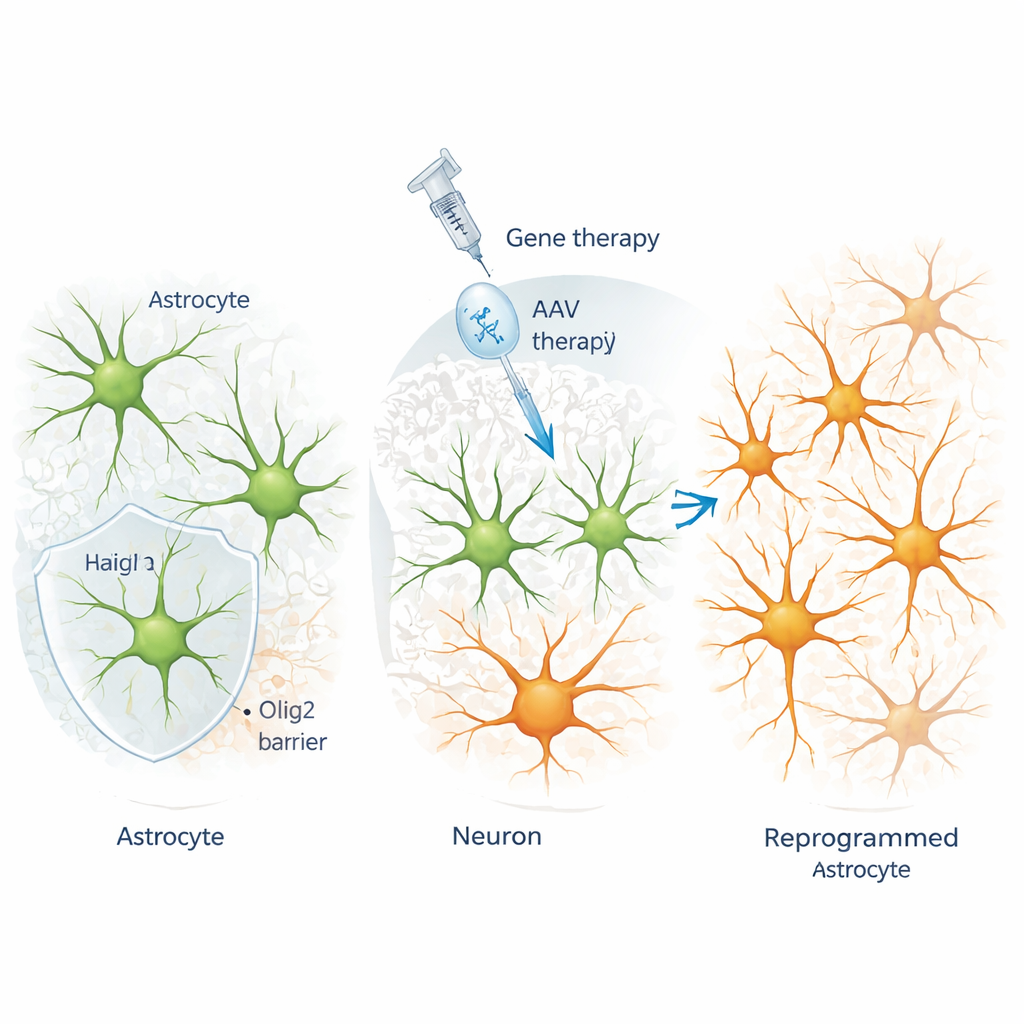
A Protein Called Olig2 Steps in to Resist Change
Working in the adult mouse cortex, the researchers delivered reprogramming factors to astrocytes using engineered viruses that are highly selective for these cells. They discovered that whenever a basic helix–loop–helix (bHLH) factor such as Ngn2, Ascl1, or NeuroD1 was forced into astrocytes, another bHLH protein, Olig2, was dramatically switched on. Under normal conditions, Olig2 is found in oligodendrocyte lineage cells, not in mature cortical astrocytes. Careful tracing experiments showed that the extra Olig2-positive cells after treatment were not produced by proliferation of oligodendrocyte precursors—instead, the very astrocytes being targeted for conversion were turning on Olig2 in response to the reprogramming signal.
Removing the Brake Triples Conversion and Yields Working Neurons
To test whether Olig2 is truly a barrier, the team used short hairpin RNAs to dial down Olig2 specifically in astrocytes that were also given Ngn2. Silencing Olig2 cut its protein levels in these cells almost to zero and had a striking effect: the proportion of labeled astrocytes that became neurons rose roughly threefold compared with Ngn2 alone. Over several weeks, many cells passed through an intermediate stage, losing typical astrocyte markers before fully gaining neuronal markers. Electrical recordings from brain slices showed that the converted cells fired action potentials and, in about half the cases, received excitatory and inhibitory synaptic inputs—hallmarks of functional integration into local circuits.
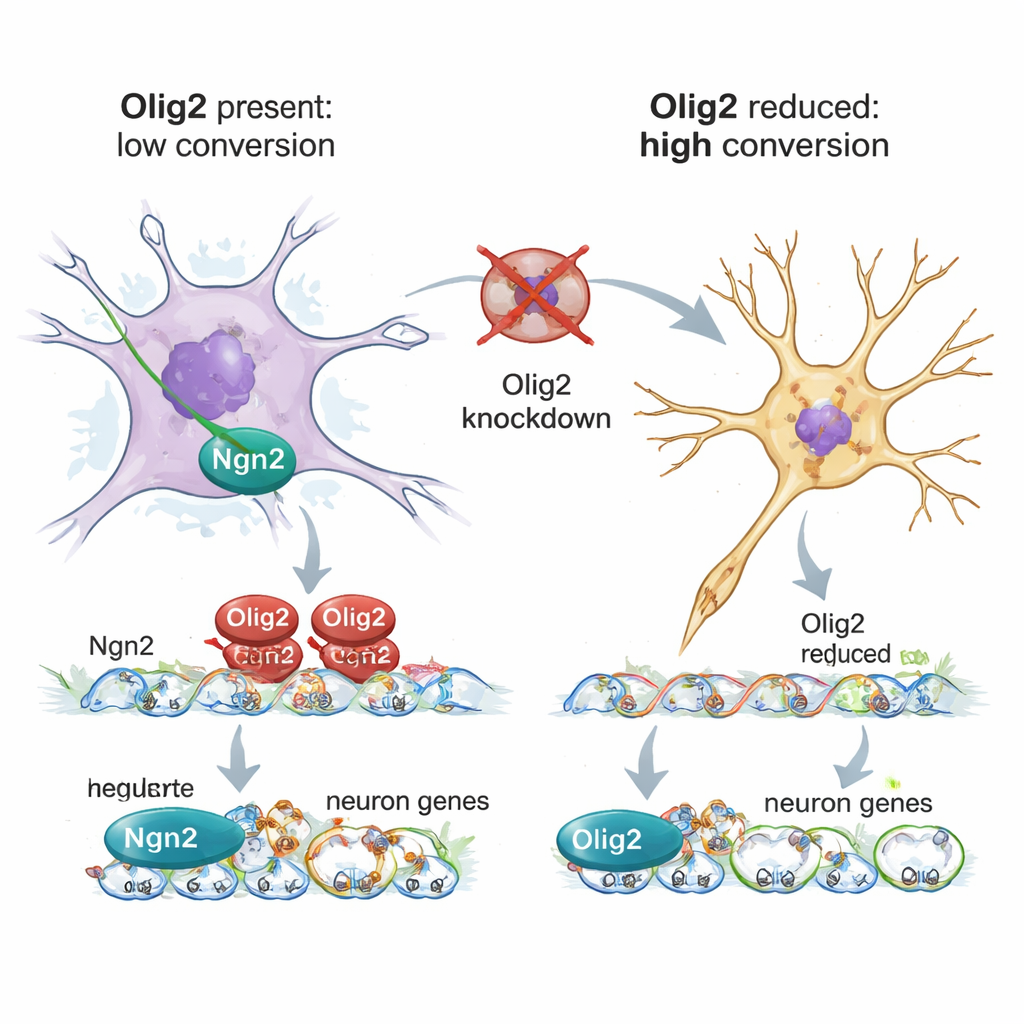
How Olig2 Blocks the Switch to a Neuron Program
Using single-cell RNA sequencing, the authors profiled thousands of individual astrocytes exposed to Ngn2, with or without Olig2 knockdown. When Olig2 was present, astrocytes only partially shifted their gene expression: some metabolic and protein-synthesis pathways were altered, but core astrocyte genes remained active and many neuron-building genes stayed muted. When Olig2 was reduced, astrocytes more fully suppressed their mature support-cell program and upregulated genes associated with neural stem cells, neurogenesis, and axon growth. A complementary method, CUT&Tag, mapped where Olig2 binds on DNA in these reprogrammed astrocytes. Olig2 landed on regulatory regions of many pro-neurogenic genes—including Ngn2 itself—consistent with a role as a direct repressor that both dampens the reprogramming factor and keeps neuronal genes off.
Rewiring Cell Identity by Lifting an Inducible Defense
Altogether, the work reveals that astrocytes mount an active, inducible defense against being turned into neurons: once a proneural factor like Ngn2 is introduced, it triggers Olig2, which in turn restrains Ngn2 and blocks key neuronal genes. Disabling Olig2 does not solve every problem—conversion efficiencies remain modest—but it substantially boosts the yield of functional new neurons and shifts astrocyte metabolism and gene expression toward a neuron-like state. For a lay reader, the takeaway is that successful brain repair may require not only stepping on the gas with pro-neuronal factors, but also releasing newly discovered brakes like Olig2 that cells use to protect their identity.
Citation: Lai, C., Hou, K., Li, W. et al. Olig2 acts as an inducible barrier to in vivo astrocyte-to-neuron conversion. Nat Commun 17, 2033 (2026). https://doi.org/10.1038/s41467-026-68869-4
Keywords: astrocyte-to-neuron conversion, cell reprogramming, Olig2, gene therapy, neuroregeneration