Clear Sky Science · en
Branched-chain amino acid specialization drove diversification within Calditenuaceae (Caldarchaeia) and enables their cultivation
Life in Boiling Water
Near‑boiling hot springs might seem like places where nothing could live, yet they are home to thriving microbial communities. This study explores one such group of heat‑loving microbes and uncovers how their taste for a particular set of building‑block molecules, called branched‑chain amino acids, shapes their way of life, their evolution, and even how scientists can finally grow them in the lab.
A Hidden Majority in a Desert Hot Spring
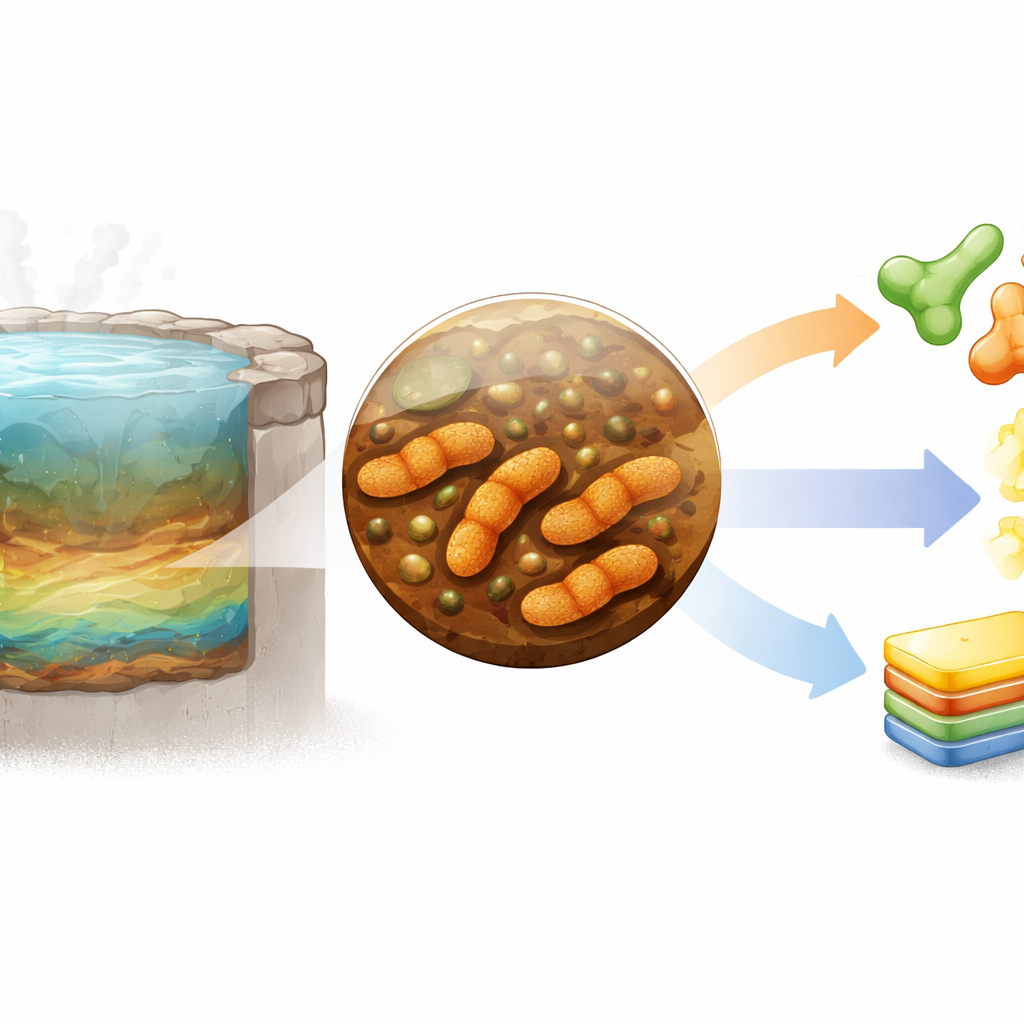
The work centers on Great Boiling Spring in Nevada’s Great Basin, where water temperatures can reach the boiling point. In these scorching, near‑neutral waters, tiny archaea—microorganisms distinct from bacteria—dominate the sediments at the hottest spots. One species in particular, newly named Calditenuis ramacidaminiphagus, turns out to be the most abundant archaeon in the hottest, clay‑rich layers, suggesting it plays an important role in how carbon and energy flow through this harsh ecosystem.
Following the Food into the Cell
To figure out what fuels this microbe, the team combined high‑resolution imaging with chemical tracers and DNA‑based methods. They fed natural sediments and long‑term lab cultures with molecules labeled in a way that allowed the researchers to track which cells were actively taking them up. In community cultures, Calditenuis ramacidaminiphagus pulled in a variety of small organic compounds, but especially mixtures of amino acids. When the scientists examined its genome and the proteins it produced, a clear pattern emerged: this archaeon is packed with transport systems and enzymes geared toward just three amino acids—leucine, isoleucine, and valine, collectively known as branched‑chain amino acids.
Specializing in a Narrow Menu
Armed with this hint, the researchers tested how different diets reshaped mixed lab communities. When branched‑chain amino acids were supplied as the only carbon source, Calditenuis ramacidaminiphagus flourished, reaching millions of cells per milliliter and nearly half of all detectable organisms. In contrast, when only polar amino acids such as aspartate were offered, other microbes took over and this archaeon declined. Its genome contains multiple copies of branched‑chain amino acid transporters and a rich arsenal of protein‑cutting enzymes that likely help free these favored molecules from larger dietary proteins. Missing, however, are comparable systems for many other amino acid types, reinforcing the idea that this organism has narrowed its lifestyle around a specific resource.
Turning Favorite Foods into Energy and Membranes
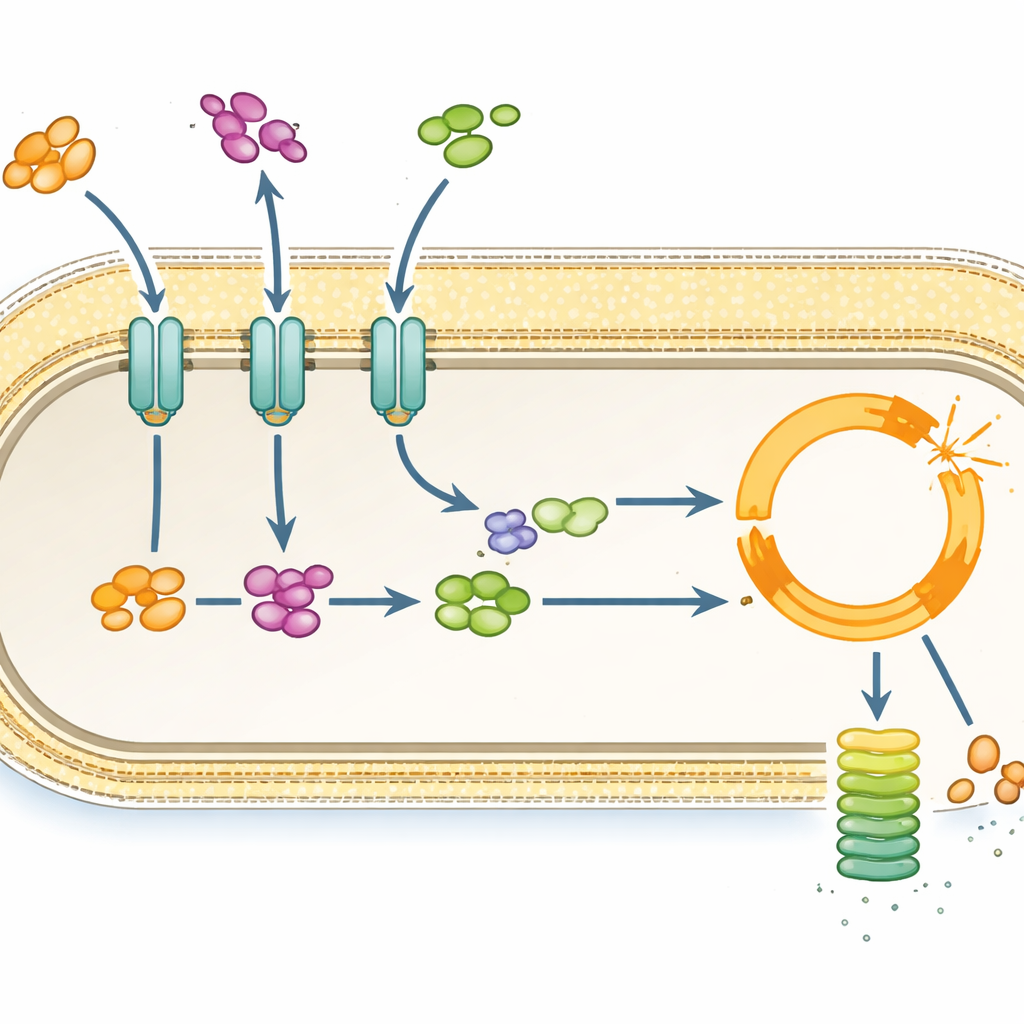
Once inside the cell, branched‑chain amino acids are not just burned for energy; they are also recycled into essential cell parts. The study reconstructs the internal chemistry of Calditenuis ramacidaminiphagus and shows that these amino acids can be converted into key molecules for both ATP‑generating cycles and the special lipids that form archaeal cell membranes. Some pathways fully oxidize the amino acids, feeding a central energy‑producing cycle that runs with oxygen. Others divert them into the “mevalonate” route, leading to isoprenoid lipids that help stabilize membranes at very high temperatures. Under conditions where energy intake outpaces growth, the cell appears to dump excess carbon as small branched organic acids, which may then be consumed by neighboring microbes—hinting at chemical partnerships within the community.
Evolution Written in Transport Genes
By comparing 62 related genomes from hot springs and fumaroles around the world, the authors show that this appetite for branched‑chain amino acids is a defining trait of the genus Calditenuis. Evolutionary reconstructions suggest that ancestors of these archaea repeatedly acquired branched‑chain amino acid transport systems from other organisms and then expanded them through gene duplication. Other close relatives in the same family seem to rely more on different amino acid types, implying a fine‑scaled division of labor: in what might look like a simple, low‑diversity environment, closely related microbes avoid direct competition by specializing on distinct slices of the organic matter buffet.
Why This Matters Beyond One Hot Spring
Together, these findings show how a narrow dietary preference can drive both ecological success and evolutionary change in extreme environments. Calditenuis ramacidaminiphagus prospers by focusing on branched‑chain amino acids, turning them into energy, membrane material, and shared byproducts, and this specialization now allows researchers to cultivate it reliably in the lab. More broadly, the work demonstrates that even in a boiling pool with few players, life is organized by sharp resource partitioning, where different microbes carve out distinct nutritional niches to coexist.
Citation: Lai, D., Mosier, D., Palmer, M. et al. Branched-chain amino acid specialization drove diversification within Calditenuaceae (Caldarchaeia) and enables their cultivation. Nat Commun 17, 2342 (2026). https://doi.org/10.1038/s41467-026-68859-6
Keywords: hot spring microbes, archaea, amino acid metabolism, thermophiles, microbial evolution