Clear Sky Science · en
Acoustic shape-morphing micromachines
Tiny Machines That Change Shape with Sound
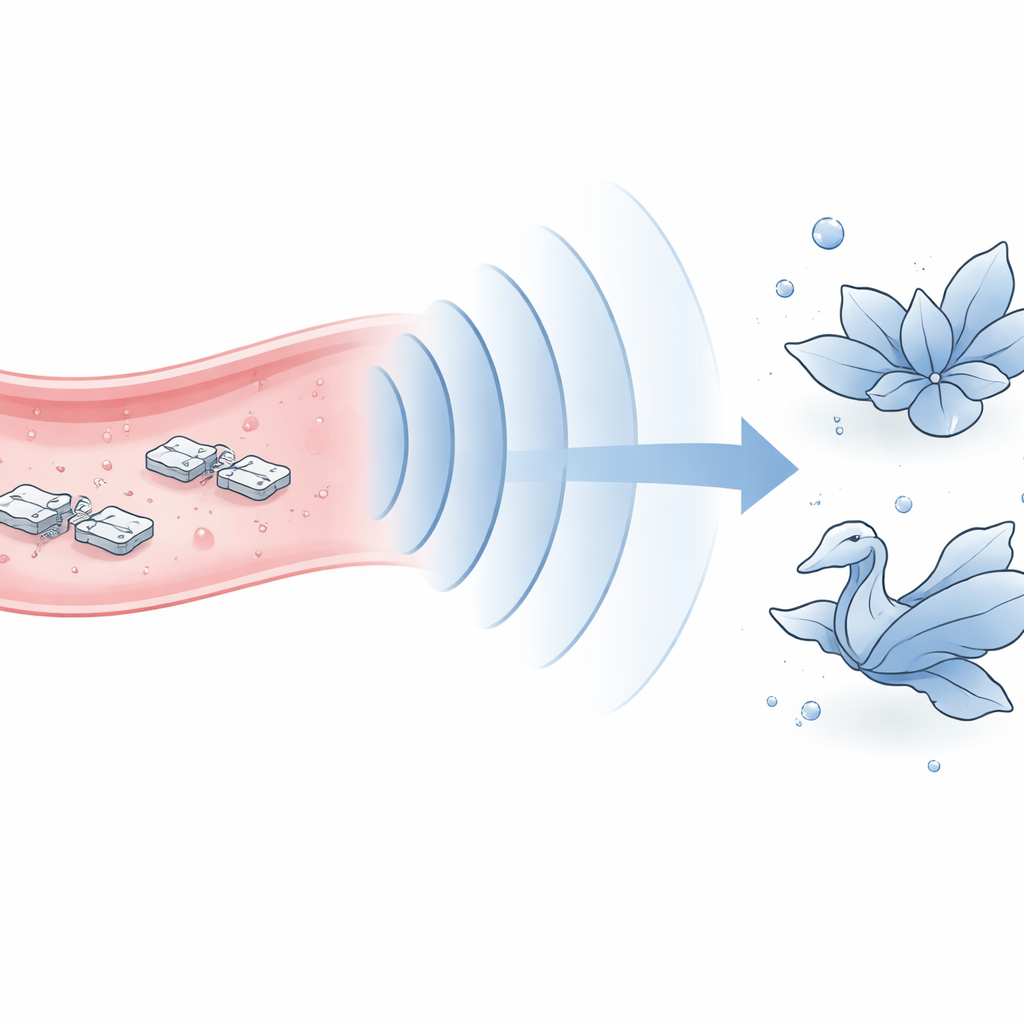
Imagine fleets of microscopic devices that can fold, curl, and bloom like flowers on command—without wires, heat, or chemicals—guided only by gentle sound waves. This study introduces just such shape-shifting micromachines, revealing how ultrasound can rapidly and reversibly reconfigure tiny structures. These advances could one day help move drugs through blood vessels, sort cells, or build smart materials that re-arrange themselves on demand.
Why Shape-Shifting Matters at Small Scales
Nature is full of living examples that survive by changing shape: pillbugs roll into protective balls, and microscopic organisms snap and contract in milliseconds to feed or flee. Engineers try to mimic this agility in soft robots, wearable devices, and medical tools. But shrinking these systems down to the width of a human hair is difficult. At such scales, friction and surface forces dominate, structures tend to be rigid and fragile, and many common shape-changing materials respond too slowly or need special environments, such as specific temperatures, light colors, or chemical conditions.
Using Sound as an Invisible Remote Control
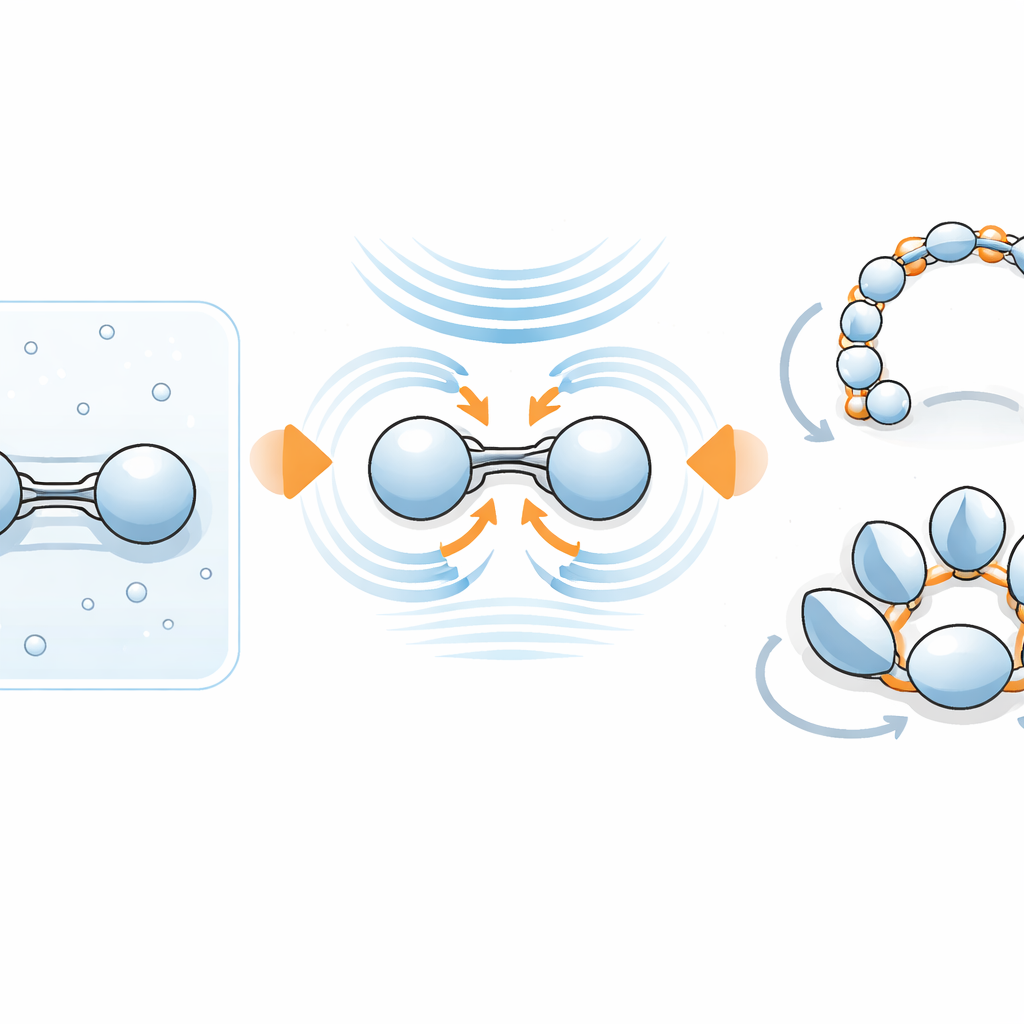
Ultrasound offers a promising alternative. It can penetrate fluids and tissues, is relatively safe, and can be generated and turned on or off with great precision. The researchers designed “acoustic shape-morphing micromachines” built from two tiny trapped bubbles linked by a soft hinge and framed by a more rigid scaffold. When an ultrasound field passes through the surrounding liquid, the bubbles pulsate and interact, pulling toward each other and bending the hinge. By changing the strength of the acoustic signal, the team can smoothly tune how far and how fast the micromachine folds, with full transformations taking only a few milliseconds and snapping back when the sound stops.
Designing Tiny Hinges That Obey a Plan
To turn a simple two-bubble unit into useful machines, the authors mapped each unit to something like a joint in a robotic arm. They systematically varied hinge length and width, showing that thinner and longer hinges bend more easily and at larger angles, whereas overly long hinges reverse behavior as fluid forces change direction. Using a standard mathematical language from robotics, they treated each module as a programmable joint with a defined rotation and position. By chaining many units together and assigning specific bending angles, they could solve both the “forward” problem (what shape results from a given pattern of joints) and the “inverse” problem (how to choose joint angles to reach a desired final outline), all in a compact, analytical way.
From Chains and Letters to Tiny Flowers and Birds
With these rules in hand, the team assembled longer structures that could transform between very different shapes. Flat chains curled into arcs, rolls, waves, and honeycomb-like patterns when exposed to ultrasound, and then relaxed back when the sound was turned off. They even encoded simple letters along a chain by assigning different target angles to different segments, effectively storing information in the way the micromachine folds. Going into three dimensions, they built a “microlotus” whose petals could rapidly open and close like a real flower, holding any intermediate position as long as the ultrasound strength was maintained and resisting small pokes from a probe. Another design, an origami-like “microbird,” reconfigured its head, wings, and tail into distinct poses analogous to flapping, taking off, turning, and hovering, all by changing how different hinge modules bent under sound.
What This Could Mean for Future Microrobots
In simple terms, this work shows how to build microscopic devices that act like tiny mechanical transformers, reshaping themselves quickly and repeatedly when bathed in ultrasound. Because sound waves travel well through liquids and soft tissue, these micromachines could eventually help steer drugs, trap particles, or adapt the behavior of soft robots deep inside the body. They could also serve as building blocks for smart materials and flexible electronics that change structure on cue. While challenges remain—such as more precise force control and scalable assembly—the study lays a clear blueprint for using sound to program shape at the microscale.
Citation: Su, X., Wang, L., Wang, Z. et al. Acoustic shape-morphing micromachines. Nat Commun 17, 2238 (2026). https://doi.org/10.1038/s41467-026-68856-9
Keywords: microrobots, ultrasound actuation, shape morphing, soft microdevices, microfluidics