Clear Sky Science · en
Facet-modulated ferroelectric polymers
Plastic That Tames Problem Electromagnetic Waves
From 5G antennas to stealthy aircraft, our world increasingly depends on materials that can control stray electromagnetic waves instead of letting them bounce around and cause interference. This study shows how a common plastic, tweaked at the atomic scale using tiny crystals, can become a powerful and tunable absorber of electromagnetic energy across a vast range of frequencies—from radio-style megahertz all the way up to futuristic terahertz bands.
Turning a Common Plastic into a Smart Material
The work centers on a well-known plastic called poly(vinylidene fluoride), or PVDF. PVDF can exist in several internal shapes, or “phases.” In its usual form (the so‑called alpha phase), the molecules are arranged so that their tiny positive and negative charges cancel out, and the material is not strongly polar. In a different arrangement (the beta phase), the same chains line up so that their charges all point in roughly the same direction. That polar beta phase can flip its internal charge under an electric field—a behavior called ferroelectricity—which is highly desirable for devices that need to sense, store, or dissipate electrical and electromagnetic energy. The catch is that the useful beta phase is normally unstable and difficult to produce uniformly in bulk plastic parts.
Using Tiny Crystal Faces as Molecular Steering Wheels
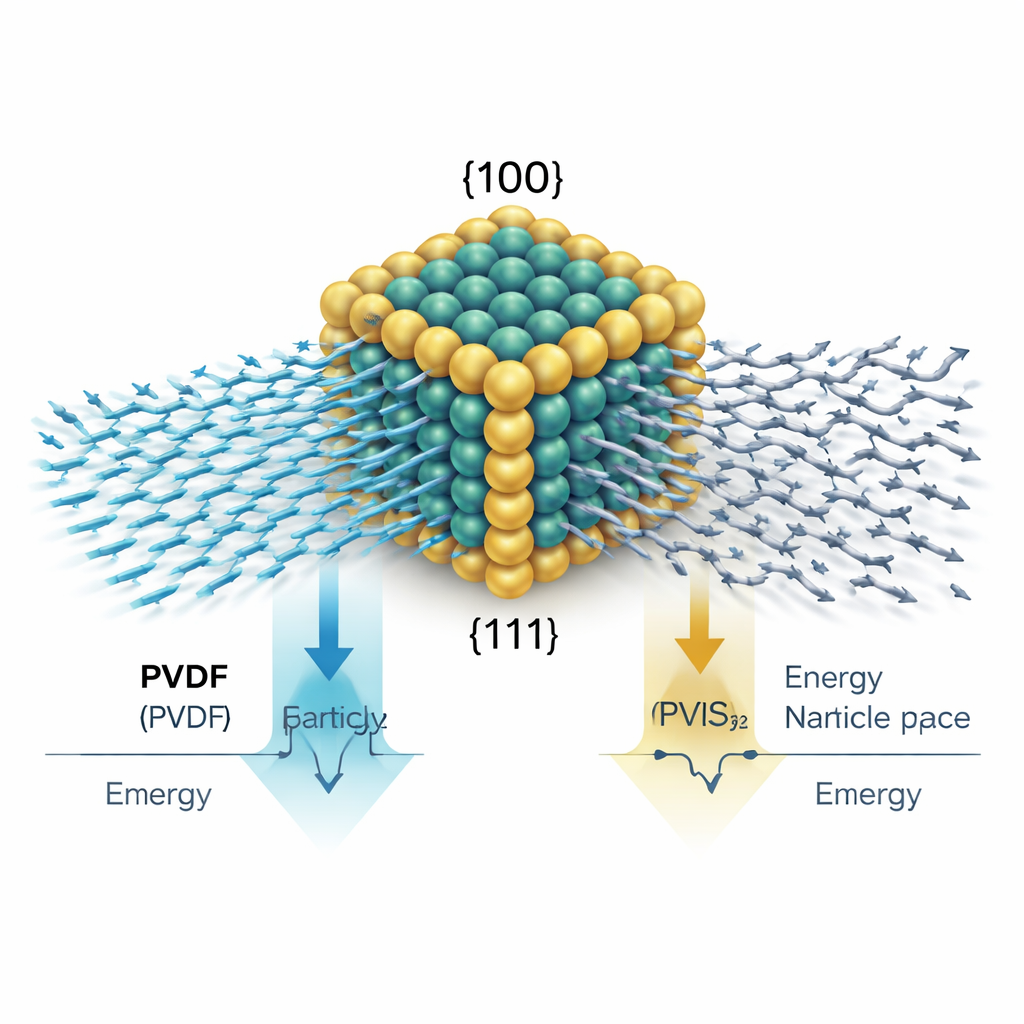
The researchers solved this stability problem by embedding nanosized particles of nickel sulfide (NiS₂) into the PVDF and carefully controlling which “faces” of the crystals are exposed. At the atomic level, different crystal faces present different arrangements of nickel and sulfur atoms and therefore interact differently with nearby polymer chains. Using advanced quantum calculations, the team showed that one specific face, called the {100} facet, binds much more strongly to the polar beta form of PVDF than to the non‑polar alpha form. That strong, highly polar surface effectively “grabs and straightens” the polymer chains, nudging them into the all‑trans beta configuration and holding them there. By contrast, another face, the {111} facet, only weakly favors the beta phase and has much less impact on the overall structure.
Seeing and Measuring the Hidden Polar Regions
To confirm that this crystal‑face steering really works, the team used a suite of microscopes and spectroscopy techniques that can map structure and electric behavior down to nanometer scales. X‑ray diffraction and infrared spectroscopy revealed that composites containing {100}‑faceted NiS₂ show a much stronger signature of the beta phase than those containing {111}‑faceted particles. High‑resolution electron microscopy visualized how PVDF chains line up differently near each type of crystal face. Atomic‑force‑based measurements then probed the local electrical response: samples rich in {100} facets displayed clear ferroelectric switching and a larger piezoelectric response, indicating that their internal dipoles can be flipped and are strongly coupled to mechanical motion. Together, these tests show that exposing the right crystal facets creates a continuous network of stable polar regions within the plastic.
Soaking Up Waves from Radio to Terahertz
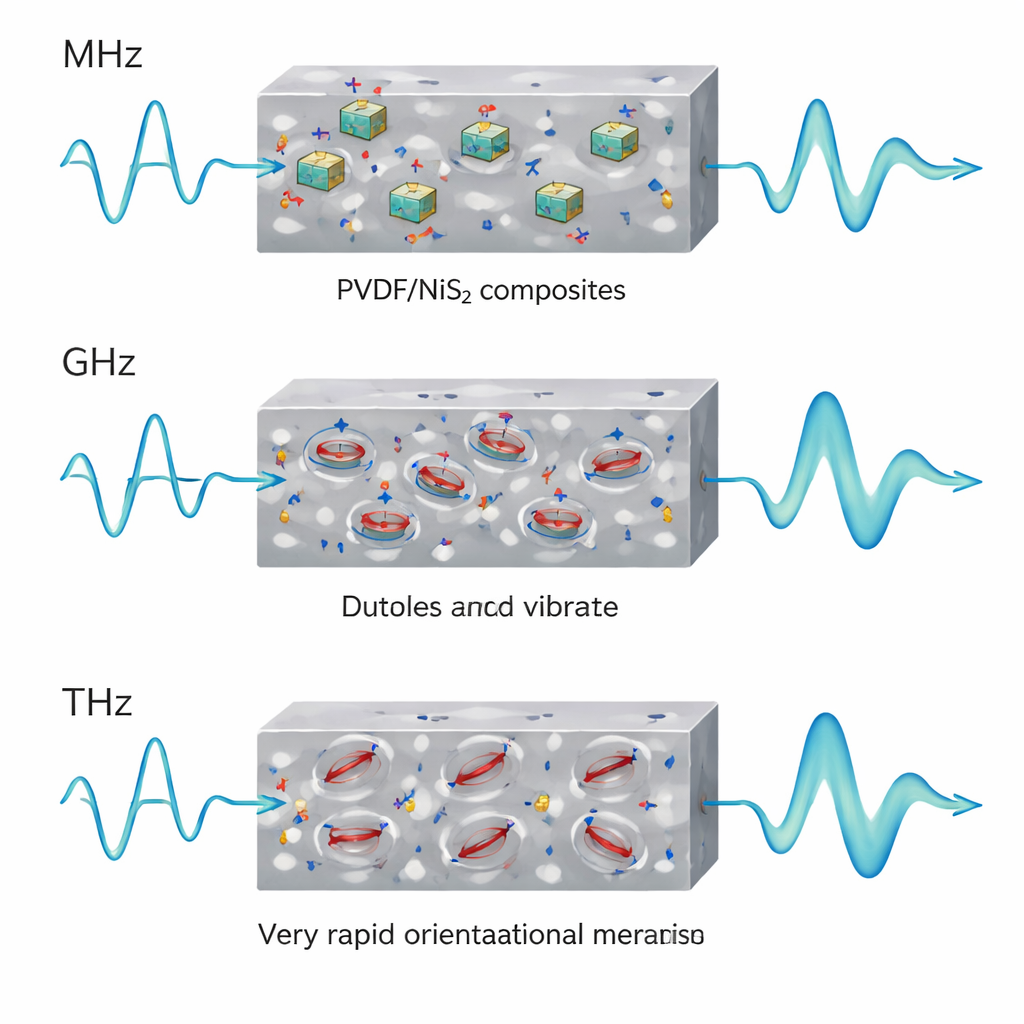
Once the polar structure was tuned, the authors asked a practical question: how well do these materials actually handle electromagnetic waves? They measured how the composites respond over an unusually broad band—from tens of kilohertz and megahertz (used in power electronics and low‑frequency communications), through gigahertz microwaves (radar and Wi‑Fi), all the way to terahertz radiation relevant for next‑generation 6G systems. In every regime, samples made with the {100} facet showed stronger “loss,” meaning they could convert incoming wave energy into harmless heat more efficiently than either pure PVDF or composites based on the {111} facet. At microwave frequencies, the best {100}‑based material absorbed incoming waves so effectively that reflections dropped by more than a billion‑fold. In the terahertz range, thin films achieved over 99.9% shielding efficiency, mostly by absorbing radiation rather than simply bouncing it away.
A New Route to Quiet, Safer Electronics
For a non‑specialist, the key message is that the researchers have found a clever, atom‑level knob for turning an everyday plastic into a versatile “electromagnetic sponge.” By choosing and designing the exposed faces of tiny inorganic crystals, they can lock PVDF into a strongly polar ferroelectric state that naturally supports several different ways of shaking and rotating its internal charges. Each of those motions is tuned to a different frequency band, so together they provide broadband absorption from MHz to THz without sacrificing efficiency. This facet‑modulated plastic could help future devices manage interference, protect sensitive electronics, and enable stealthier or more reliable communication systems, all while remaining lightweight, flexible, and relatively easy to manufacture.
Citation: Cai, B., Hou, ZL., Qi, YY. et al. Facet-modulated ferroelectric polymers. Nat Commun 17, 2065 (2026). https://doi.org/10.1038/s41467-026-68855-w
Keywords: ferroelectric polymers, PVDF composites, electromagnetic wave absorption, terahertz shielding, crystal facet engineering