Clear Sky Science · en
Highly tunable band structure in ferroelectric R-stacked bilayer WSe2
Why tiny sliding crystals matter
Imagine a light, flexible material that can remember its electronic state, switch that state with a small burst of electricity, and help host exotic phases of matter such as superconductivity. This paper explores such a platform: an ultrathin crystal made of two stacked layers of the semiconductor tungsten diselenide (WSe2). By carefully examining how light interacts with this “bilayer” at very low temperatures, the authors show how its internal electric structure can be precisely tuned—laying groundwork for ultrafast memory, quantum electronics, and new ways to control superconductivity.
Two-layer materials with a built-in switch
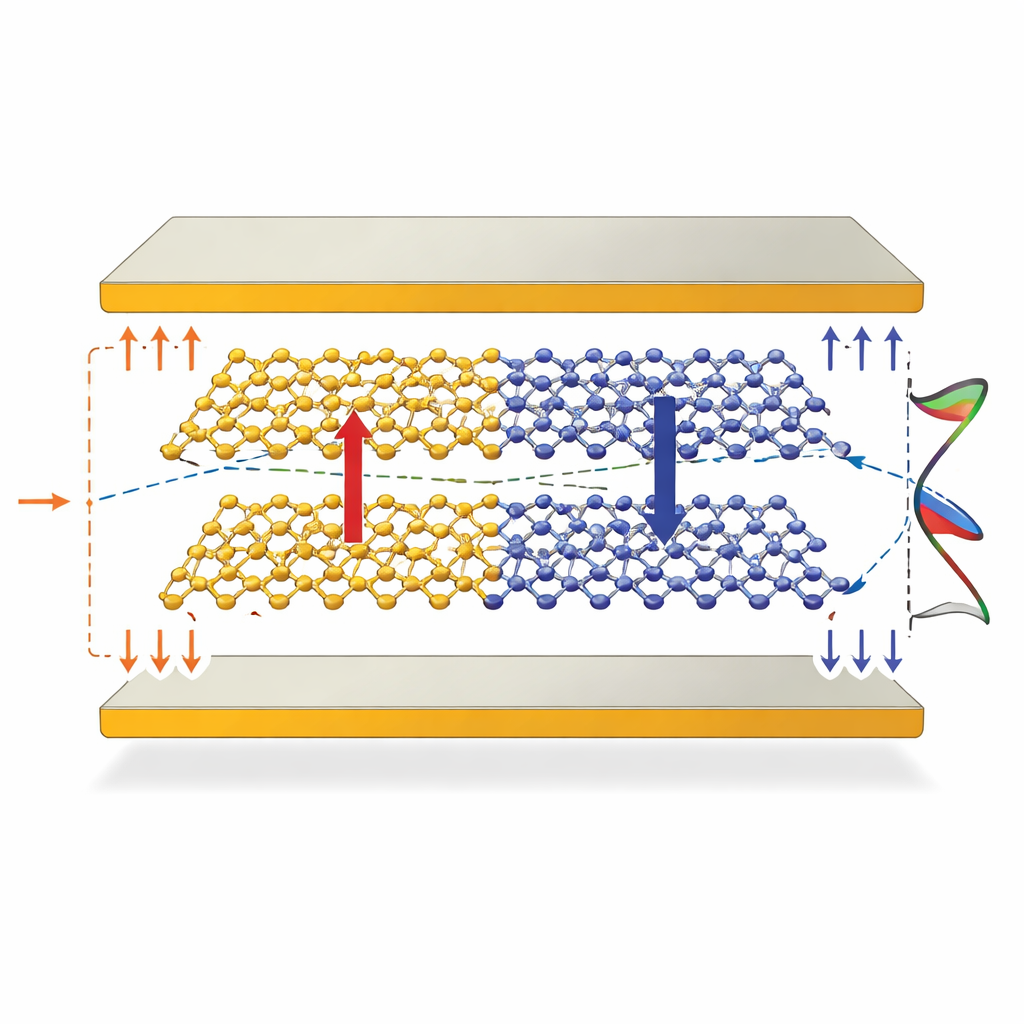
Most electronics rely on moving charges through rigid crystals. Here, the key idea is different: two atomically thin WSe2 sheets are stacked in a special “rhombohedral” pattern so that one layer is slightly slid sideways with respect to the other. This sideways shift breaks the symmetry between the layers and creates a permanent electric polarization pointing out of the plane of the sheets, a bit like a tiny built-in battery across the bilayer. Crucially, this polarization can be reversed not by pushing atoms straight up or down, but by sliding one layer laterally—a mechanism called sliding ferroelectricity. Such a switch promises fast, durable, and low-power operation compared with conventional ferroelectric materials.
Light as a window into hidden electronic structure
To uncover how this built-in polarization shapes electronic behavior, the researchers shine white light on a carefully fabricated device where the bilayer is sandwiched between insulating boron nitride and controlled by graphite gates above and below. At 4 kelvin, they measure how the reflected spectrum changes as they add electrons or holes and as they apply a vertical electric field. The response of tightly bound electron–hole pairs called excitons, and their dressed versions known as exciton-polarons, acts as a sensitive fingerprint of the underlying “band structure” — the energy landscape that electrons and holes occupy. From how the exciton resonances shift and split, the team shows that electrons and holes prefer different regions in momentum space (distinct “valleys”), confirming a so‑called type-II alignment where electrons and holes reside in different layers and valleys.
Domains that point up, domains that point down
The bilayer does not adopt a single polarization everywhere. Instead, it breaks up into large regions, or domains, where the two layers are stacked in mirror-related ways known as AB and BA. These domains have opposite built-in electric fields. By applying a small external field and watching how different exciton features brighten, dim, or hybridize, the authors provide clear optical evidence that both domain types coexist within the laser spot. In particular, they see that excitons in the two domains shift in opposite directions with field and can mix with excitons that live across the two layers, revealing a delicate balance between intralayer and interlayer states. This allows them to estimate how much the band gaps of the two layers differ and to confirm that typical samples host a patchwork of oppositely polarized regions.
Measuring and controlling the internal electric field
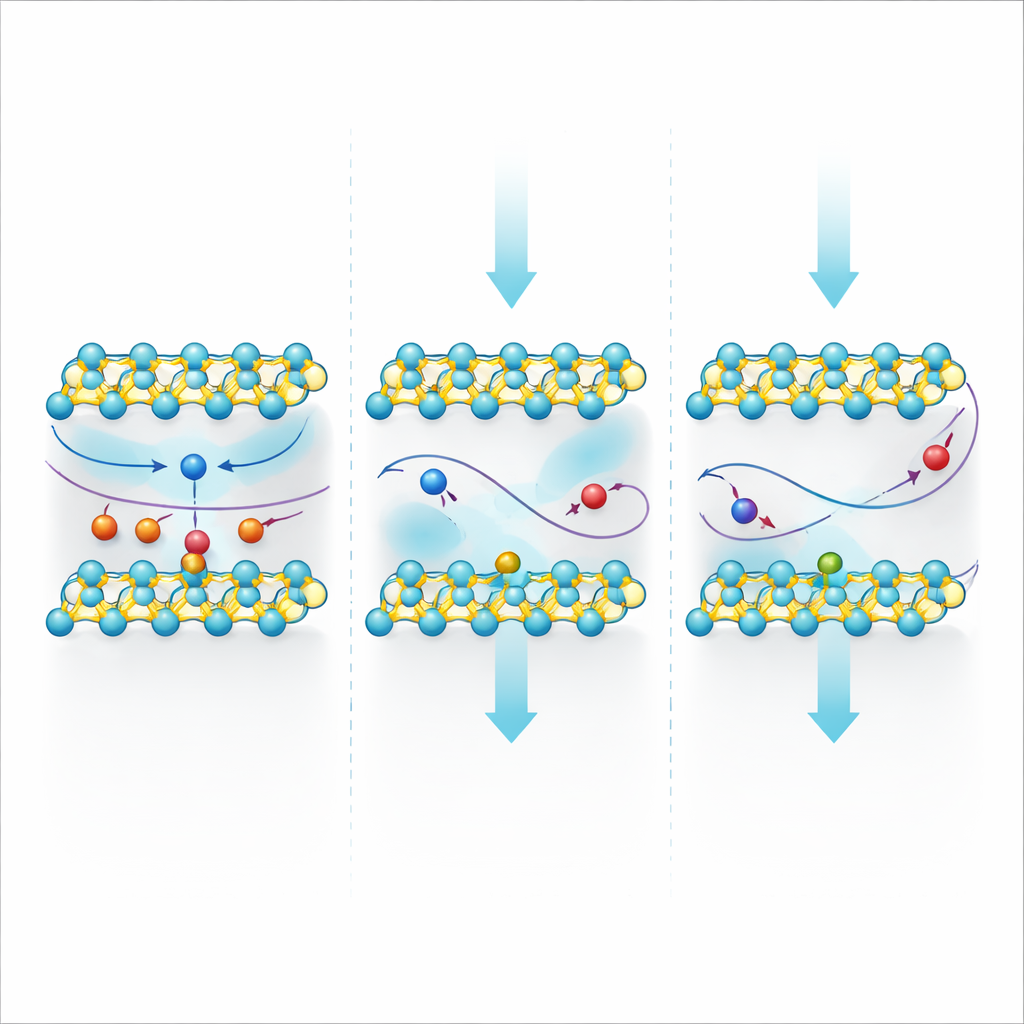
A central question is how strong the intrinsic polarization field actually is and whether it can be tuned. The team uses exciton-polarons as a built-in probe: when electrons sit closer to one layer, they interact more strongly with excitons in that layer, shifting those spectral lines more than in the other layer. By sweeping an external electric field until the shifts of two polaron species become equal, they pinpoint the field that exactly cancels the internal one. This yields a built-in field of about 0.1 volts per nanometer, corresponding to an interlayer potential difference of roughly 66 millivolts. Pushing the field further in the hole-doped regime, they observe a sudden reversal of which layer hosts the highest-energy holes—the valence band maximum—which they attribute to the ferroelectric domains themselves flipping their polarization.
From tunable bands to future devices
For non-specialists, the key message is that this two-layer WSe2 crystal behaves like a tiny, electrically reconfigurable landscape for electrons and holes. The authors extract concrete numbers for how far the energy levels of the two layers are offset and how strong the spontaneous polarization is, then show that an applied field can switch which layer is energetically favored and even reverse the domain polarity. These parameters are essential for interpreting more complex “twisted” versions of the material, where tiny rotation angles lead to moiré patterns and phenomena like superconductivity. Beyond fundamental physics, the ability to slide and switch ferroelectric domains and to steer excitons with small voltages points toward ultrafast non-volatile memories, neuromorphic elements that mimic synapses, and new optoelectronic and spin-based devices built from a single, atomically thin platform.
Citation: Li, Z., Thor, P., Kourmoulakis, G. et al. Highly tunable band structure in ferroelectric R-stacked bilayer WSe2. Nat Commun 17, 2457 (2026). https://doi.org/10.1038/s41467-026-68854-x
Keywords: ferroelectric bilayer WSe2, sliding ferroelectricity, 2D semiconductor excitons, twisted bilayer moiré, quantum optoelectronics