Clear Sky Science · en
Printed origami thermoelectric generator achieves > 20 Wm−² from low-grade heat via material and process design
Turning Waste Heat into Useful Power
Every day, our gadgets, factories, and even household heaters throw away large amounts of low‑temperature heat. This warm but not hot energy usually drifts into the air unused. The study described here shows how that lost warmth can be turned into electricity using a new kind of ultra‑thin, foldable power source. Built entirely by printing and then folding like origami, this device can deliver enough power to run small sensors and electronics without batteries, opening a path toward maintenance‑free wearables and Internet‑of‑Things devices.
Why Folded Power Sources Matter
Modern society wastes a huge share of the energy it consumes as mild heat from machines, pipes, and human bodies. Thermoelectric generators can convert a temperature difference directly into electricity, but the best versions are usually made from rigid, expensive crystals that are hard to scale up. Printing offers a cheaper, roll‑to‑roll style route, but printed materials often sacrifice performance or flexibility. The researchers set out to combine the low cost and shape‑shifting promise of printing with power levels high enough to make these generators truly useful in everyday settings.
Designing a Better Printed Material
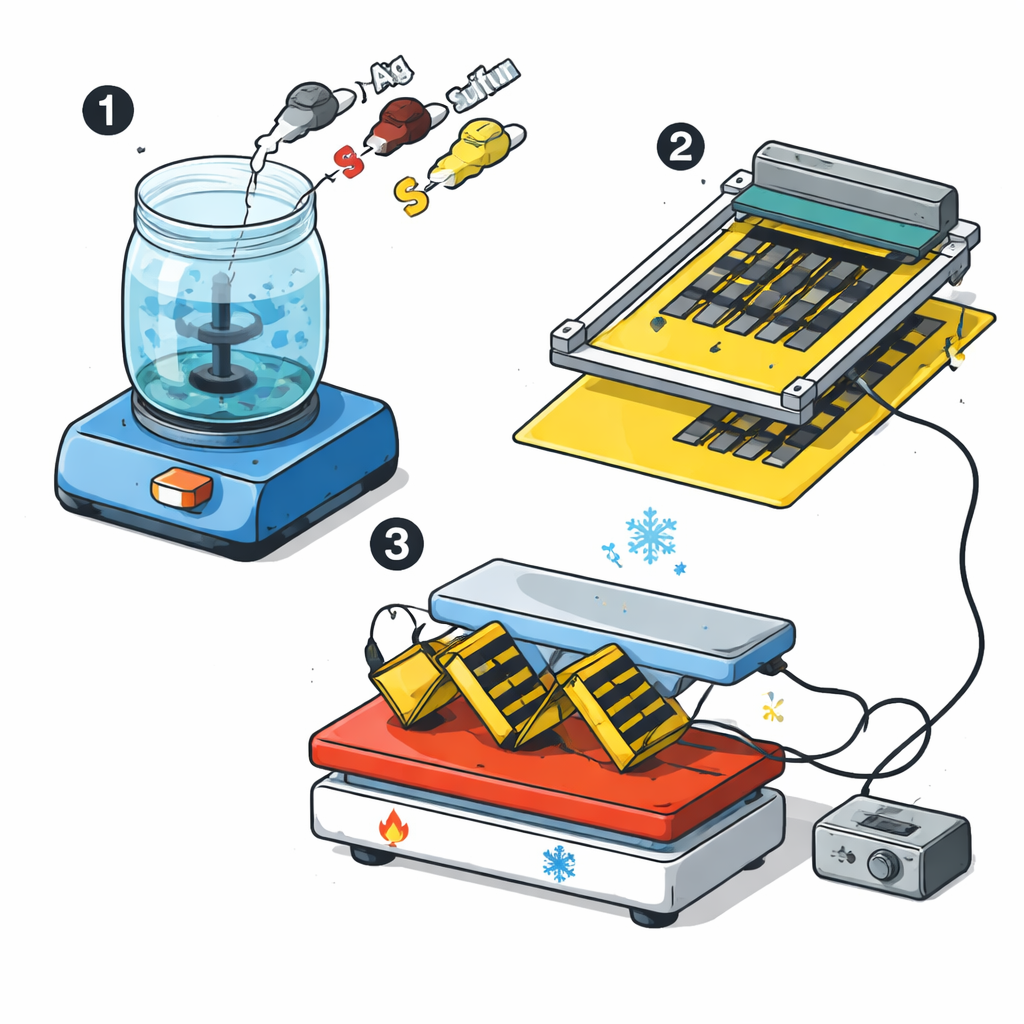
At the heart of the new device is a specially engineered thin film based on silver, selenium, and a small amount of sulfur. By tweaking the exact recipe—slightly shifting the balance of elements and swapping about 2 percent of the selenium for sulfur—the team tuned how electrons move through the film. This careful adjustment produced a material that conducts electricity very well while still producing a sizable voltage from a temperature difference. At around 90 °C (360 K), the optimized film reached a power factor roughly two‑thirds higher than the group’s earlier silver–selenium films, all while remaining flexible after being pressed into a dense, smooth layer.
Built to Bend, Twist, and Last
Because future power sources may need to wrap around pipes or live on moving bodies, mechanical toughness is crucial. The researchers printed several versions of their films on thin Kapton plastic and subjected them to repeated bending and twisting. Even when bent around small cylinders hundreds of times, the sulfur‑enhanced films showed only minor changes in electrical resistance, and they survived one thousand bend cycles without visible cracking. This durability comes from both the material design and a hot‑pressing step that compacts the printed layer, improving adhesion and reducing weak spots.
From Flat Print to Origami Generator
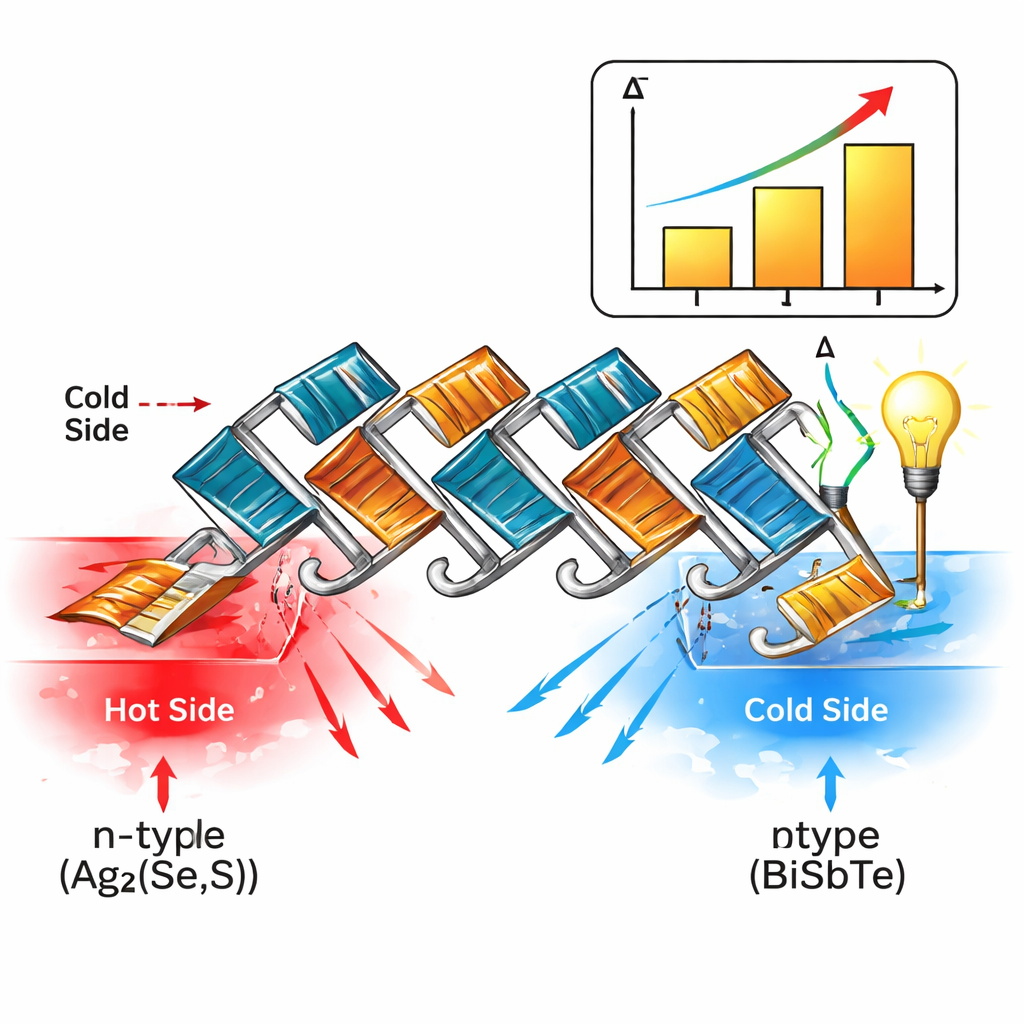
To turn the improved films into a working generator, the team printed alternating stripes of their new n‑type material and a complementary p‑type material on a flexible sheet, added carbon and silver contact layers, and then folded the whole stack into a zigzag origami shape. In this form, the thin legs bridge between a hot side and a cold side, forcing heat to flow through many junctions connected electrically in series. With a temperature difference of 80 kelvin—similar to that between a warm surface and a cool environment—the origami device produced about 0.9 milliwatts of power. That corresponds to more than 20 watts per square meter of active area and roughly 800 microwatts per gram, roughly double the power density of earlier printed origami generators.
Reliable Power for the Long Haul
For practical use, steady performance over time is as important as peak numbers. The researchers ran their printed origami module through dozens of operating cycles at different temperature differences. The device repeatedly delivered nearly the same output—within just a few percent variation—showing that the printed layers, electrical connections, and folded structure can withstand thermal and mechanical stress. Computer simulations that included the measured material properties closely matched the experimental voltages and powers, giving further confidence that the approach can be scaled and optimized.
What This Means for Everyday Technology
In simple terms, the work shows that thin, printable, and foldable sheets can be engineered to harvest low‑grade heat with record power density for printed devices. Instead of relying on batteries that must be replaced or recharged, small sensors on factory lines, in smart buildings, or even on the human body could draw their energy from gentle temperature differences using such origami generators. While more development is needed to integrate them into products, this combination of clever material chemistry, low‑cost printing, and space‑saving folding brings waste‑heat‑powered electronics a significant step closer to reality.
Citation: Luo, N., Wang, Z., Verma, A.K. et al. Printed origami thermoelectric generator achieves > 20 Wm−² from low-grade heat via material and process design. Nat Commun 17, 1259 (2026). https://doi.org/10.1038/s41467-026-68852-z
Keywords: thermoelectric generator, printed electronics, origami energy harvester, waste heat recovery, flexible power source