Clear Sky Science · en
Ultralong-range exciton transport in submillimeter-scale spherulite film of π-conjugated polymers
Why This Matters for Future Screens and Solar Cells
Light-powered technologies like phone screens, flexible displays, and solar cells all rely on tiny packets of energy called excitons that must move efficiently through thin films of organic materials. However, in most plastic-like light-emitting layers, these excitons travel only very short distances before fading away, limiting brightness and efficiency. This paper shows how a carefully designed blue-emitting polymer can self-organize into large, wheel-like crystal patterns that let excitons travel almost twenty times farther than in typical films, opening new possibilities for sharper, brighter, and more energy-efficient devices.
Shaping Plastic into Giant Crystal Wheels
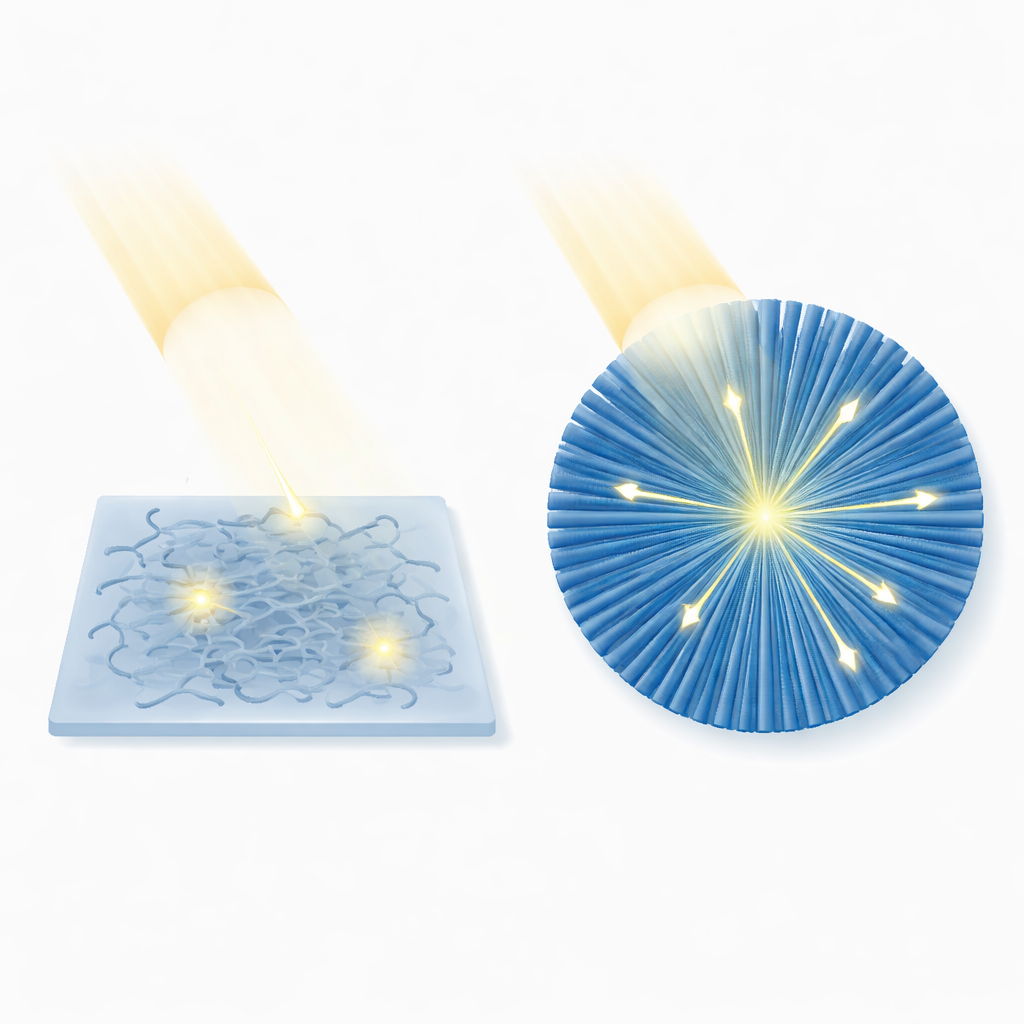
The researchers start with a family of light-emitting plastics known as π-conjugated polymers, which are easy to process from solution like inks. Normally, when these polymers are spin-coated into thin films, their long chains tangle and pack in a disordered fashion. This disorder creates many low-energy “trap” sites where excitons get stuck and die out, severely limiting how far they can spread. To overcome this, the team modifies the side chains of a polydiarylfluorene polymer so that, under gentle solvent vapor annealing, the material no longer forms a uniform, glassy film. Instead, it grows into large circular patterns called spherulites—crystal structures made of radially arranged nanofibers that can span hundreds of micrometers across a substrate.
Building a Highway for Energy Flow
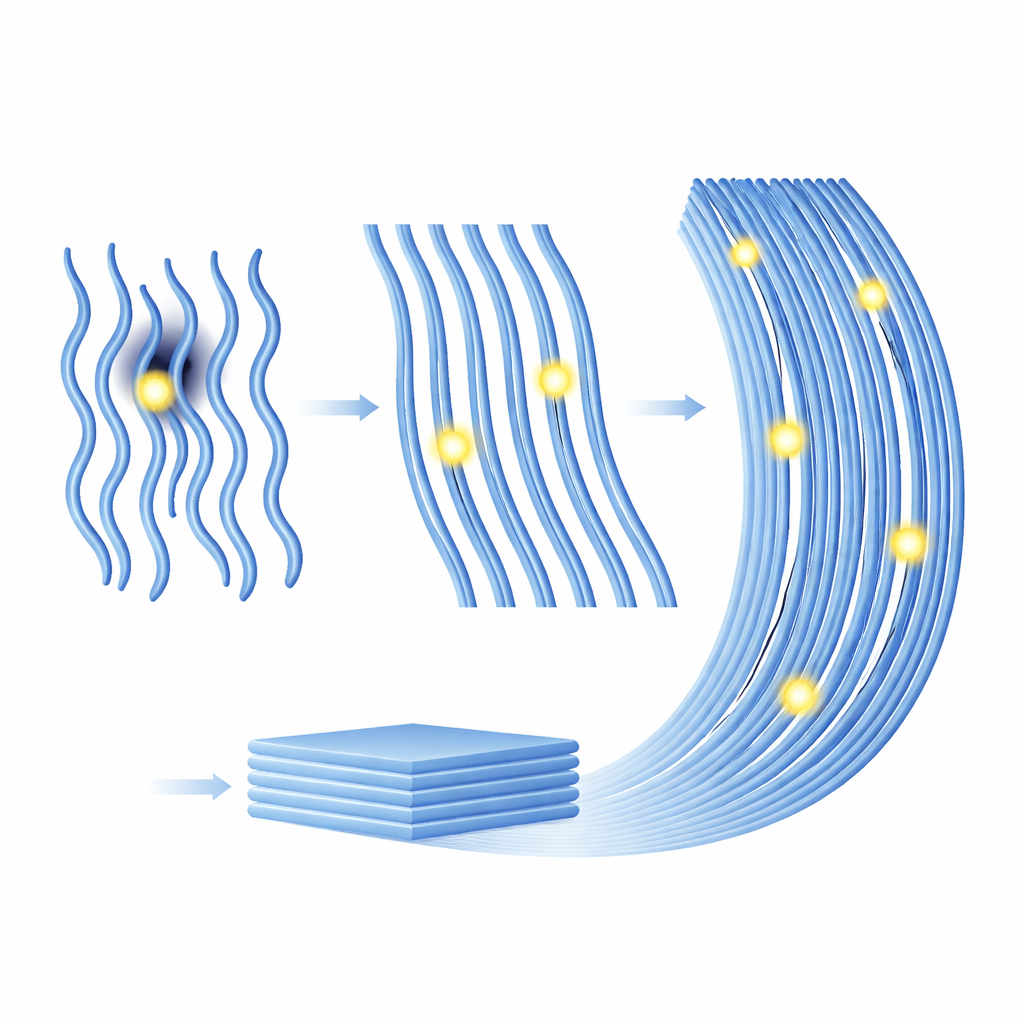
Using a suite of imaging and diffraction techniques, the team reveals how these spherulites are built from the bottom up. Atomic force, electron microscopy, and X-ray scattering show that each spherulite consists of dense bundles of nanofibers, with polymer chains neatly folded and aligned along the growth direction. The distances between chains and between repeating units along the backbone are highly regular, and the film exhibits clear crystalline signatures rather than a random arrangement. This long-range order smooths out the energy landscape, reducing variations that would otherwise scatter or trap excitons. In essence, the spherulite converts a rough terrain into a well-paved highway, where energy can move more freely along tightly packed, directionally aligned chains.
Watching Excitons Travel Much Farther
To directly track how excitons move, the researchers use transient photoluminescence microscopy, which creates a tiny excited spot in the film and then watches how the glowing region spreads out over time. From these movies, they calculate how quickly excitons diffuse and how far they travel before recombining. In the spherulite films, the average exciton diffusion length reaches about 186 nanometers, with maximum values up to roughly 396 nanometers—record-high distances for solution-processed polymer films, and comparable to some carefully grown nanofibers and single crystals. Diffusion coefficients are similarly enhanced, reaching up to about 0.63 square centimeters per second. Complementary measurements show that radiative emission is faster, non-radiative losses are lower, and trap-related “tail” states in the energy spectrum are significantly reduced in the spherulite films compared with ordinary spin-coated films.
Turning Better Transport into Better Devices
To test whether this structural order and improved energy transport actually matter in real devices, the team builds deep-blue polymer light-emitting diodes using either standard amorphous films or the new spherulite films as the emitting layer. Both devices emit similar blue colors, but the spherulite-based diodes show narrower spectra and purer color, along with higher brightness and efficiency. The peak external quantum efficiency and current efficiency improve by around 30–40 percent, and the maximum brightness reaches nearly 4900 candela per square meter at relatively low current density. Transient electroluminescence measurements indicate that, in the ordered films, fewer carriers are lost to defects and excitons can recombine more effectively over longer distances, avoiding local congestion and annihilation that plague disordered films.
What This Means for Everyday Technology
Overall, the study demonstrates that coaxing a solution-processed polymer into large, well-ordered spherulites can dramatically extend how far excitons travel, while at the same time improving the brightness and color purity of blue light-emitting devices. For a layperson, this means that by carefully controlling how plastic-like materials crystallize, scientists can turn them into efficient energy-transport networks, much like upgrading a city from winding side streets to a connected highway system. This strategy could help future displays, lighting panels, and perhaps even organic solar cells become more efficient, more colorful, and easier to manufacture over large areas.
Citation: Sun, L., Yuan, Y., Xu, Y. et al. Ultralong-range exciton transport in submillimeter-scale spherulite film of π-conjugated polymers. Nat Commun 17, 2094 (2026). https://doi.org/10.1038/s41467-026-68849-8
Keywords: exciton transport, conjugated polymers, spherulite crystals, polymer light-emitting diodes, organic optoelectronics