Clear Sky Science · en
Single-crystalline BaxSr1-xTaO2N solid-solution photocatalyst with low defect concentrations for solar-driven water splitting
Turning Sunlight and Water into Fuel
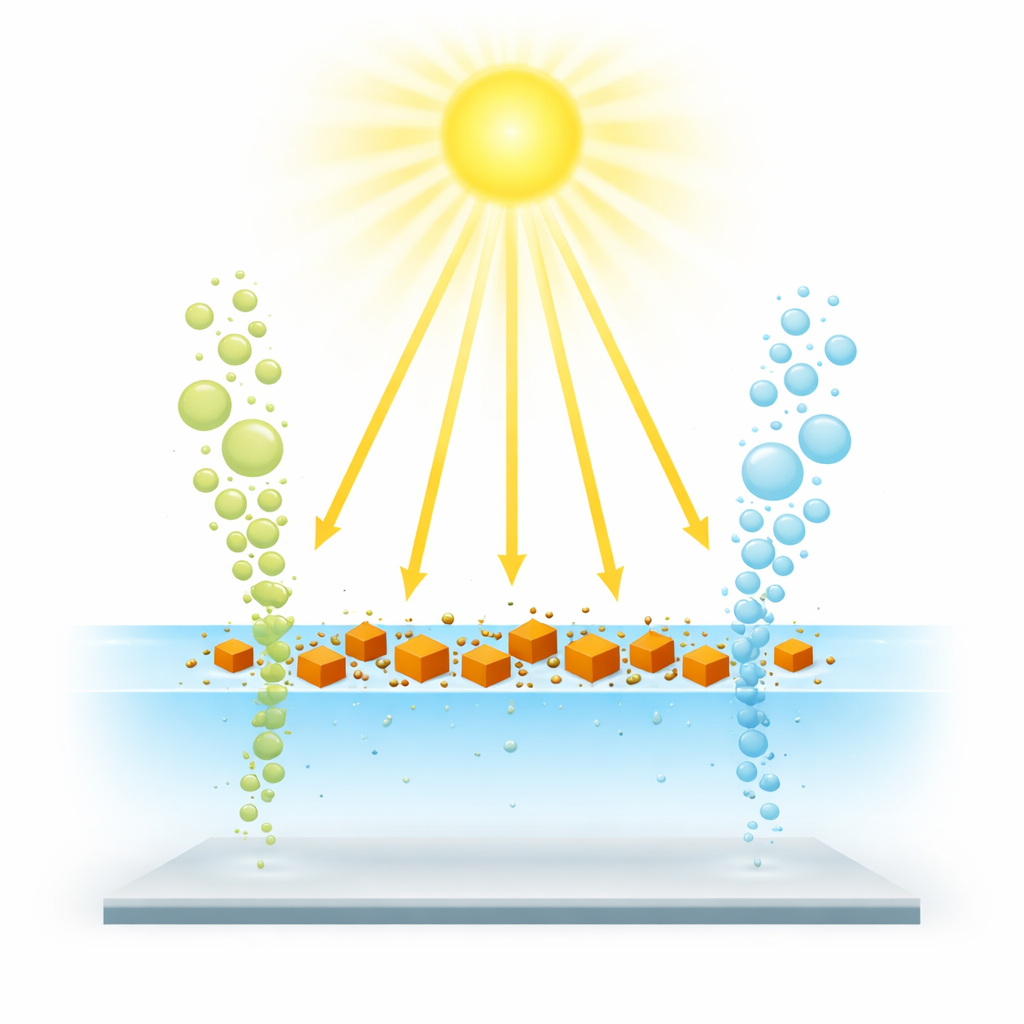
Imagine making clean fuel from nothing more than sunlight and water, with no smokestacks, no carbon emissions, and no moving parts. That is the promise of photocatalysts—special materials that can split water into hydrogen and oxygen when illuminated. This paper reports a new kind of tiny crystal that makes this reaction far more efficient under visible light, nudging solar-made hydrogen a step closer to practical reality.
Why Splitting Water with Light Is Hard
To split water using sunlight, a material must absorb light, pull apart charges inside itself, and then use those charges to drive two separate reactions: one that releases hydrogen gas and another that releases oxygen gas. Many known photocatalysts only work under harsh ultraviolet light, wasting most of the solar spectrum. Others can use visible light but are riddled with internal flaws that act like tiny potholes for charges, causing them to crash into each other and disappear as heat before they can make fuel. Finding a visible-light material with few such defects is one of the central challenges in turning water splitting into a practical energy technology.
A New Blend of Atoms for Better Light Harvesting
The researchers focused on a family of materials called tantalum-based oxynitride perovskites, which absorb visible light up to about 600 nanometers and have energy levels well matched to splitting water. They created a solid solution—a controlled mixture—of two known compounds, BaTaO2N and SrTaO2N, to form a new material called BaxSr1−xTaO2N (shortened here to BSTON). By carefully tuning the ratio of barium to strontium and the starting ingredients, they produced nanosized, single-crystalline particles about 50 nanometers across. These particles have a nearly ideal crystal geometry with minimal lattice distortion, which makes it easier for electrons and holes to move without getting trapped.
Smart Chemistry to Reduce Hidden Flaws
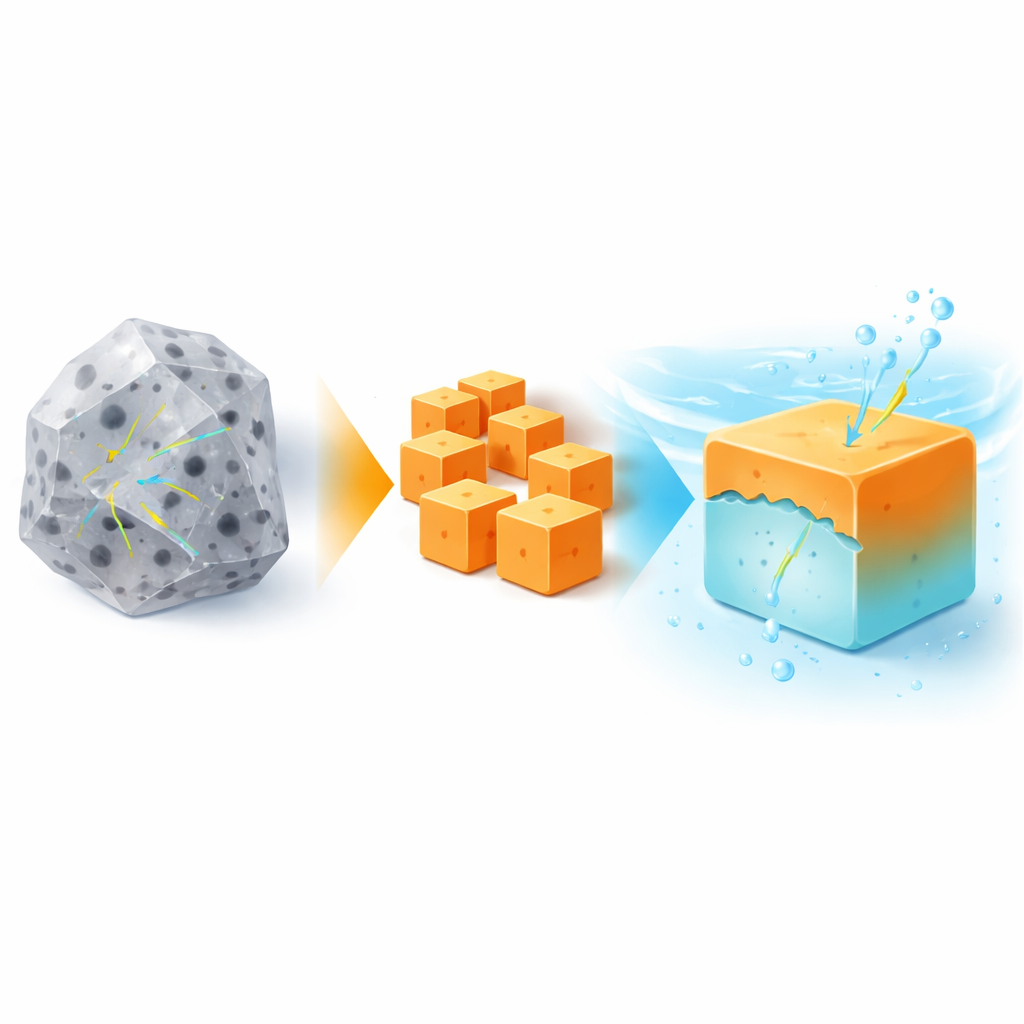
Crucially, the team changed how the material was made. Instead of starting only from an oxide, which must be heavily altered in a hot nitrogen-rich atmosphere, they used a mix of two tantalum compounds: TaS2 and Ta3N5. The layered TaS2 helped the formation of very small crystals, while the nitrogen-containing Ta3N5 reduced the structural upheaval that usually creates defects during nitridation. Microscopy and spectroscopic measurements showed that in the optimized version, BSTON(TN0.2), the barium and strontium atoms are evenly distributed and the crystal is highly ordered. Sensitive optical tests revealed that this version has fewer electronic states in the bandgap—signatures of fewer internal defects—compared with material made without Ta3N5.
Balancing Hydrogen and Oxygen Reactions
These structural improvements translated into striking performance gains. When decorated with tiny platinum and chromium oxide particles, the optimized BSTON produced hydrogen from water containing a sacrificial agent with an apparent quantum yield of 13.5% at 420 nanometers—among the best reported for this class of oxynitrides. When loaded with a cobalt oxide cocatalyst and subjected to a high-temperature treatment in hydrogen, it produced oxygen with a quantum yield of 25.9% at the same wavelength. Interestingly, the heat treatment that activates oxygen production tends to reduce hydrogen production, and vice versa. Detailed measurements of how light-generated charges decay over time revealed why: high-temperature treatment creates a special “tail” of shallow trap states near the surface that temporarily hold holes and guide them toward the oxygen-forming reaction, while leaving the bulk of the crystal largely unchanged.
What Surface States Do Behind the Scenes
The team used advanced ultrafast optical techniques and modeling to show that these surface traps behave like controlled stepping-stones for holes. In the as-made material, electrons and holes mainly recombine directly, limiting both reactions. After strong heat treatment, the new surface states slow certain recombination pathways and extend the lifetime of holes near the surface, making them more available to drive the oxygen-forming half-reaction. Because the particles are so small—comparable to how far a hole can travel before vanishing—the details of what happens at the surface largely determine how much gas is produced.
Steps Toward Practical Solar Hydrogen
In everyday terms, this study shows how “tidying up” the interior of a light-absorbing crystal while “redecorating” its surface can dramatically boost its ability to turn sunlight and water into fuel. The new BSTON material does not yet perform overall water splitting in a single step, but its record-level efficiencies for the separate hydrogen and oxygen reactions, under visible light, are a major step forward. With better placement and design of helper catalysts and further reductions in remaining defects, the authors argue that these solid-solution perovskites could one day underpin robust, scalable systems that generate clean hydrogen fuel directly from sunlight.
Citation: Wang, F., Nakabayashi, M., Nandal, V. et al. Single-crystalline BaxSr1-xTaO2N solid-solution photocatalyst with low defect concentrations for solar-driven water splitting. Nat Commun 17, 2341 (2026). https://doi.org/10.1038/s41467-026-68848-9
Keywords: solar water splitting, photocatalyst, perovskite oxynitride, hydrogen production, surface defects