Clear Sky Science · en
The representation of omitted sounds in the mouse auditory cortex
When silence speaks in the brain
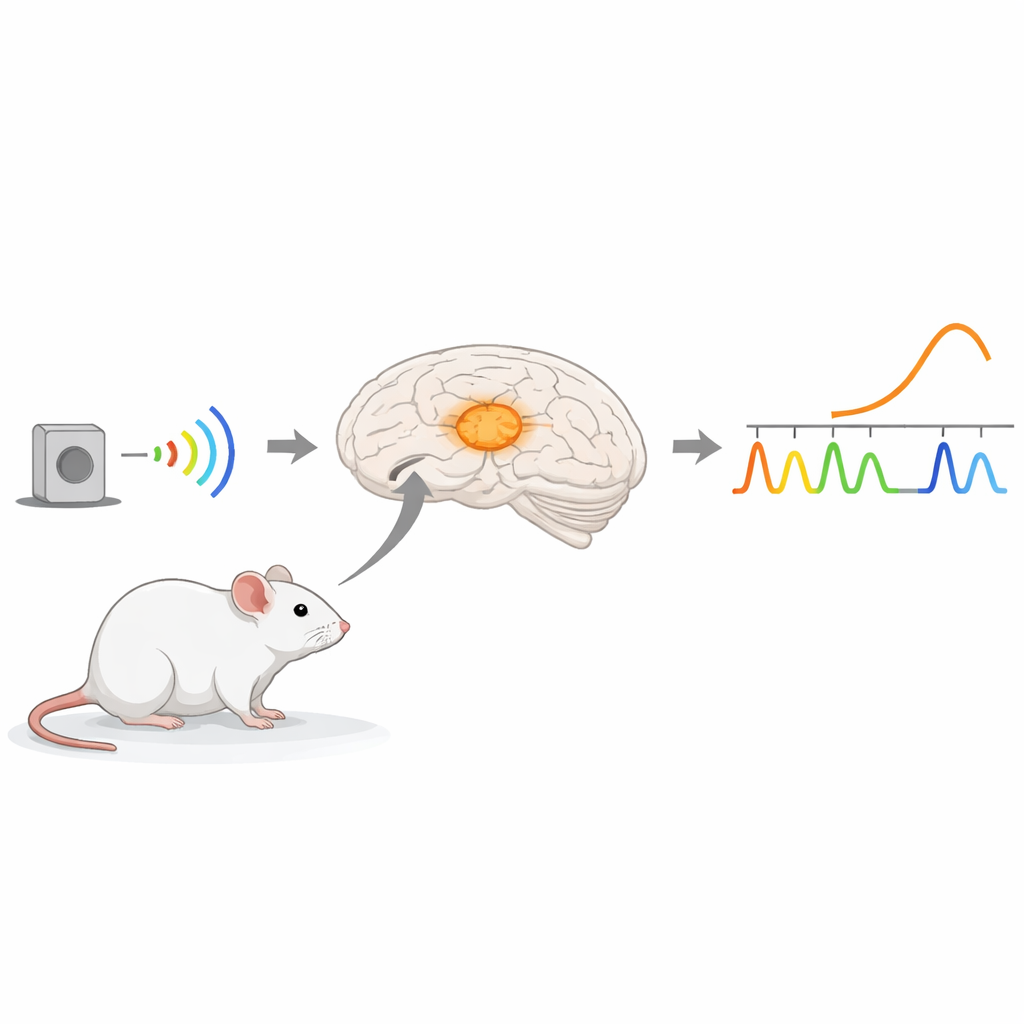
Imagine listening to a steady beat of drum hits and suddenly one is skipped. Even without any sound, you feel that missing beat. This study asks how the brain of a mouse, and by extension our own, reacts when an expected sound does not arrive. By watching thousands of neurons in real time, the researchers discovered that a specific area of the auditory cortex becomes highly active not when a sound occurs, but when a sound should have occurred and is absent.
The brain’s habit of predicting the world
The sensory world is full of patterns: footsteps on stairs, syllables in speech, notes in music. Brains use these regularities to predict what will happen next and to respond more quickly and accurately. In hearing research, this predictive ability has been studied using odd “deviant” sounds that break a pattern. However, such designs make it hard to separate the brain’s prediction from the response to the actual sound. A cleaner test is to establish a highly regular sequence of sounds and occasionally omit one. In that case, there is no incoming sound; any response in the brain must come from its expectation.
Listening for the missing click
The researchers played long, precisely timed sequences of identical soft sounds to awake, head-fixed mice. Every 200 milliseconds a tone or brief noise was presented, and on a subset of trials a sound was left out without warning. While this happened, the team used fast calcium imaging to monitor the activity of neurons across the entire auditory cortex and down through its layers. They also filmed the mouse’s face and eye with infrared cameras to track pupil size and tiny whisker movements, providing a behavioral readout of whether the animal detected that something in the sequence had changed.
A special patch for missing sounds
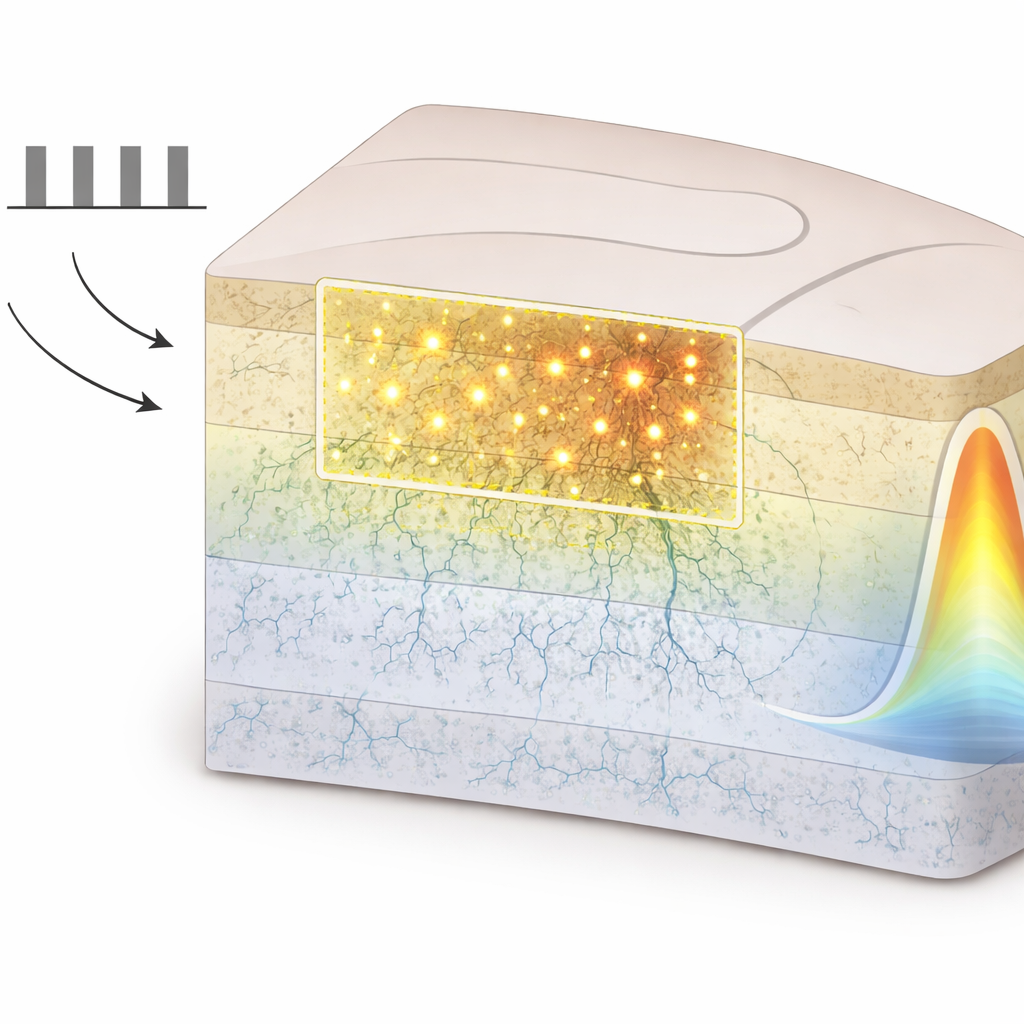
Surprisingly, the strongest responses to these omissions did not appear in the primary sound-processing regions, where ordinary tone responses are large. Instead, they were concentrated in a higher-order area called the temporal association area, especially in its posterior and medial portions. In this “omission-responsive region,” neurons fired weakly to the repeated sounds but showed a strong, gradual rise in activity starting exactly when the missing sound should have begun and continuing until the next sound arrived. When two sounds in a row were omitted, the activity rose again at the time of the second gap, showing that this was not merely a lingering response to sound offset but a genuine reaction to violated expectations. The response was strongest in upper and middle layers of this region and weaker in deeper layers, hinting at a specialized microcircuit for handling predictions.
Silence that changes behavior
Even though the mice were not trained to perform any task, their bodies betrayed that they noticed the missing sounds. The pupils widened shortly after an omission, a classic sign of heightened arousal, and this change began before the next sound, indicating that it was linked to the gap itself. Whisker and facial movements, which normally show brief bursts following each sound, also shifted: after an omission, the next sounds evoked bigger movements, and this adaptation depended on how many sounds had occurred beforehand. Neural responses in the omission-responsive region mirrored these changes more strongly than those in primary areas, tying the specialized omission signal to the animal’s monitoring of recent sound statistics.
Beyond simple prediction errors
The team tested whether the omission signal could be explained by simpler mechanisms such as responses to sound offset, fatigue from repetition, or rhythmic entrainment to the sound sequence. By comparing different timing patterns, inserting pairs of omissions, and altering the regularity of the sequence, they found that none of these alternatives fit the data. The omission response had a distinct shape, location, and sensitivity to temporal structure. Interestingly, when the timing of sounds was jittered, the omission response shrank but did not vanish, showing that it depends on how regular the sequence is, but also on longer-term experience of that regularity.
What this means for how the brain predicts
Classic theories of predictive coding suggest that the brain separately represents predictions and the errors when reality does not match them, and that these signals should be brief and tied to the expected duration of a stimulus. Here, omission responses were positive and ramping, outlasting the short sounds that were missing, and were concentrated in a specific higher-order area and its upper layers. This pattern is more consistent with the brain building up an integrated measure of how much reality diverges from its expectations over time, rather than simply signaling a momentary prediction error. In other words, a tiny gap in a sound sequence reveals a specialized circuit that “listens” for silence, accumulates evidence that something is wrong, and feeds this information forward to guide behavior.
Citation: Peters, J., Cai, Z., van Veghel, M. et al. The representation of omitted sounds in the mouse auditory cortex. Nat Commun 17, 2107 (2026). https://doi.org/10.1038/s41467-026-68847-w
Keywords: auditory prediction, omission response, mouse auditory cortex, predictive processing, temporal association area