Clear Sky Science · en
Orbital exchange-mediated current control of magnetism
Why moving electrons can flip tiny magnets
Modern technologies—from computer memory to tiny sensors—rely on the ability to flip and steer magnetism quickly and efficiently. Today’s devices mostly do this by pushing the spins of electrons around with electric currents. This paper reveals that another, often overlooked property of electrons—their orbital motion around atoms—can be used even more powerfully to control magnetism. By harnessing this “orbital” behavior, the authors show a new route to faster, more versatile, and more energy‑efficient magnetic devices.
From spinning tops to orbiting paths
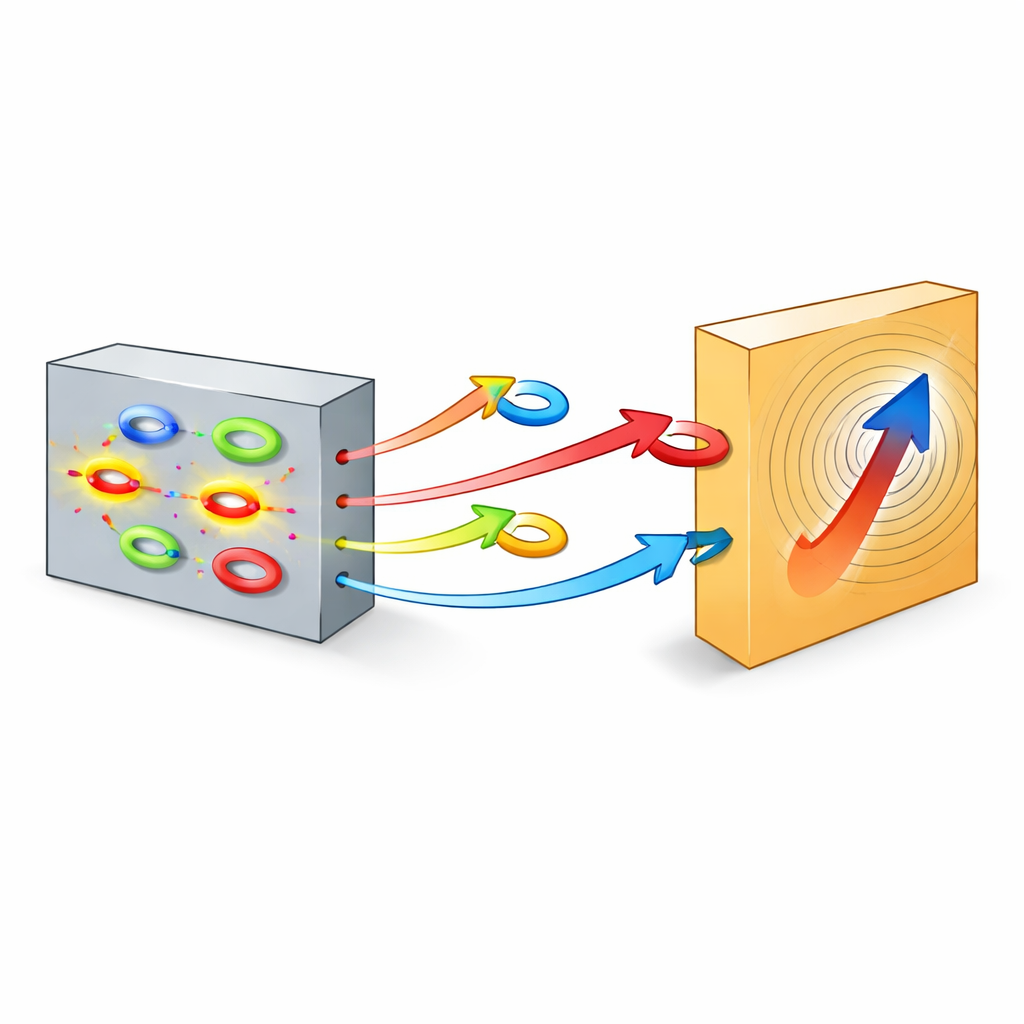
Electrons carry two key forms of angular momentum. Spin is like a tiny bar magnet pointing up or down; orbit is the path electrons trace around an atom, which also carries a kind of magnetic moment. For decades, research on current‑controlled magnetism has focused almost entirely on spin: use a current to send spin into a magnet and you can switch or tilt its magnetic direction. Recently, experiments have shown that currents can also push orbital motion sideways, in effects called the orbital Hall and orbital Edelstein effects. But these findings were still interpreted as ultimately acting through spin. The new work breaks from this view and asks: what if orbital motion itself directly talks to the magnet, without going through spin first?
A new way for currents to talk to magnets
The authors build a theoretical framework where moving electrons exchange their orbital motion directly with localized electrons inside a magnet through what they call orbital exchange interactions. They include not just the usual orbital angular momentum (how much the electron “whirls”) but also orbital angular position (how the shape of the orbital is oriented in space). When a current flows in a neighboring metal, it generates nonequilibrium orbital patterns—flows and distortions of these orbitals—that leak into the magnet. Through orbital exchange, these patterns produce torques on the magnet’s internal moments and also change the basic “rules” that govern how the magnet responds to fields and motion.
Tuning magnetic stiffness, friction, and timing
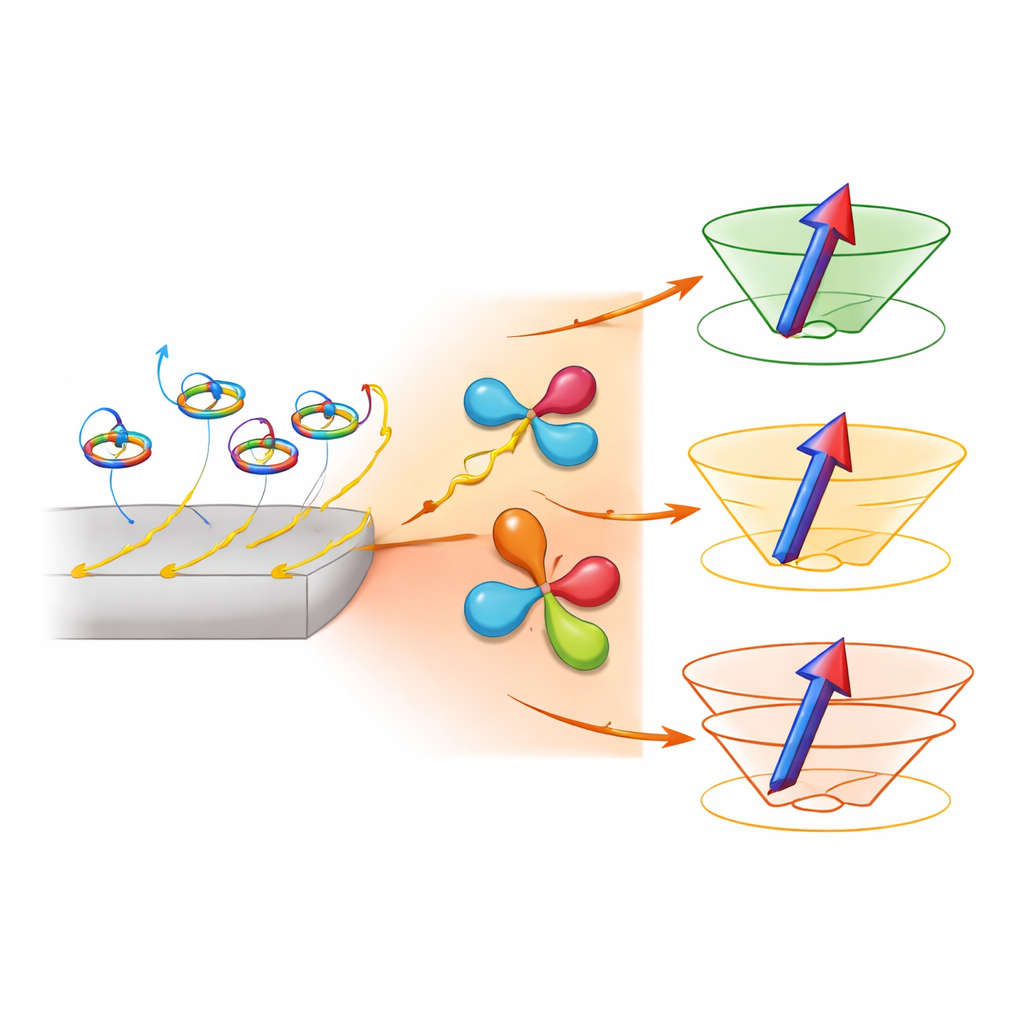
In standard pictures, a magnet’s behavior is set by three key ingredients: anisotropy (which directions the magnet prefers), damping (how quickly it loses energy and comes to rest), and the gyromagnetic ratio (how fast it precesses when nudged). Using a minimal model that still captures the essential physics, the authors show that orbital exchange lets an electric current adjust all three. Current‑driven orbital densities can tilt or reshape the magnet’s anisotropy, making some directions easier or harder to align with. They can modify the effective damping, changing how sharply magnetic motion is damped, and even tweak the precession rate itself. On top of that, orbital exchange generates its own damping‑like and field‑like torques, providing new handles to drive or steady magnetization dynamics.
Why orbital control can beat spin control
To judge how important this route might be in real materials, the authors estimate the strength of orbital‑exchange effects and compare them to conventional spin‑based mechanisms. Using known values from transition‑metal magnets, they find that orbital exchange is not a tiny correction: its strength is comparable to, or even larger than, that of spin exchange. Combined with the fact that orbital currents and orbital accumulations are often significantly stronger than their spin counterparts, the analysis suggests that orbital‑mediated control can dominate how currents influence magnetism. This means that many experiments previously interpreted in terms of spin alone may in fact be strongly shaped by orbital physics.
How to spot orbital control in the lab
The theory also offers clear experimental tests. In harmonic Hall measurements, where a current and a magnetic field are applied while monitoring a Hall voltage, orbital exchange predicts characteristic changes in how the signal varies with field strength and direction; these allow researchers to separate orbital‑driven anisotropy changes from conventional torques. In spin‑torque ferromagnetic resonance experiments, where a microwave current excites the magnet and its resonance is tracked, orbital exchange should shift the resonance frequency and linewidth in ways that differ from spin‑based effects, even when the magnetization has no component along some symmetry directions. Together, these signatures provide practical ways to quantify orbital‑exchange‑mediated control in real devices.
What this means for future magnetic technologies
By elevating orbital motion to a central player, this work broadens the toolkit for electrically controlling magnetism. It suggests that materials with strong orbital responses—not just traditional magnets governed by spin—could be engineered to achieve efficient switching, tunable damping, and new kinds of magnetic behavior. The ideas also extend naturally to more exotic systems where complex orbital or multipolar orders dominate. In short, the paper argues that the paths electrons take around atoms are not just spectators to spin physics, but powerful levers for shaping the magnets of future technologies.
Citation: Lee, GH., Kim, KW. & Lee, KJ. Orbital exchange-mediated current control of magnetism. Nat Commun 17, 2236 (2026). https://doi.org/10.1038/s41467-026-68846-x
Keywords: orbital magnetism, current-induced torques, spintronics, magnetic anisotropy, orbital Hall effect