Clear Sky Science · en
Tunable chiral and nematic states in the triple-Q antiferromagnet Co1/3TaS2
Magnetism with a Hidden Twist
Magnetic materials usually bring to mind simple bar magnets that point north or south. But inside many crystals, the tiny atomic magnets can arrange themselves in far more intricate patterns. This study explores such hidden order in a layered material called Co1/3TaS2, revealing how its internal magnets can be smoothly tuned between different states that break symmetry in unusual ways. These states could underpin future low-power electronics that rely on the orientation and topology of spins rather than electric charge alone.
Why This Crystal is Special
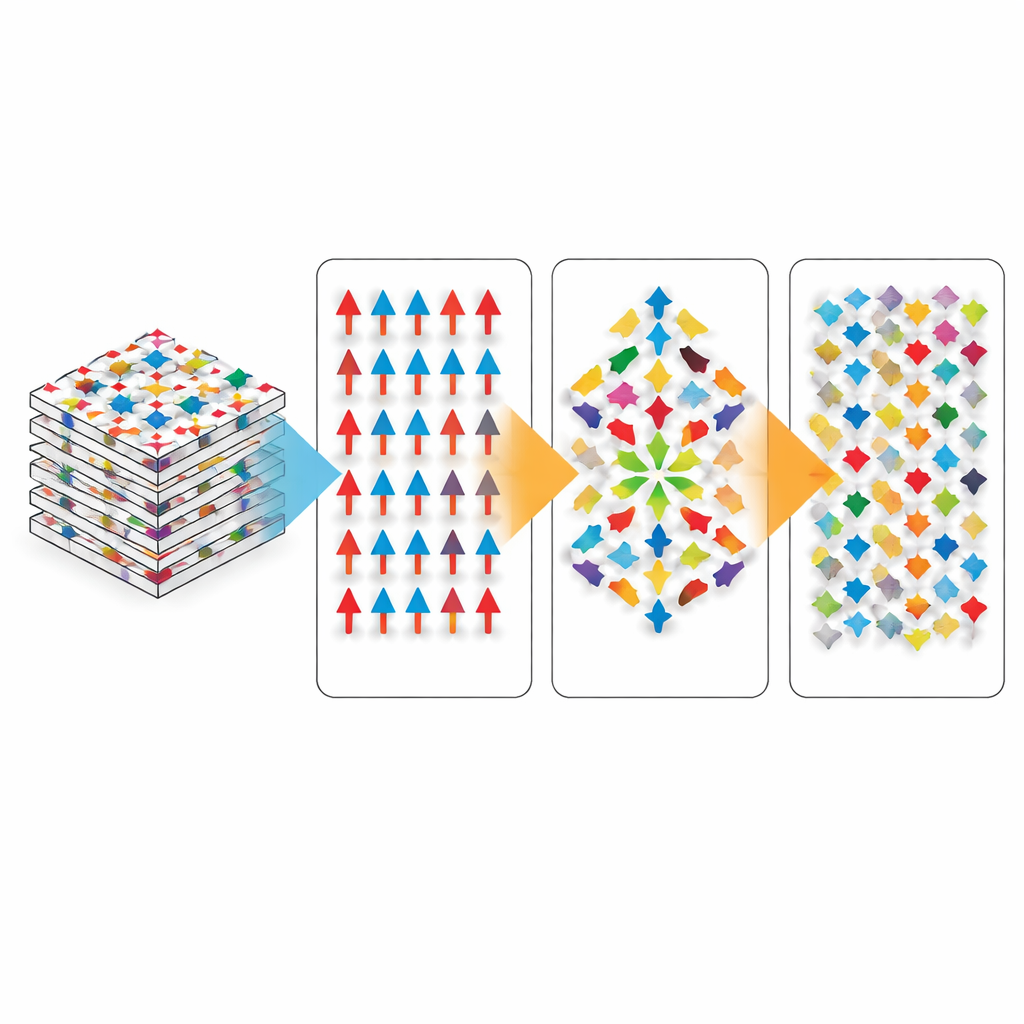
Co1/3TaS2 is built from sheets of atoms stacked like a deck of cards, with cobalt ions forming a triangular grid inside each layer. The spins on these cobalt ions interact in a frustrated way, meaning they cannot all align to satisfy their mutual preferences. As the crystal is cooled, this frustration produces two distinct kinds of order. At intermediate temperatures, the spins form stripes: rows of spins pointing alternately up and down. This stripe pattern picks out a particular direction in the otherwise sixfold-symmetric lattice, creating a kind of three-way "directional" order known as nematicity. At lower temperatures, a different pattern emerges in which spins point along four directions that form a distorted tetrahedron in space, giving rise to a chiral state whose handedness can be flipped by a magnetic field.
Seeing Invisible Order with Light
Traditional techniques such as neutron scattering can detect complex magnetic order, but struggle to see how it varies across a crystal. The authors instead use polarized light as a microscope for magnetism. They measure magnetic circular dichroism, which senses how a material reflects right- and left-circularly polarized light differently, and magnetic linear dichroism, which compares reflection for different linear polarizations. In Co1/3TaS2, circular dichroism is a direct fingerprint of chiral spin textures, while linear dichroism reveals nematic stripe order and how it breaks rotational symmetry in the plane. By tracking these optical signals as they vary with temperature and magnetic field, the team maps out which combinations of chirality and nematicity occur in each phase of the material.
A Tunable Landscape of Magnetic Phases
The measurements show that Co1/3TaS2 does not switch abruptly from stripes to a chiral state; instead, it passes through a rich sequence of phases controlled by temperature and out-of-plane magnetic field. At higher temperatures, stripes dominate, producing strong nematic signals but no chirality. At low temperatures and high fields, a purely chiral state appears with no nematic signature, corresponding to a highly symmetric arrangement of three intertwined magnetic waves. Most intriguingly, at low temperatures and low fields the material sits in an intermediate state that shows both strong chirality and strong nematicity. In this regime, the underlying triple-wave pattern is slightly unbalanced, distorting the ideal tetrahedral arrangement and breaking rotational symmetry while still retaining handedness.
A Smooth Path Between Stripe and Swirl
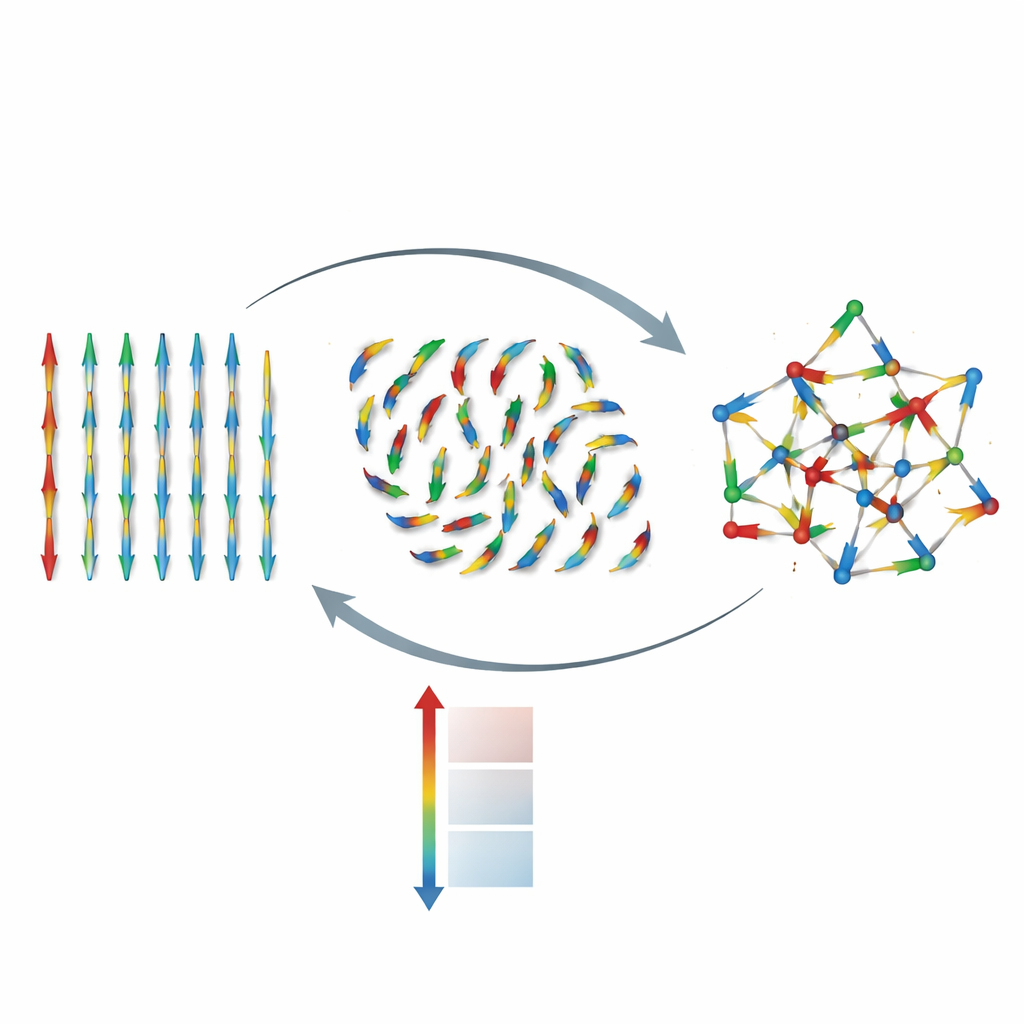
To explain this tunable behavior, the authors propose a theoretical picture in which the spin pattern can be described as a continuous blend of three basic waves on the triangular lattice. By varying the relative weight of these three components, the system can smoothly evolve from a single-wave stripe pattern to a fully symmetric triple-wave chiral state, with many intermediate "distorted" configurations in between. Additional four-spin interactions and weak magnetic anisotropy select which point on this manifold is energetically favored under given field and temperature conditions. Computer simulations based on this model reproduce the observed phase diagram, supporting the idea that Co1/3TaS2 hosts a rare continuous family of multi-wave magnetic states.
Domains, Handedness, and Future Uses
High-resolution optical microscopy reveals how these exotic orders carve the crystal into magnetic domains. Nematic stripe domains can extend nearly a millimeter and remain pinned in place even after repeated warming to room temperature, likely anchored by subtle strains in the crystal. By contrast, chiral domains—regions of opposite handedness—are much smaller and can be easily rearranged by modest magnetic fields without disturbing the nematic background. This separation between robust directional order and flexible chirality suggests a new way to encode information: the direction could define a stable "channel," while chirality could provide a switchable binary state within it. More broadly, this work demonstrates how polarized light can both detect and image subtle magnetic symmetries, opening a path to discovering and controlling topological spin textures in a wide variety of quantum materials.
Citation: Kirstein, E., Park, P., Cho, W. et al. Tunable chiral and nematic states in the triple-Q antiferromagnet Co1/3TaS2. Nat Commun 17, 2212 (2026). https://doi.org/10.1038/s41467-026-68843-0
Keywords: antiferromagnetism, spin chirality, nematic order, magneto-optical microscopy, topological Hall effect