Clear Sky Science · en
Middle East dust as an important external driver of the Indian Ocean Dipole
Dust That Shapes Distant Seas
Storms, floods, and droughts around the Indian Ocean affect hundreds of millions of people, yet the ocean shifts that drive these extremes are still being uncovered. This study reveals a surprising player in that story: dust storms from the deserts of the Middle East. By tracing how dust travels and alters sunlight, clouds, winds, and ocean temperatures, the authors show that these tiny particles can tip the balance of a powerful climate pattern in the Indian Ocean.
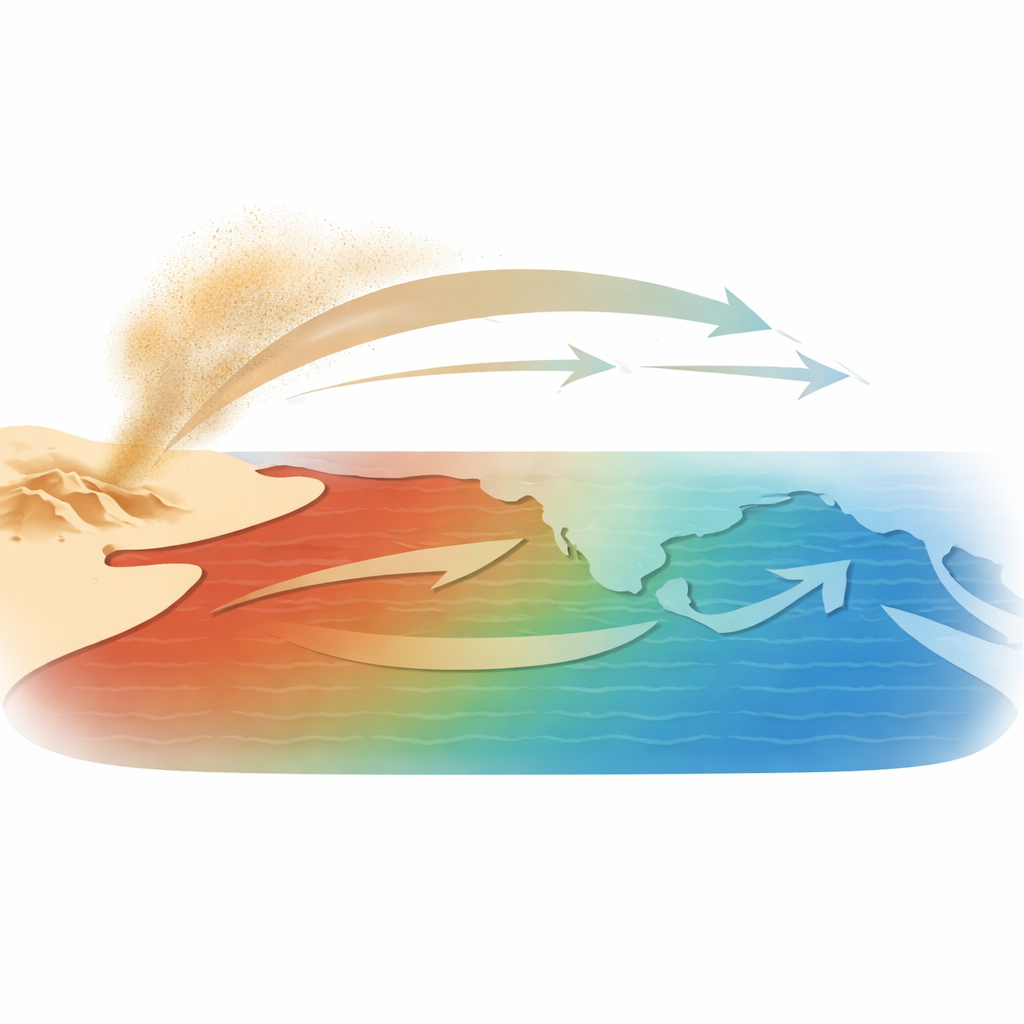
A Giant Seesaw in the Indian Ocean
The Indian Ocean Dipole is like a huge seesaw of ocean warmth. In some years, waters in the western Indian Ocean become warmer than usual while the eastern side near Indonesia turns cooler. This “positive” phase tends to bring heavy rains to East Africa and dry conditions to Indonesia and Australia. In the opposite “negative” phase, the pattern flips. These swings reshape monsoon rains, crop yields, wildfire risk, and flood hazards across countries from East Africa to India, Indonesia, and Australia. While scientists have long known that this dipole is linked to well-known climate patterns such as El Niño, they had not fully accounted for the role of airborne dust.
Dust Highways from Desert to Ocean
Every summer, strong winds sweep over the deserts of the Middle East, lifting vast amounts of mineral dust and carrying it over the Arabian Sea and the western tropical Indian Ocean. Dust in the air blocks and absorbs sunlight: it warms the air aloft but cools the surface by shading it. Using satellite records, weather reanalyses, and surface observations, the authors show that these dust plumes have declined noticeably since about 2010. Over the same period, the Indian Ocean Dipole shifted toward more frequent positive phases. Statistical analyses reveal that summer dust changes explain roughly one‑third of year‑to‑year swings in the dipole, even after subtracting out the influence of El Niño and other slow climate shifts.
How Less Dust Warms One Side of the Ocean
Climate model experiments help turn this statistical link into a physical story. When the model is forced to reduce summer dust over the Middle East, more sunlight reaches the surface of the western Indian Ocean. Because the warm layer of water there is relatively shallow, this extra energy quickly heats the surface. Warmer water fuels stronger rising air and more towering clouds, lowering surface pressure over the western basin. That pressure dip pulls surface winds to blow more strongly from east to west along the equator, changing how heat is stored and moved within the ocean.
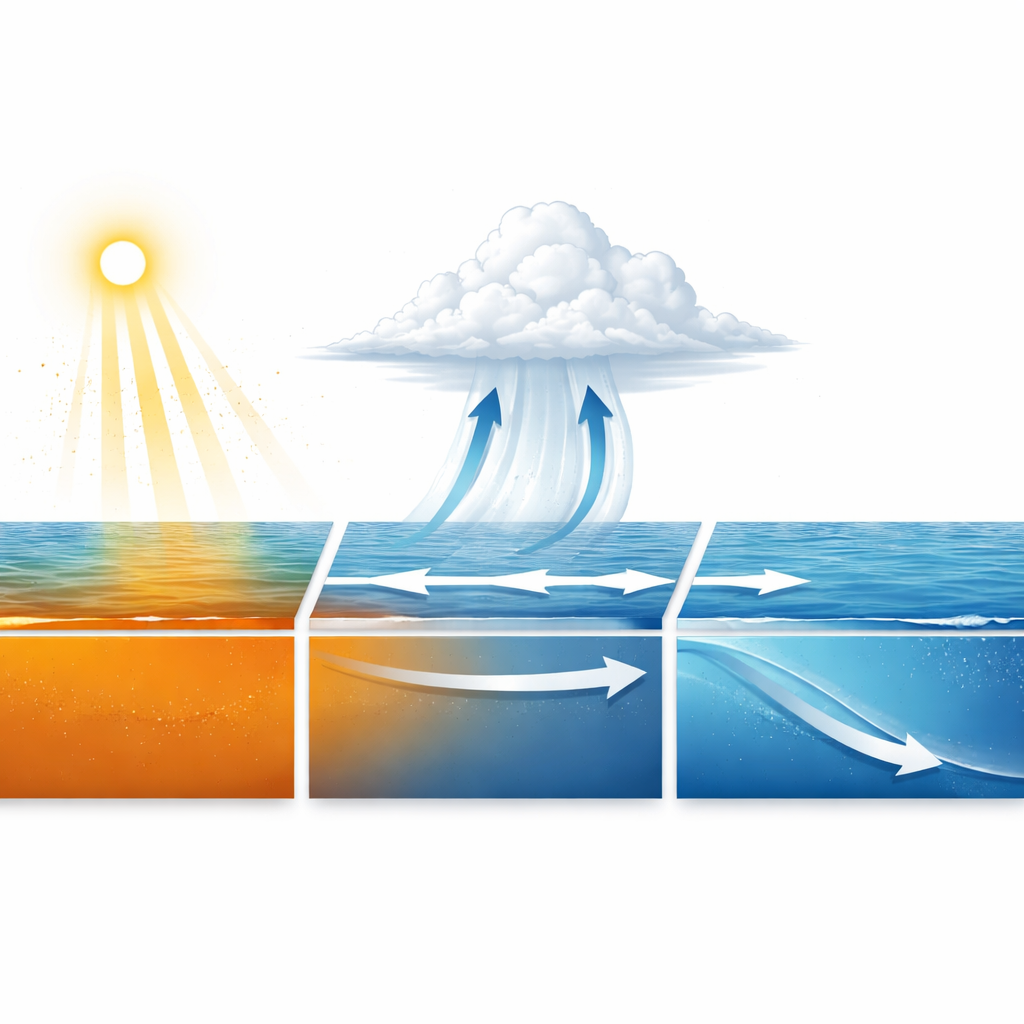
From Small Particles to a Stronger Ocean Seesaw
These altered winds push warm surface waters westward and reduce their usual spread toward the eastern basin. As a result, the boundary between warm surface water and cooler deeper water slopes more steeply: it deepens in the west and shoals in the east. The eastern surface cools as deeper, colder waters are pulled upward, while the west stays warm and loses less heat to evaporation because the winds there weaken. Cloud changes then amplify the contrast: fewer low clouds and more high clouds over the west let in more sunlight and trap more heat, while the opposite happens over the east. Together, these wind, ocean, and cloud feedbacks reinforce the classic positive dipole pattern of a warm west and cool east.
What This Means for Future Weather Risks
To a non‑specialist, the key message is that dust from faraway deserts is not just a hazy backdrop; it can actually steer major climate swings over the Indian Ocean. The study finds that summertime dust from the Middle East rivals, and in peak season even exceeds, El Niño as a driver of the Indian Ocean Dipole. Because the dipole strongly influences floods, droughts, and monsoon behavior, changes in future dust emissions—driven by land use, drying soils, and shifting winds—could alter regional climate risks. Incorporating dust more carefully into seasonal forecasts and long‑term climate models may therefore improve our ability to anticipate disruptive rainfall patterns and extreme events around the Indian Ocean rim.
Citation: Liu, G., Xie, SP., Hansen, J.E. et al. Middle East dust as an important external driver of the Indian Ocean Dipole. Nat Commun 17, 2166 (2026). https://doi.org/10.1038/s41467-026-68842-1
Keywords: Indian Ocean Dipole, desert dust, Middle East climate, monsoon rainfall, aerosol–ocean interaction