Clear Sky Science · en
Shifting winter atmospheric teleconnections to the North Pacific reconcile Younger-Dryas and Holocene δ18O signals
Why Ancient Winters in Alaska Matter Today
When we think about past ice ages, it is easy to imagine a world simply colder than today. But this study shows that the real story is about how winter storms shifted their paths across the globe. By reading subtle chemical clues locked in Alaskan lake mud, the authors reveal that similar cold signals in the past were actually caused by very different atmospheric patterns. Understanding those shifting winter pathways helps us grasp how today’s climate system might reorganize in a warming world.

Reading Climate History in Lake Mud
The researchers focused on three small lakes in Alaska’s Matanuska–Susitna Valley, near Anchorage. These lakes are fed mainly by groundwater, which in turn comes largely from winter snowmelt in nearby mountains. As lake water evaporates and minerals settle to the bottom, thin layers of calcium carbonate are laid down year after year. The oxygen atoms in those minerals come from the lake water and carry a measurable fingerprint, known as an oxygen isotope ratio. Because that ratio depends on where the moisture came from and how cold it was when snow formed, the lake sediments act like long-running recorders of winter weather stretching back more than 14,000 years.
Two Kinds of Cold in the Distant Past
One major cold snap the team examined is the Younger Dryas, a sudden return to near-glacial conditions about 12,800 to 11,700 years ago. In Greenland ice cores, this event shows up clearly as a sharp drop in oxygen isotope values, indicating strong cooling. The same kind of drop appears at the same time in the Alaskan lake records. By tying precise lake ages to volcanic ash layers and radiocarbon dates, the authors argue that Alaska’s winters cooled dramatically in step with Greenland. Yet other clues, such as high biological productivity in the lakes and warm-season indicators from nearby sites, suggest that Alaskan summers remained relatively mild. In other words, winters became harsher while summers stayed relatively warm, boosting the contrast between seasons.
From Atlantic-Controlled to Pacific-Driven Winters
After the ice sheets retreated, sea level rose and the Bering Strait flooded, changing how oceans and atmosphere interacted around Alaska. The lake records show that by the early Holocene, winters warmed and moisture increasingly arrived from the south over the North Pacific rather than from the North Atlantic. Oxygen isotope values stabilized near modern levels for several thousand years, even as the Atlantic circulation continued to evolve. Later, during the last few thousand years, the records show renewed, and sometimes even larger, drops in the winter isotope signal. This time, however, the patterns match an increase in climate modes like El Niño and the Pacific Decadal Oscillation, which favor storm tracks that pull subtropical Pacific moisture northward toward Alaska. The same kind of isotope dip that once signaled extreme cold now reflected long-distance moisture transport along a different atmospheric route.
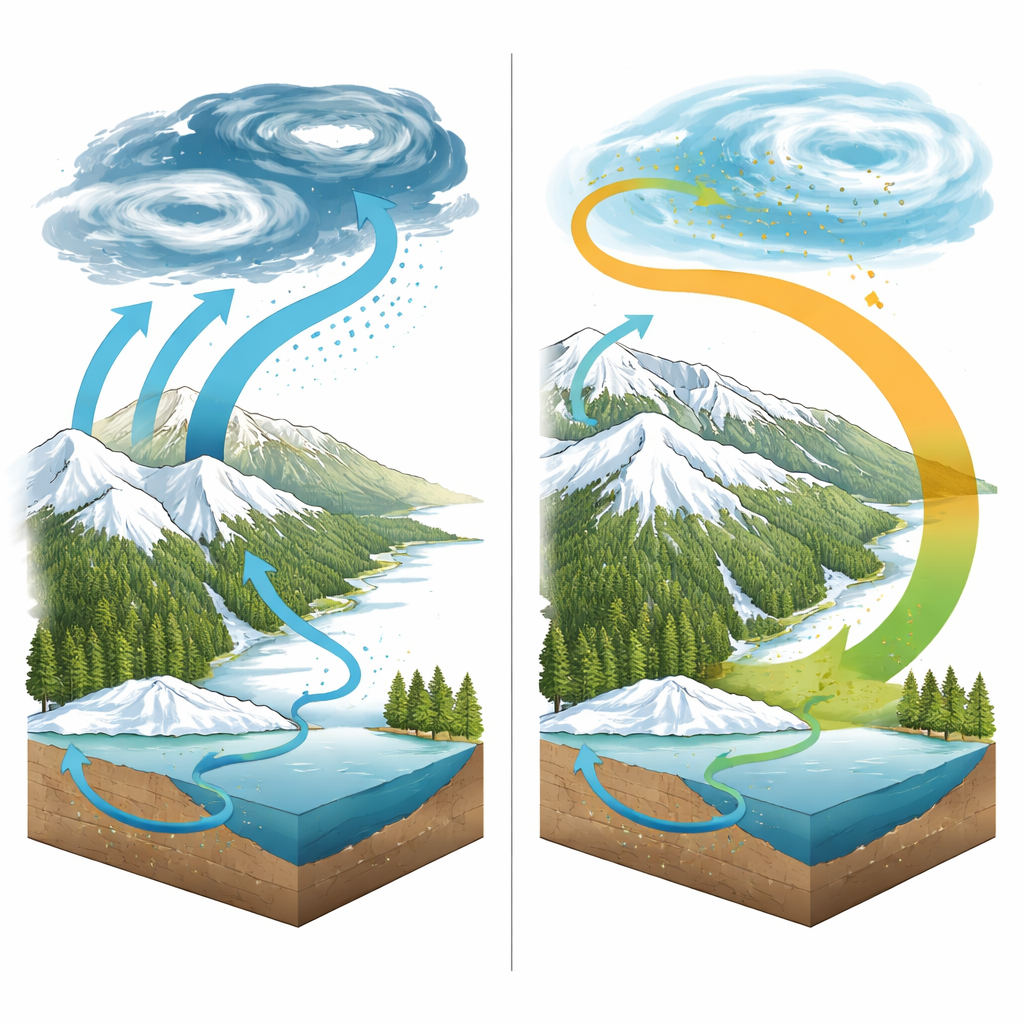
Different Paths, Similar Signals
By comparing lakes that respond mainly to winter snowfall with a nearby lake more sensitive to summer evaporation, the study separates winter from summer effects in the climate record. During the Younger Dryas, all three lakes show changes consistent with very cold winters and fairly dry, yet not dramatically altered, summers. In the late Holocene, however, the winter-sensitive lakes register strong swings linked to changing storm tracks over the Pacific, while the summer-sensitive lake shows its own distinct pattern. The key lesson is that similar isotope shifts in lake sediments can arise from different combinations of temperature, moisture source, and storm path. Without seasonal context, those signals could easily be misread.
What This Means for Our Climate Future
To a non-specialist, the main takeaway is that where winter storms come from can matter as much as how warm or cold the planet is overall. The Alaskan lakes reveal that the Northern Hemisphere’s atmosphere has switched between being tightly linked to the North Atlantic and being more strongly guided by the Pacific tropics. Such reorganizations can reshape snowfall, sea ice, and ecosystems without always leaving obvious traces in summer-focused records like tree rings. As we look ahead, models and observations will need to capture not only gradual warming but also potential shifts in winter storm pathways—changes that these Alaskan lakes show have happened before and could happen again.
Citation: Anderson, L., Finney, B.P. & Baxter, W.B. Shifting winter atmospheric teleconnections to the North Pacific reconcile Younger-Dryas and Holocene δ18O signals. Nat Commun 17, 2287 (2026). https://doi.org/10.1038/s41467-026-68841-2
Keywords: Alaska paleoclimate, Younger Dryas, North Pacific storms, oxygen isotopes, Holocene climate