Clear Sky Science · en
Repeatability of gene expression evolution in experimental environmental adaptation
Why evolution’s “replay button” matters
If we could rewind the tape of life and let it play again, would living things evolve in the same way or head down entirely new paths? This question isn’t just philosophical; it shapes how we think about predictability in evolution, from antibiotic resistance to crop breeding and climate change responses. This study uses large-scale lab experiments to ask whether living organisms repeatedly change how their genes turn on and off when they adapt to new environments—and finds that, at least for gene activity, evolution is surprisingly repeatable and rule‑bound rather than wildly random.
Running evolution in the lab
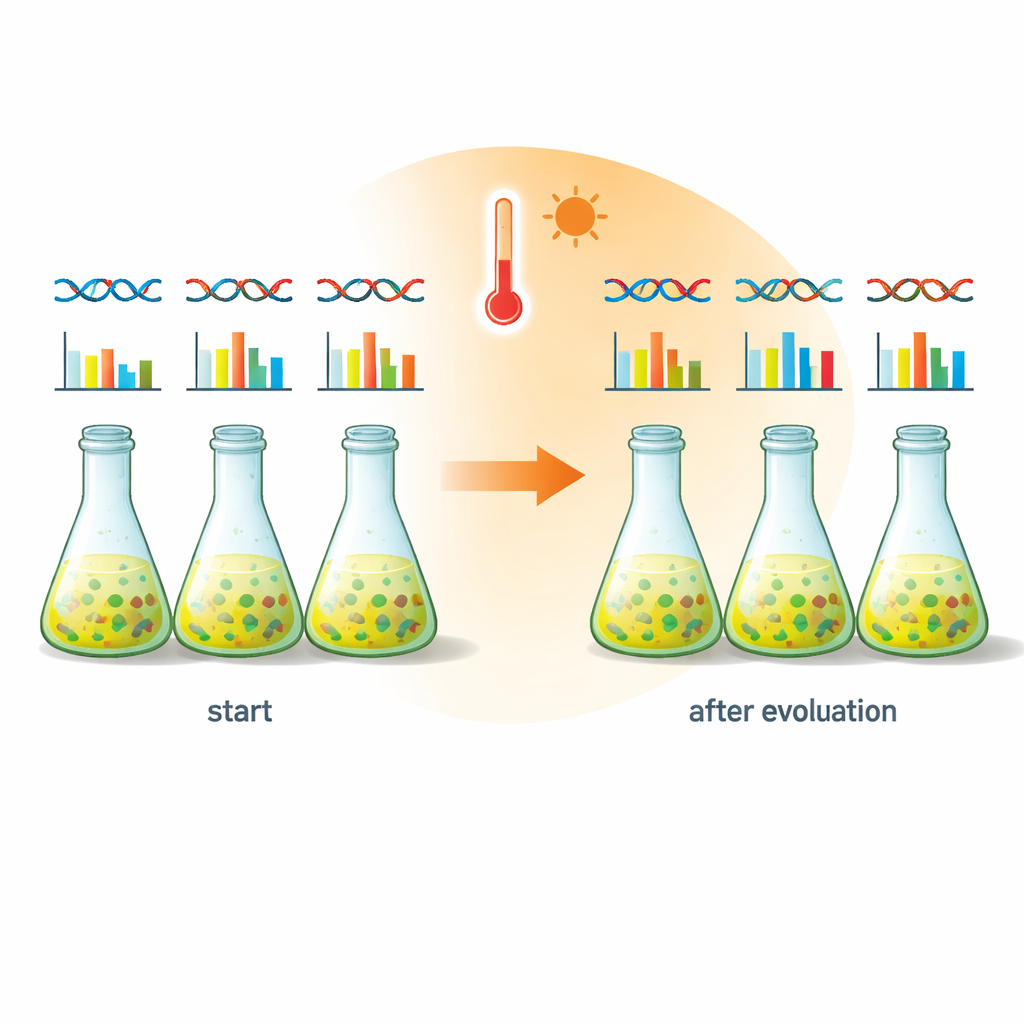
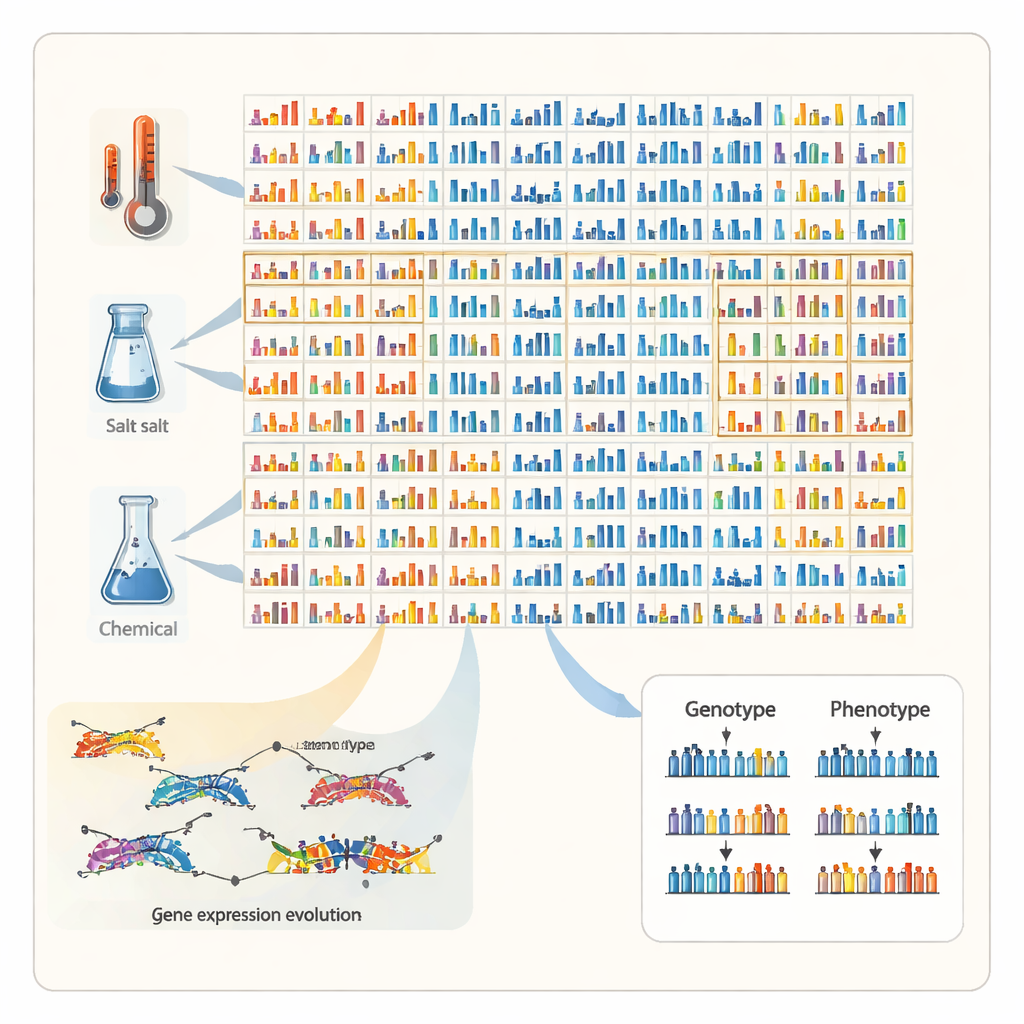
In nature, it’s nearly impossible to evolve the very same starting population under precisely the same conditions more than once. In the lab, however, scientists can do just that. The authors gathered data from 10 such “experimental evolution” studies, covering bacteria, yeast, insects, a tiny marine crustacean, guppies, and a weedy plant adapting to 22 different environments, such as new temperatures, salt levels, or herbicides. In each case, multiple replicate populations started from the same ancestor and evolved in parallel for many generations. Researchers then measured the activity of thousands of genes at once—known as the transcriptome—treating the expression level of each gene as a distinct trait. In total, they analyzed 182,103 gene-expression traits, asking how similarly those traits changed in separate populations facing the same environmental challenge.
Patterns that rise above chance
To judge repeatability, the study focused on genes whose activity shifted significantly during adaptation, called differentially expressed genes. For each experiment, the authors compared pairs and groups of replicate populations and counted how many genes changed in all of them. They then compared these overlaps to what would be expected if each population’s gene activity changed independently by chance. Across nearly all environments and species, the overlaps were far larger than random models predicted—often by 10 to 100 standard deviations, an enormous margin in statistics. The result held under increasingly strict definitions of “repeatable”: first just asking whether a gene changed, then whether it changed in the same direction (up or down), and finally whether both direction and size of change matched across populations.
Environment as a guiding hand
Evolution doesn’t happen in a vacuum, so the researchers also asked how much the shared environment drives these repeated patterns. For studies with more than one environment—such as bacteria adapting to different carbon sources or stresses—they compared how similar gene-expression changes were among populations in the same environment versus in different ones. Populations adapting to the same environment showed much stronger agreement than those adapting to different environments, even though both exceeded chance expectations. This suggests that environment-specific natural selection is the main force steering gene activity along similar paths, with additional, weaker contributions from other factors.
Mutations bias the dice, but don’t load them completely
One obvious non-environmental factor is mutation itself. Some genes may simply be more likely to have mutations that alter their activity, no matter what the environment is. To test this, the authors analyzed a special “mutation accumulation” experiment in bacteria, where populations repeatedly passed through tiny bottlenecks so that natural selection was largely stripped away and mutations piled up almost at random. Even here, gene-expression changes showed some repeatability beyond chance, indicating that mutation bias does nudge evolution toward certain genes. Still, these repeatable patterns were much weaker than in the adaptation experiments, reinforcing the conclusion that natural selection in specific environments is the dominant force shaping repeated gene-expression changes.
Why some genes are more predictable than others
Not all genes behaved equally. Using a long-term experiment in which 11 bacterial populations evolved in the same nutrient-poor medium for 50,000 generations, the authors asked which genes repeatedly changed their activity across many replicates. They found that some genes rarely changed at all, while others changed in multiple populations—far more often than a simple random model would predict. A key clue came from regulatory architecture: genes controlled by more transcription factors, the proteins that switch genes on or off, were more likely to show repeatable expression evolution. The idea is that such genes offer more “targets” for mutations that can tweak their activity, increasing the chances that evolution will repeatedly alter them when conditions demand it.
What this means for the predictability of life
When scientists have looked at DNA changes across species or experiments, they often found that the exact mutations underlying adaptation differ from case to case, suggesting evolution is highly contingent on chance events. This new work shows that, even if the genetic details diverge, the resulting patterns of gene activity—the molecular phenotype—are much more predictable. Different mutations in different genes can converge on similar expression outcomes that help organisms cope with the same stress. For a layperson, the message is that evolution is less like a random walk and more like many different roads leading to the same destination: while the molecular routes vary, the way organisms adjust their gene activity in response to a given environment is strikingly repeatable and largely shaped by necessity rather than pure chance.
Citation: Li, J., Zhang, J. Repeatability of gene expression evolution in experimental environmental adaptation. Nat Commun 17, 2036 (2026). https://doi.org/10.1038/s41467-026-68838-x
Keywords: evolution, gene expression, natural selection, experimental evolution, adaptation