Clear Sky Science · en
Fatigue resistant elastocaloric effect in TiNi via texture-precipitate synergy
Cooling Our World in a New Way
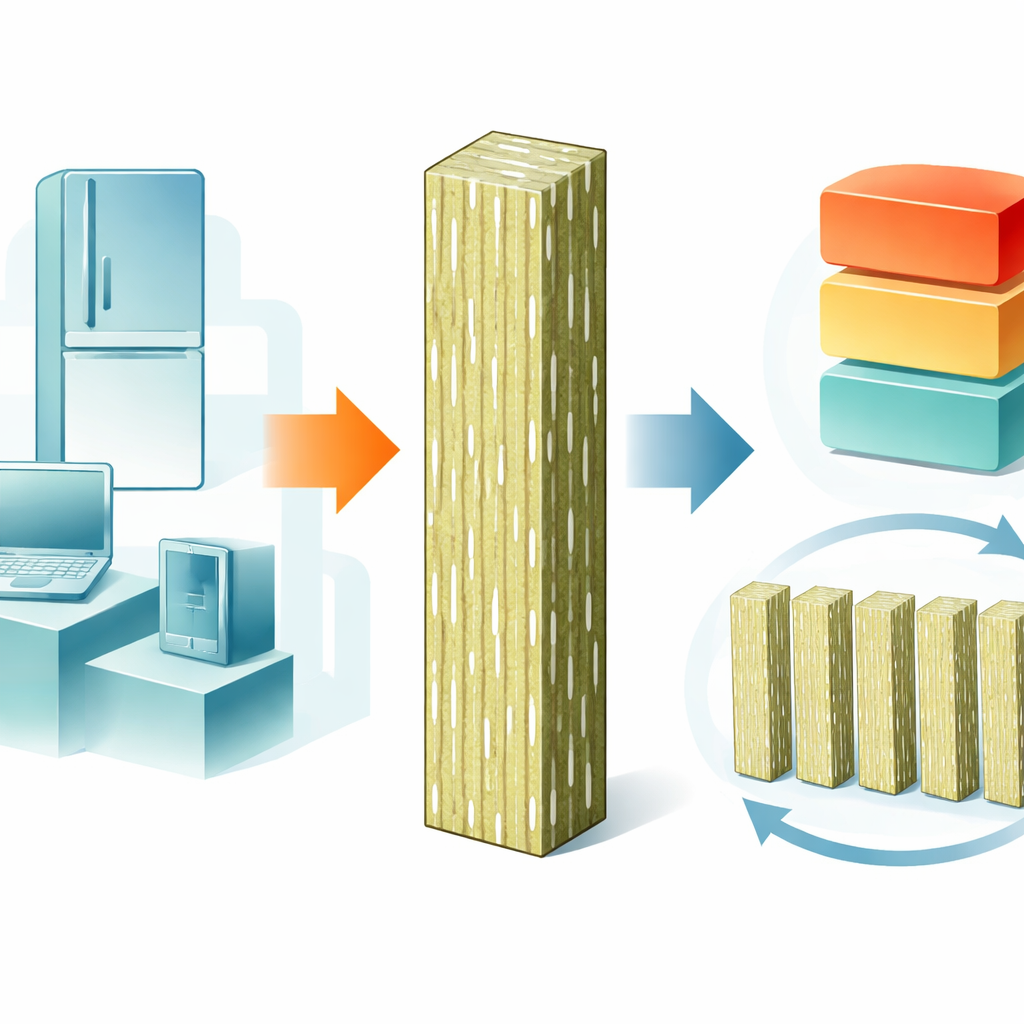
Keeping food fresh, data centers running, and medicines safe all depends on cooling technology. Today’s refrigerators and air conditioners mostly rely on gases that can harm the climate and machines that are already close to their efficiency limits. This study explores a very different approach: a solid metal that cools down when you squeeze it and warms back up when you release it. The researchers show how carefully arranging the internal structure of a titanium–nickel alloy lets it deliver strong cooling again and again, even after ten million squeeze–release cycles, pointing the way toward quieter, greener fridges and heat pumps.
From Gas-Based Fridges to Solid Cooling
Conventional cooling works by compressing and expanding special gases, a method that is effective but energy-hungry and increasingly problematic because many of these gases trap heat in the atmosphere. An emerging alternative uses solid materials that change their internal crystal structure when stressed. In some metal alloys, this change is reversible and releases or absorbs heat, much like melting and freezing do, but without the material actually turning into a liquid. When such an alloy is quickly unloaded after being squeezed, its temperature can drop sharply, offering a potential route to clean, compact cooling devices.
A Metal That Keeps Its Cool Under Pressure
The team focused on a well-known “shape memory” metal made of titanium and nickel, already used in eyeglass frames and medical stents for its ability to spring back into shape. The challenge has been that, under repeated use, these alloys gradually crack or lose much of their cooling power. In this work, the authors designed a special version of the alloy with a slightly altered composition and a tiny amount of oxygen. Using directional solidification—cooling the molten metal from one side so it freezes with aligned grains—they created long column-shaped crystals that all point in nearly the same direction. Within these columns they grew a dense, even forest of microscopic rod-like particles made of a titanium–nickel–oxygen compound. This combination of grain alignment and internal particles is the heart of their design.
How Hidden Structures Shape Performance
Because the alloy’s crystals are lined up, squeezing it along that direction produces a large, controlled change in shape as its internal structure shifts from one ordered pattern to another. This change in pattern is tied directly to how much the material heats or cools. Experiments showed that when compressed along the textured direction, the alloy could repeatedly change length by more than six percent—remarkably high for a solid metal—and still spring back. When the researchers cycled the material up to ten million times, it retained a strong cooling swing of about sixteen degrees Kelvin, with only a modest drop from its initial performance. In contrast, pieces squeezed perpendicular to the grain direction quickly accumulated permanent strain and lost stability, underscoring how crucial the alignment is.
A Gentle, Even Transformation Inside
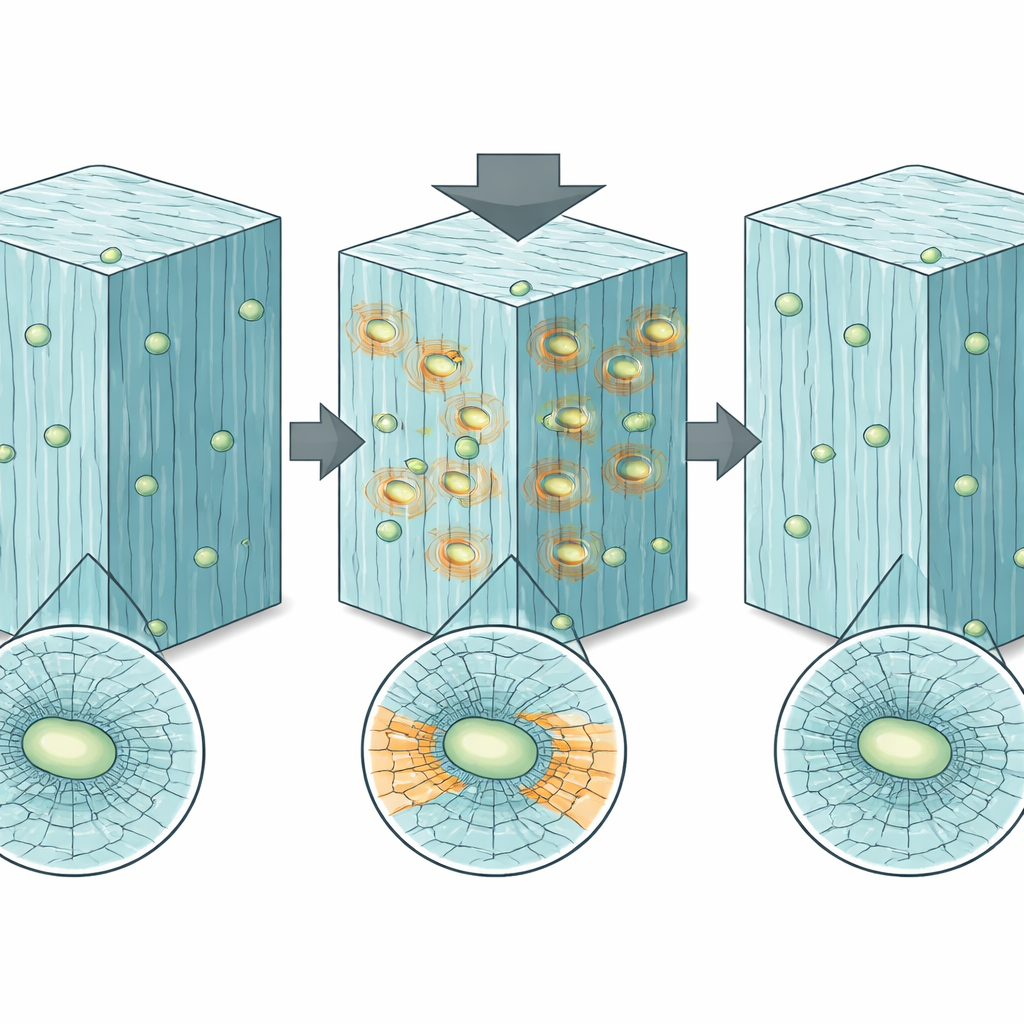
Microscope and X-ray studies revealed why this alloy is so durable. In many shape memory metals, the internal change in crystal pattern races through the material in abrupt bands, creating local hot spots of strain that eventually cause damage. Here, however, the change happens more smoothly and in many places at once. The tiny titanium–nickel–oxygen particles share the same basic orientation as the surrounding metal but slightly distort the nearby crystal lattice. These local distortions make it easier for the new phase to start right at the particle–matrix boundaries. Under load, countless small regions around these particles gradually switch structure, and then switch back when the load is removed, spreading the work evenly and avoiding violent bursts.
Building a Metal Like Reinforced Concrete
On a larger scale, the metal acts a bit like reinforced concrete. The long, textured grains play the role of the concrete, while the aligned internal particles act like the rebar, guiding and limiting how the internal transformation can grow. Compression loading, which naturally discourages cracking, works together with this “reinforced” architecture to hold damage at bay. High-resolution imaging showed dense but confined regions of lattice strain and dislocations near the particles, which serve both as safe starting points for the phase change and as barriers that keep it from growing into large, destructive zones. The result is a metal that can repeatedly undergo the cooling transformation without tearing itself apart.
What This Means for Future Cooling
For non-specialists, the key message is that the way atoms and tiny particles are arranged in a metal can drastically change how it behaves in the real world. By co-designing the direction of the crystals and the pattern of internal particles, the researchers created a titanium–nickel alloy that offers strong cooling and lasts through millions of use cycles. This work suggests a practical path toward solid-state cooling devices that are efficient, compact, and kinder to the climate, and it offers a blueprint for engineering other smart metals that can work hard for a very long time without wearing out.
Citation: Li, X., Liang, Q., Liang, C. et al. Fatigue resistant elastocaloric effect in TiNi via texture-precipitate synergy. Nat Commun 17, 2147 (2026). https://doi.org/10.1038/s41467-026-68835-0
Keywords: solid-state cooling, shape memory alloys, elastocaloric effect, fatigue resistance, TiNi materials