Clear Sky Science · en
Photothermal effects control ultrafast charge transport in titanium carbide MXenes
Turning Light into Heat in New Metal Sheets
Imagine an ultra-thin metal coating that not only carries electricity very well, but also soaks up light and turns it into heat that lingers for hundred-billionths of a second. This study looks at such a material—titanium carbide MXene—and shows how light-generated heat can temporarily slow down the flow of electric charges. Understanding this behavior could help engineers design better devices for cooling, sensing heat, or harvesting light as thermal energy.
A New Kind of Flat Metal
MXenes are a family of two-dimensional materials: stacks of atomically thin metal-carbide sheets only a few nanometers thick. The specific MXene studied here, called Ti₃C₂Tₓ, acts like a metal but can be processed from liquids and sprayed into thin films, making it attractive for flexible electronics and light-based devices. Earlier research found something puzzling: when Ti₃C₂Tₓ is hit by a short laser pulse, its ability to conduct electricity drops almost instantly and stays low far longer than in normal metals. This “negative photoconductivity” was known, but the reason for its long lifetime—lasting well beyond a billionth of a second—was unclear. Was it due to exotic long-lived electronic states, or was heat trapped in the material playing the key role?
How Heat Changes Charge Flow
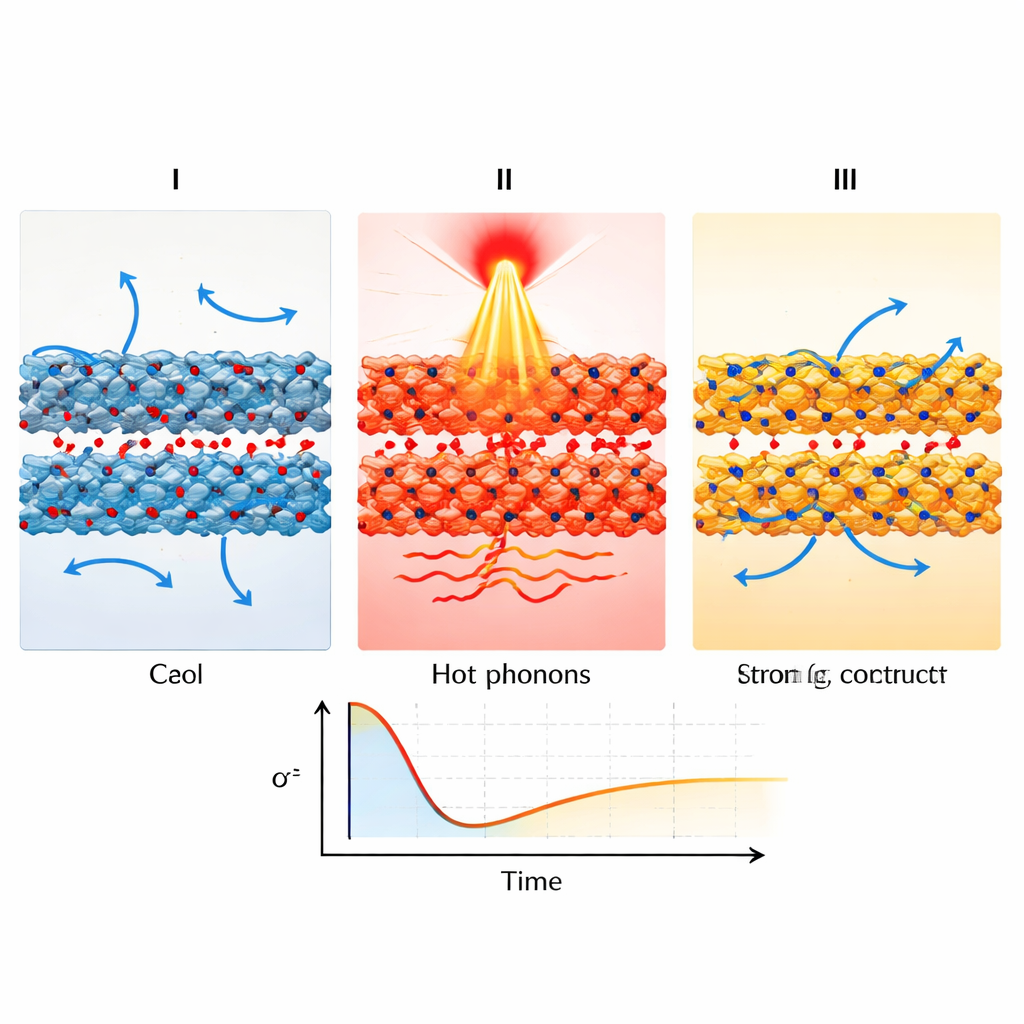
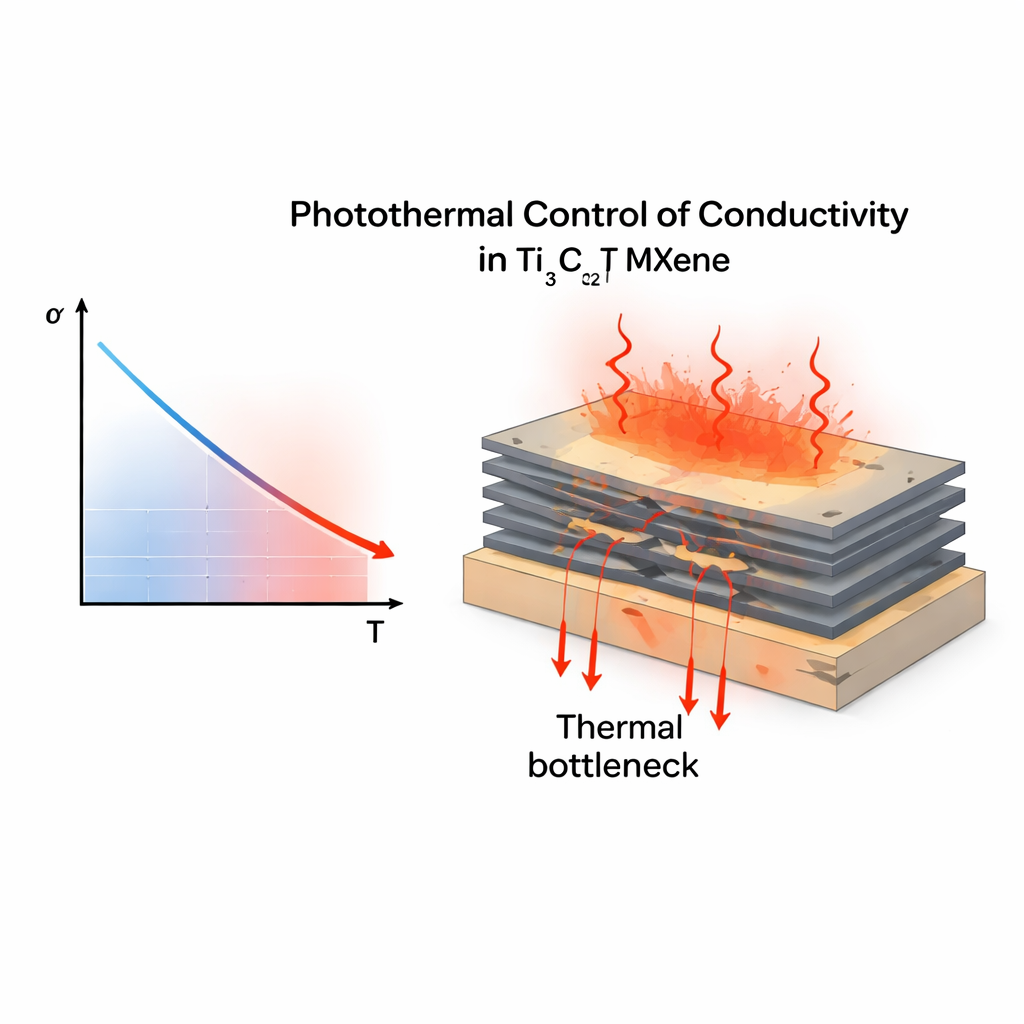
The authors first measured how electrical conductivity in Ti₃C₂Tₓ depends on temperature without any light pulses, using terahertz radiation as a contact-free probe. As they cooled the film, its conductivity increased, meaning that charges moved more easily at lower temperatures. This trend pointed to vibrations of the crystal lattice—phonons—as the main obstacle to charge motion: fewer vibrations at low temperature mean fewer collisions and better conductivity. From these measurements they extracted microscopic quantities such as how long charges travel before scattering and how far they move between collisions, showing that changes in scattering, not in charge density, dominate the behavior.
Ultrafast Light Pulses and Long-Lived Heat
Next, the team fired extremely short laser pulses of different colors and strengths at the MXene film while again probing it with terahertz waves to watch its conductivity in real time. Right after excitation, conductivity dropped within less than a trillionth of a second, consistent with hot charges quickly dumping their energy into the lattice and heating it. After this ultrafast step, the material entered a long-lived state in which conductivity remained suppressed for hundreds of picoseconds or more. Crucially, when the researchers compared different pump colors, they found that as long as the total absorbed energy was the same, the long-lived conductivity change was essentially identical. They also saw that the effect became stronger at lower starting temperatures, where the same deposited energy produces a larger temperature rise because the heat capacity is smaller.
Proving It Is Really All About Heat
To test this thermal picture, the authors built a simple model that linked absorbed light energy to a rise in lattice temperature using known heat capacities, and then used their temperature-dependent conductivity data to predict how much the conductivity should drop. Without adjusting any free parameters, the model matched the measured long-lived photoconductivity remarkably well. They then turned to transient reflectivity measurements—watching tiny changes in reflected light—to track how long the heat persists. By varying the repetition rate of the laser, they showed that leftover heating from previous pulses is still visible more than 100 nanoseconds later. This slow cooling suggests a thermal bottleneck, likely because heat flows poorly from the MXene into the supporting substrate and between stacked layers, so the material acts as a small but efficient heat reservoir.
Why This Matters for Future Devices
Putting these pieces together, the study concludes that light does not create exotic long-lived electronic states in Ti₃C₂Tₓ. Instead, it very efficiently heats the lattice, and this heat dissipates unusually slowly, keeping the material in a warmed, less conductive state for an extended time. For a layperson, this means that these atomically thin metal sheets behave like tiny thermal sponges: they absorb light, convert it into heat almost instantly, and then hold onto that heat while their electrical properties change in a predictable way. Such behavior could be harnessed in technologies where one wants to store light as heat, convert temperature differences into electricity, catalyze reactions using warmth produced by light, or build sensitive infrared and terahertz detectors that respond through heat-controlled conductivity.
Citation: Zheng, W., Ramsden, H., Ippolito, S. et al. Photothermal effects control ultrafast charge transport in titanium carbide MXenes. Nat Commun 17, 1201 (2026). https://doi.org/10.1038/s41467-026-68831-4
Keywords: MXenes, photothermal effects, ultrafast spectroscopy, thermal conductivity, titanium carbide