Clear Sky Science · en
Potential and challenges for sustainable progress in human longevity
Why longer lives still matter to all of us
Most of us hope to live not just long lives, but long and healthy ones. Over the past century, rising life expectancy has been a quiet success story of modern societies. Yet in many wealthy countries, these gains have begun to slow, raising worries that we may be approaching a hard ceiling for human lifespan. This study looks beneath national averages to the regional level across Western Europe to see where progress in longevity is continuing, where it is stalling, and what that means for our collective future.
A tale of two eras in added years of life
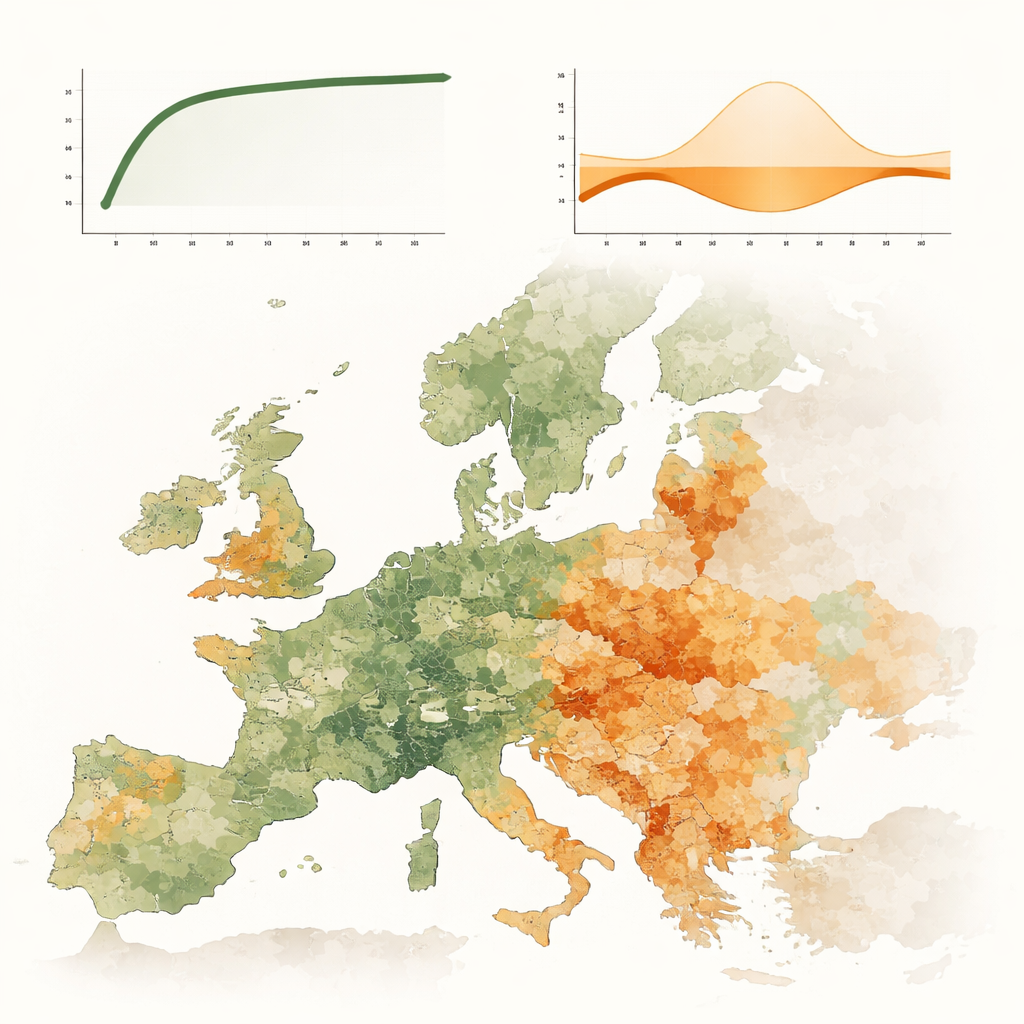
Using data from 450 regions in 13 Western European countries between 1992 and 2019, the researchers charted how life expectancy at birth changed over time. They found a clear split into two eras. From the early 1990s to about 2005, people across Western Europe gained life at a steady clip: roughly three and a half extra months per year for men and two and a half months for women. Regions that started out behind caught up fastest, so differences in lifespan between places shrank. This period, the authors argue, was a kind of golden age of shared progress in longevity.
When the brakes went on, but not for everyone
After the mid-2000s, the picture changed. Overall gains in life expectancy slowed to about two extra months per year for men and just one month for women by 2018–2019. At the same time, gaps between regions began to widen again. Crucially, it was not the leading regions that faltered. Places at the top of the longevity ladder largely kept adding years at nearly the same pace as before. Instead, the slowdown came from regions that had been lagging behind. Their earlier rapid improvements stalled or even reversed, especially for people in late middle age. As a result, the distance between the best- and worst-off regions in Europe started to grow once more.
Where you live shapes how fast life is getting longer
The study maps how these changes played out on the ground. In the early 1990s, some of the lowest life expectancies were found in eastern Germany, parts of Portugal, areas along the Belgian–French border, and Scotland. Over time, new clusters of slower progress or stagnation appeared in western Germany, southern Denmark, and parts of the United Kingdom, while some Portuguese regions improved their standing. Regions with the highest life expectancy were often in Spain, Italy, Switzerland, and parts of England, and new "hot spots" emerged in northern Italy and Swiss regions. By the late 2010s, certain metropolitan areas, such as western inner London, had pulled far ahead, showing that very high life expectancy is still possible under the right conditions.
The critical ages where progress is slipping
To understand why gains are slowing, the authors examined death rates at different ages. For younger adults (35–54) and older people (75–84), the risk of dying continued to fall at a fairly steady rate. The real trouble appeared in the 55–74 age group. In the 1990s, death rates in this band were dropping by about two percent per year; by the 2010s, the decline had roughly halved, and in some regions it turned into an increase. This worrying pattern is especially visible among men in eastern Germany and women in western Germany. In parts of the UK, death rates among younger adults have also risen, echoing "deaths of despair" seen in other English-speaking countries, driven by alcohol, drugs, suicide, and other socially rooted causes.

What this means for the future of long lives
For a layperson, the main message is both sobering and hopeful. On the one hand, the overall slowdown and the rise in deaths in midlife show that longer lives are not guaranteed, even in rich societies. Economic shocks, uneven access to good jobs and health care, and harmful habits can all erode the gains of past decades. On the other hand, the fact that some European regions continue to extend life expectancy steadily suggests that there is still room to push human longevity higher. With targeted public health efforts, attention to regional inequalities, and future breakthroughs against major age-related diseases, the best-performing regions today may point the way toward healthier and longer lives for many more people tomorrow.
Citation: Bonnet, F., Alliger, I., Camarda, CG. et al. Potential and challenges for sustainable progress in human longevity. Nat Commun 17, 996 (2026). https://doi.org/10.1038/s41467-026-68828-z
Keywords: life expectancy, human longevity, Western Europe, regional health disparities, midlife mortality