Clear Sky Science · en
National climate action can ameliorate, perpetuate, or exacerbate international air pollution inequalities
Why cleaner air in one country depends on others
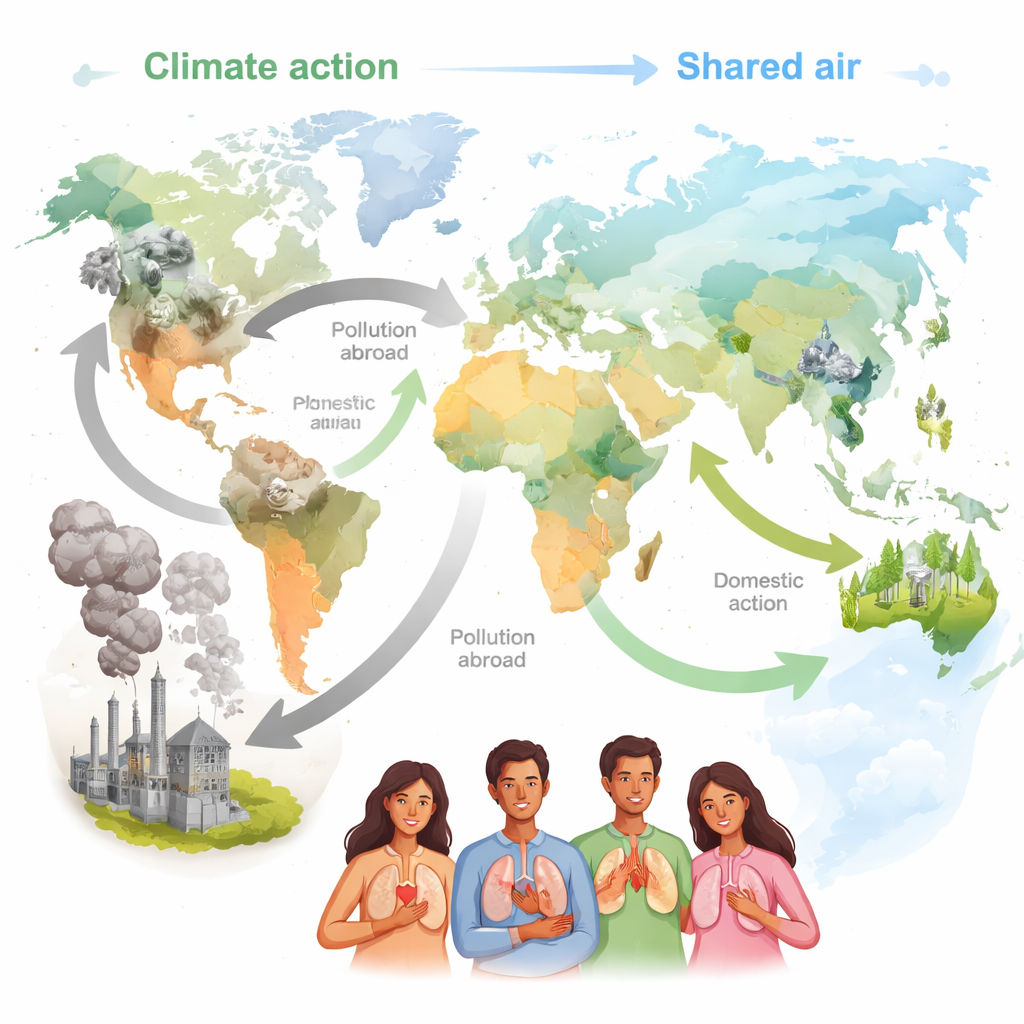
Most of us think of air pollution as a local problem: smoke from nearby traffic, factories, or fires. But the wind doesn’t stop at borders. This study shows how climate actions taken in one country can either ease or worsen air pollution inequalities in other countries, especially between wealthy nations and those still developing. Understanding these hidden connections helps explain why fair climate policies matter for everyone’s lungs, not just the global thermostat.
Climate policies that clean the air and save lives
When governments cut greenhouse gas emissions, they usually also reduce harmful air pollutants from the same sources, such as power plants, vehicles, and industry. The authors estimate that strong, globally coordinated climate action could prevent up to 1.32 million premature deaths in 2040 compared with a worst-case future where societies are divided and climate action is weak. These gains come mostly from lowering fine particle pollution (PM2.5), a dust-like mixture small enough to enter the bloodstream and damage the heart, lungs, and other organs.
Different futures, different winners
The study explores 24 possible futures that combine two ingredients: how societies develop (more equal and cooperative versus more unequal and fragmented) and how hard the world works to limit climate change. In every future that improves on the worst case, air pollution deaths fall, but not by the same amount or in the same places. Asia sees the largest absolute benefits because of its huge and aging population and the heavy pollution burdens in countries like China and India; in the most optimistic scenario, roughly four out of every five avoided deaths occur in Asia. Still, the health gains per person and the way they are shared across regions depend strongly on both economic pathways and the level of climate ambition.
How much your air depends on your neighbors
A key idea in this research is the “transboundary fraction” — the share of a country’s health gains from cleaner air that come from pollution cuts outside its borders. A low fraction means a nation can largely protect its own air by cleaning up at home. A high fraction means it relies heavily on others doing their part. The authors find that, on average, developing countries have higher transboundary fractions than rich countries. In one ambitious, cooperative scenario, the 20 least developed countries rely on foreign action for about three-quarters of their air-quality health benefits, while the 20 most developed countries rely on it for about two-thirds. Africa stands out: about 12% of its air-pollution health gains, on average, come from emission cuts in other regions, and this share grows when mitigation is strong.
When inequality reshapes the winds of benefit
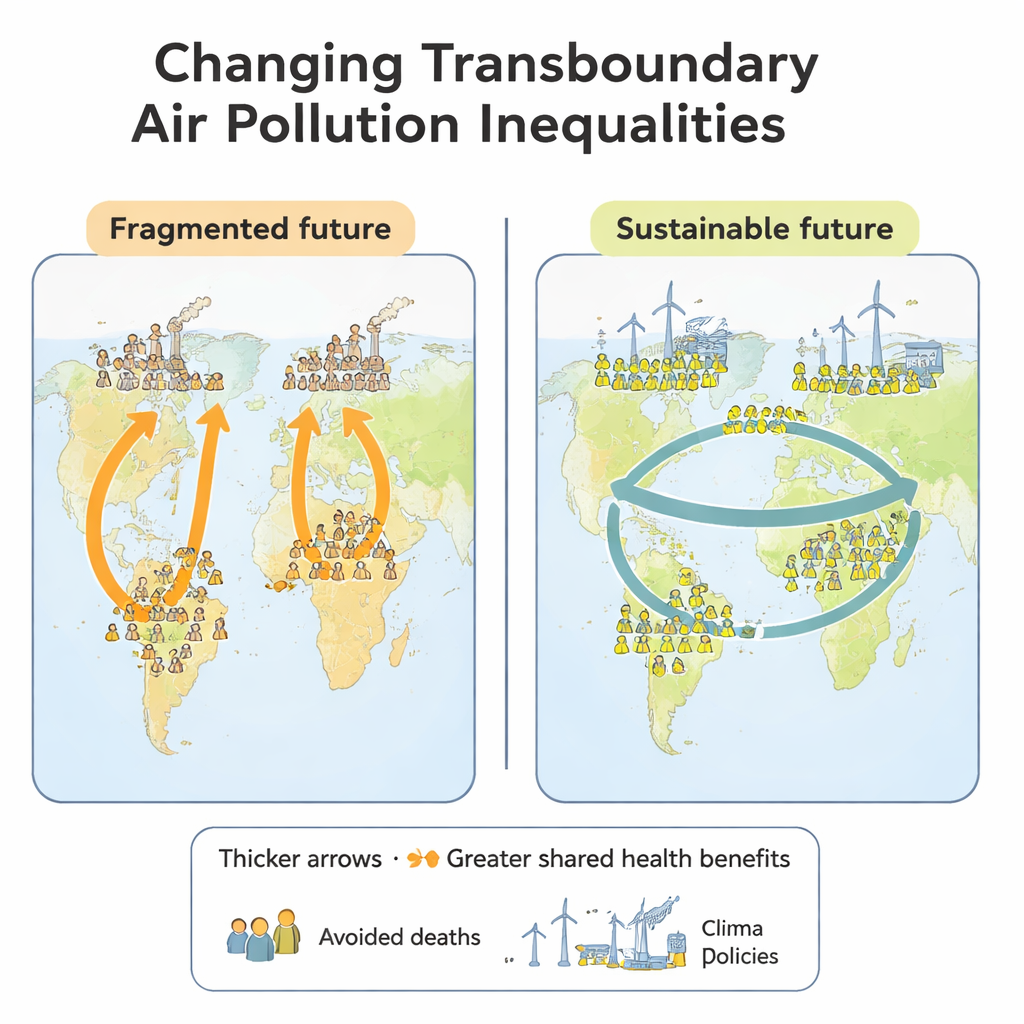
The pattern of who helps whom is not fixed. In futures where development is more unequal and fragmented, many African countries become even more dependent on outside action, because they industrialize more slowly while richer regions remain the main sources of pollution cuts. The authors also examine “exchanges” of benefits between pairs of countries or regions. Often one partner sends many more health benefits than it receives. For example, some neighboring country pairs in Africa and Asia show large imbalances in who helps whom through cleaner air. Shifting from a fragmented to a more sustainable development path tends to make many of these exchanges more balanced and allows lower-income countries to contribute more to shared health gains.
Designing climate policies that are fair in the air we share
For a layperson, the main message is that climate policy is not just about cutting carbon or counting total lives saved. It also shapes who depends on whom for clean air. Strong, global climate action greatly reduces deaths from air pollution overall, but without attention to how societies develop and who takes action, it can leave poorer countries unusually reliant on decisions made in wealthier capitals. Climate strategies that pair deep emission cuts with fair, inclusive development give developing nations more power to clean their own air while still benefiting from their neighbors’ actions. In a world where the air we breathe crosses borders daily, fair climate policy becomes a matter of shared responsibility as well as shared survival.
Citation: Nawaz, M.O., Henze, D.K. National climate action can ameliorate, perpetuate, or exacerbate international air pollution inequalities. Nat Commun 17, 1649 (2026). https://doi.org/10.1038/s41467-026-68827-0
Keywords: air pollution, climate policy, health impacts, environmental inequality, transboundary pollution