Clear Sky Science · en
Saturation of space weathering in shaping lunar regolith particle morphology
Why Moon Dust Still Matters
The Moon may look calm and unchanging, but its surface is constantly battered by tiny meteoroids and bombarded by particles from the Sun. This invisible sandblasting, called space weathering, gradually grinds and reshapes the lunar soil, or regolith. Understanding how fast this process works, and whether it ever “finishes,” matters for reading the Moon’s history, planning future landings, and predicting how dusty surfaces will behave on other airless worlds.
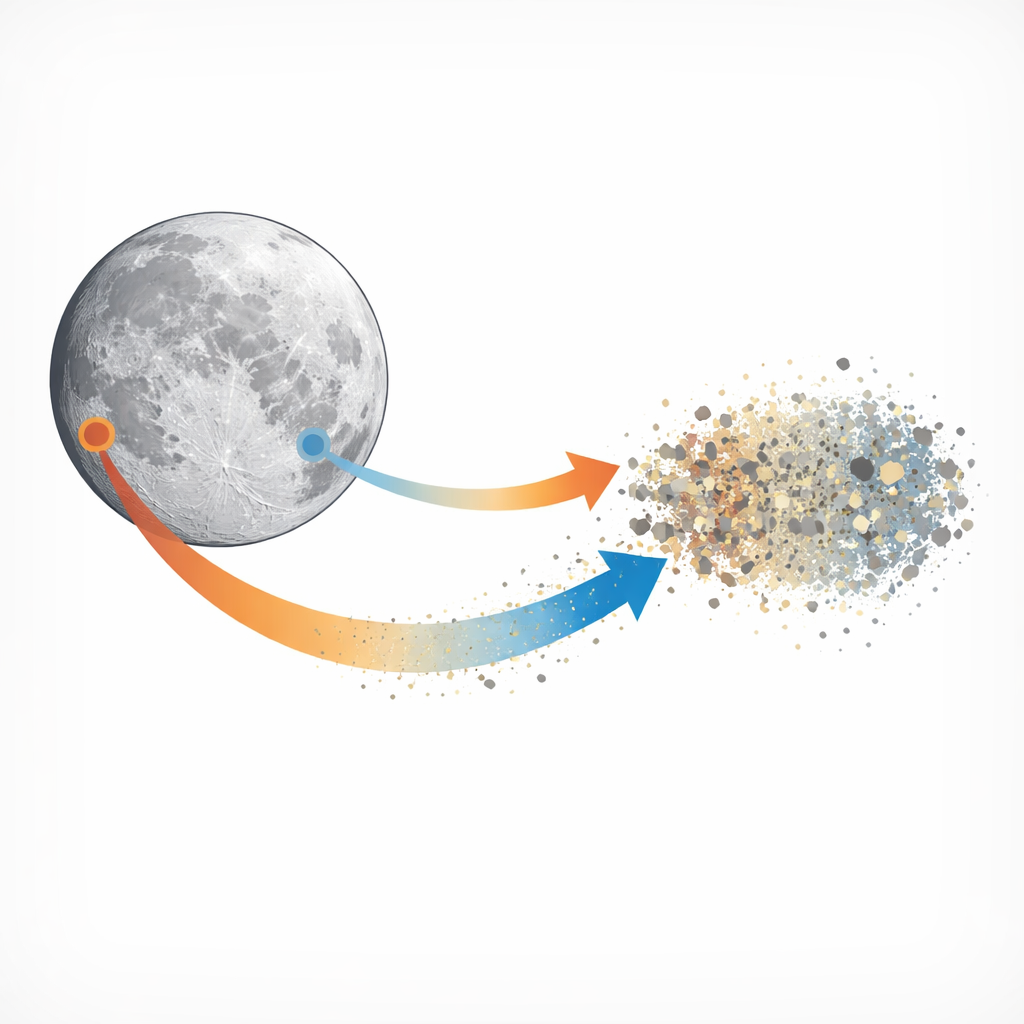
Two New Samples from Opposite Sides of the Moon
China’s Chang’e‑5 and Chang’e‑6 missions recently brought back soil from two very different places: a young lava plain on the Moon’s Earth‑facing side and another young lava region on the hidden farside. These paired samples are the youngest mare (dark lava) soils ever returned, giving scientists a rare chance to compare how soil evolves under similar ages but different local conditions. Earlier work showed that the two sites differ in lava chemistry and in how strongly they were hit by micrometeorites, hinting that their soil grains might also look quite different under the microscope.
Seeing Inside Thousands of Grains in 3D
Instead of hand‑picking and slicing a few grains, the researchers scanned bulk soil from both missions using high‑resolution X‑ray micro‑CT, similar to a medical CT scan but at micrometer scale. They then trained machine‑learning algorithms to automatically separate and identify individual particles in three dimensions. This allowed them to classify tens of thousands of grains as basalt fragments, glass‑rich impact clumps called agglutinates, mixed rock pieces known as breccias, and single‑mineral grains of different densities. For each type, they measured shape descriptors such as how stretched, smooth, or rounded each grain was, building a statistically robust picture of regolith morphology instead of relying on a few showcase particles.
Different Origins, Different Impacts, Same Grain Shapes
The chemical fingerprints of the basalt grains confirm that the two sites have distinct volcanic stories. Nearside Chang’e‑5 basalts contain more plagioclase, a lighter mineral, while farside Chang’e‑6 basalts are denser and relatively richer in darker minerals. The team also examined agglutinates, which form when micrometeorite impacts melt and weld soil fragments into vesicle‑rich glassy clumps. Larger agglutinates from the Chang’e‑6 soil have markedly lower internal porosity than those from Chang’e‑5, a sign that the farside region endured hotter, more energetic micrometeorite hits that let gas escape more efficiently from the melt. Despite these contrasts in lava source and impact intensity, when the authors compared grain shapes across matching particle types and sizes, the distributions of aspect ratio, smoothness, and roundness from the two sites were almost indistinguishable.
When Space Weathering Runs Out of Room to Act
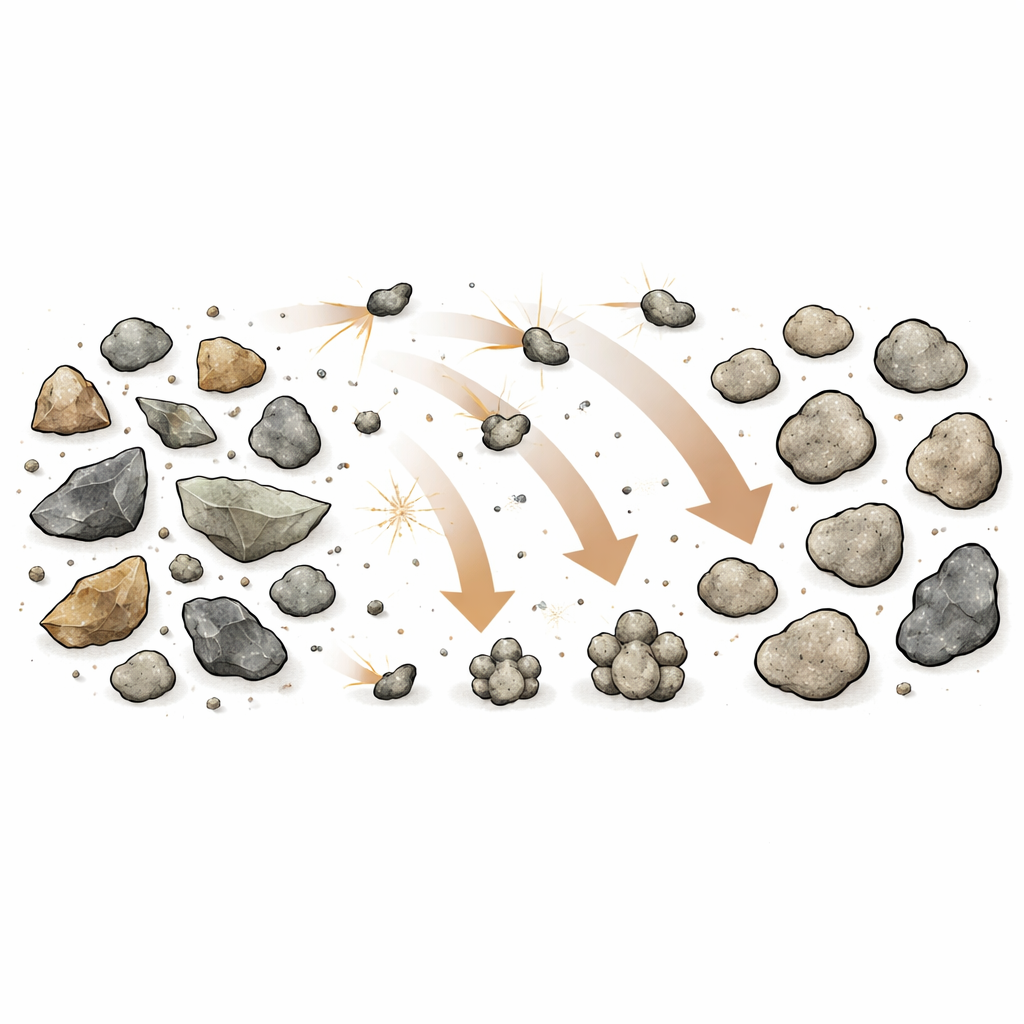
This surprising similarity suggests that, for the dominant “bulk soil” grains between about 20 and 200 micrometers, space weathering drives particle shapes toward a common end state. The main sculpting process is not catastrophic shattering but slow “gardening”: countless small collisions that abrade, chip, and rework grains while mixing the upper soil. Over time, both simple grains (single crystals or basalt chips) and more complex clumps (breccias and agglutinates) are reshaped until further impacts change their statistics very little. By combining shape data with independent estimates of how long the soils have been exposed at the surface, the team concludes that this morphological saturation is reached in roughly 2.2 million years or less—well within the exposure ages of both Chang’e landing sites, and apparently persisting even in older Apollo soils.
What This Means for the Moon and Beyond
For a non‑specialist, the key message is that the Moon’s surface grains do not keep changing forever. After a few million years of bombardment, their shapes reach a kind of equilibrium: different regions, with different lavas and different impact conditions, end up with very similar grain‑shape statistics. This finding helps scientists separate signals of local geology from the universal “polishing” of space weathering when they read the Moon’s surface record. It also suggests that grain shape could serve as a transferable yardstick for interpreting soils on other airless bodies—such as asteroids and small moons—where the same competition between breaking, welding, and abrasion may likewise drive regolith toward stable, predictable forms.
Citation: Luo, A., Cui, Y., Wang, G. et al. Saturation of space weathering in shaping lunar regolith particle morphology. Nat Commun 17, 2220 (2026). https://doi.org/10.1038/s41467-026-68824-3
Keywords: lunar regolith, space weathering, Chang’e samples, micrometeorite impacts, airless bodies