Clear Sky Science · en
Giant near-field nonlinear electrophotonic effects in an angstrom-scale plasmonic junction
Light control in ultra-tiny spaces
Modern technologies from the internet to medical scanners rely on light signals that must be generated, guided, and switched ever faster and in ever smaller devices. But shrinking photonic components down toward the scale of individual atoms pushes today’s methods to their limits. This study shows that by squeezing light into a gap only a few angstroms wide—less than a billionth of a meter—and adding a small electrical voltage, it is possible to boost certain light-conversion effects by thousands of percent. Such extreme control in an ultra-tiny space hints at future chips where optics and electronics meet on truly atomic scales.
Cramming light between metals
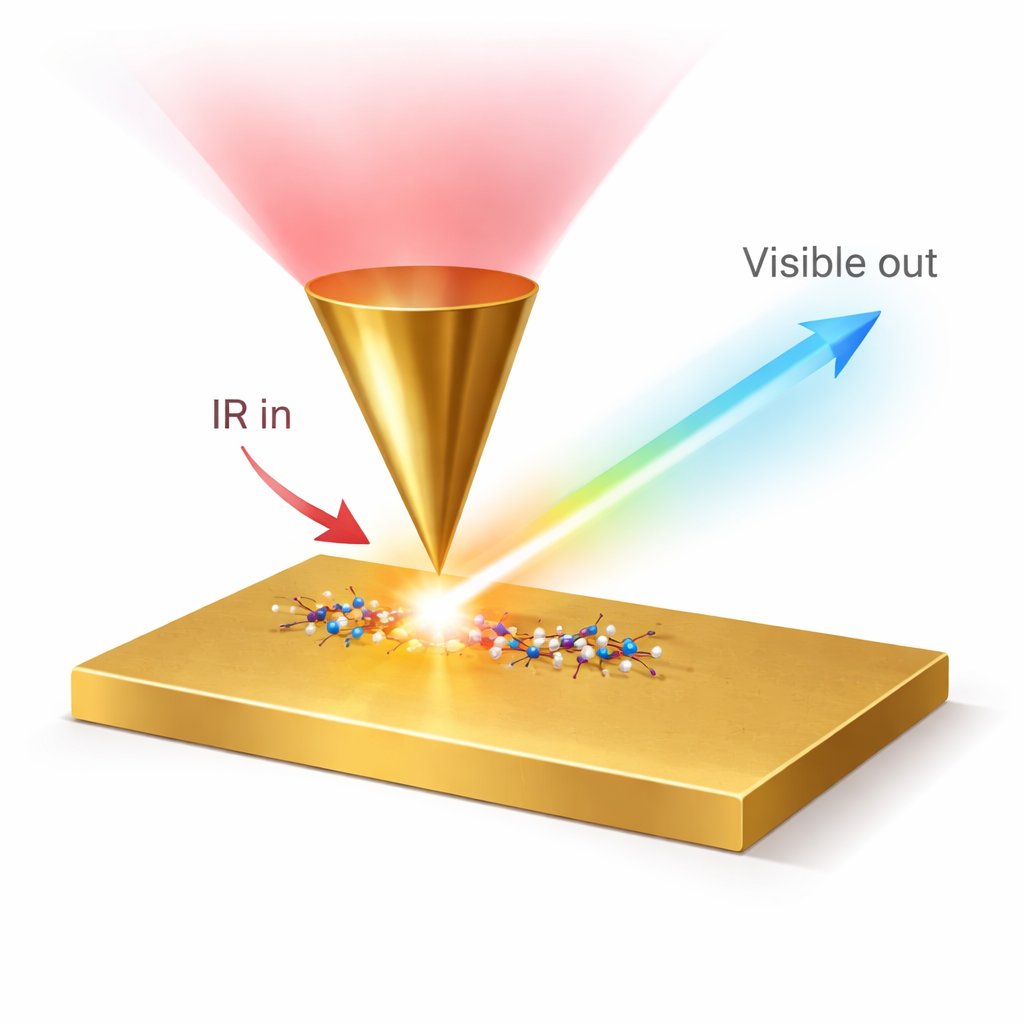
The researchers build on the idea of plasmons—ripples of electrons on a metal surface that can grab incoming light and squeeze it into a volume far smaller than its wavelength. They form a junction between a sharp gold needle and a flat gold surface, separated by a gap of about 5–8 angstroms, roughly the thickness of a single layer of organic molecules. A self-assembled molecular film only ~6 angstroms thick fills this gap. When infrared laser pulses hit the tip, the electromagnetic field becomes enormously intensified in this tiny region, turning the gap into a nanoscale “spotlight” where light interacts unusually strongly with matter.
Turning one color of light into another
Inside this hotspot, the team studies nonlinear optical processes—effects where the output light is not simply a brighter version of the input, but a different color altogether. In second-harmonic generation, two incoming infrared photons combine to produce one photon at twice the frequency, in the visible range. In sum-frequency generation, photons from two different beams (one mid-infrared, one near-infrared) merge to yield higher-energy visible light. Normally these processes are weak, but the intense near field in the angstrom-scale gap makes them far more efficient. The researchers detect this upconverted light emerging both forward and backward from the gap, confirming that it is driven by the confined field between tip and surface.
Light output steered by a single volt
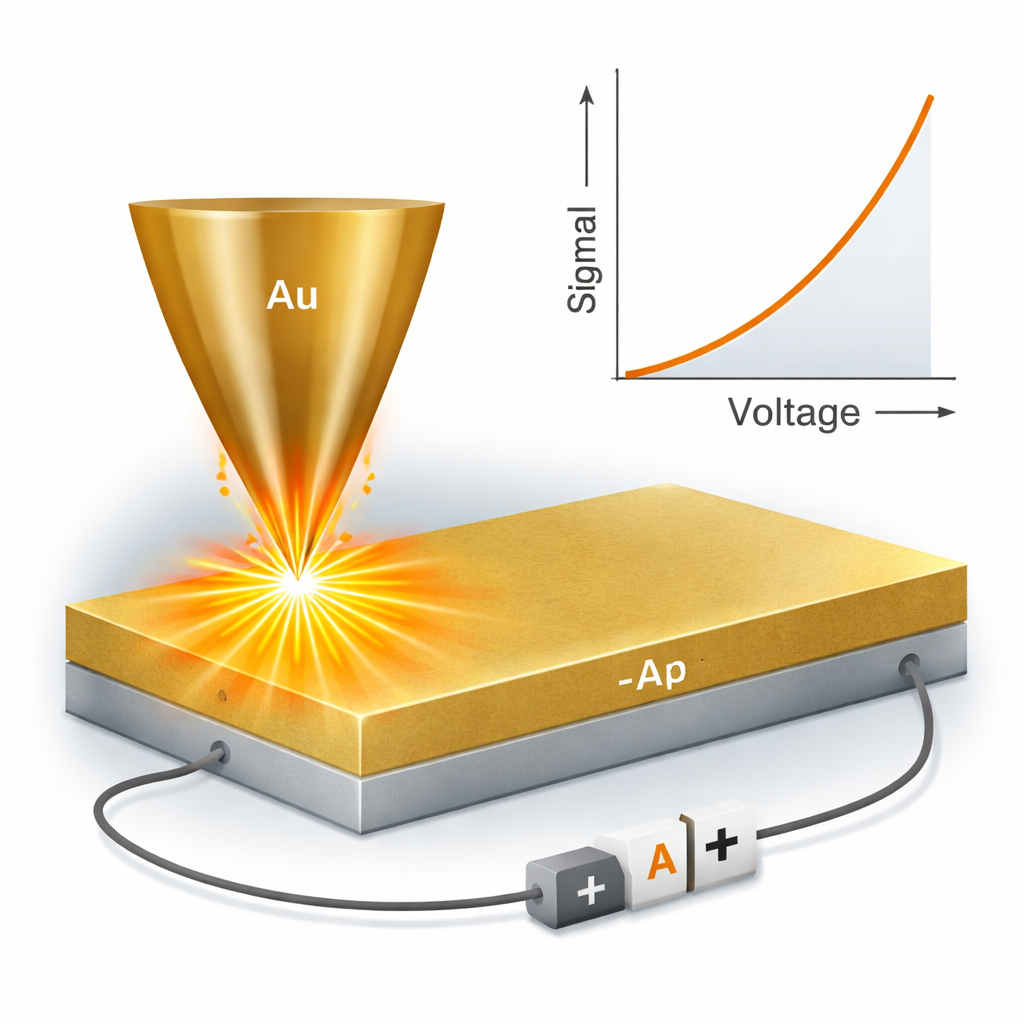
A key advance is that the strength of these nonlinear signals can be tuned not by rebuilding the structure, but simply by applying a small voltage between tip and substrate. Because the gap is so tiny, even a one-volt bias creates an enormous static electric field across it. This field mixes with the oscillating laser field in the molecules and in the gold surface, effectively adding an extra “electro-optic” channel that can either reinforce or counteract the usual nonlinear response. The result is a giant electric-field-induced effect: by sweeping the voltage from about minus one to plus one volt while keeping the geometry fixed, the authors see the upconverted light intensity change by roughly 2000 percent—a modulation depth far beyond what nanometer-scale devices have achieved.
Broadband and robust in real-world conditions
Strikingly, this huge electrical control does not rely on fragile or specially engineered materials. It appears both in the molecular film and even from bare gold, showing that the angstrom-scale gap itself is the main ingredient. The effect also works over a wide span of wavelengths, from mid-infrared inputs to visible outputs, and is observed not only in ultra-high vacuum but also in ordinary air at room temperature. The authors show that quantum effects in such tiny gaps help keep the optical field enhancement nearly constant as the distance shifts by a fraction of an angstrom, ensuring that the observed changes really stem from the applied voltage rather than from mechanical drift.
Toward atomic-scale light switches
For a non-specialist, the takeaway is that the team has created a kind of light “dimmer and color shifter” whose knob is an electrical voltage of less than one volt, acting over a space only a few atoms wide. Compared with existing devices that may need tens or hundreds of volts to achieve similar control, this angstrom-scale approach promises much lower power and far smaller footprints. Because it is largely independent of the specific material in the gap, it could be combined with more exotic media in the future to reach even stronger responses. Together, these results point toward a new class of ultracompact components where electronic and optical signals can be interconverted and modulated at the scale of individual molecules and atoms.
Citation: Takahashi, S., Sakurai, A., Mochizuki, T. et al. Giant near-field nonlinear electrophotonic effects in an angstrom-scale plasmonic junction. Nat Commun 17, 2012 (2026). https://doi.org/10.1038/s41467-026-68823-4
Keywords: plasmonics, nonlinear optics, nanophotonics, electro-optic modulation, tip-enhanced spectroscopy