Clear Sky Science · en
Experimental quantification of hydrogen content in the Earth’s core
Hidden Water Deep Inside Our Planet
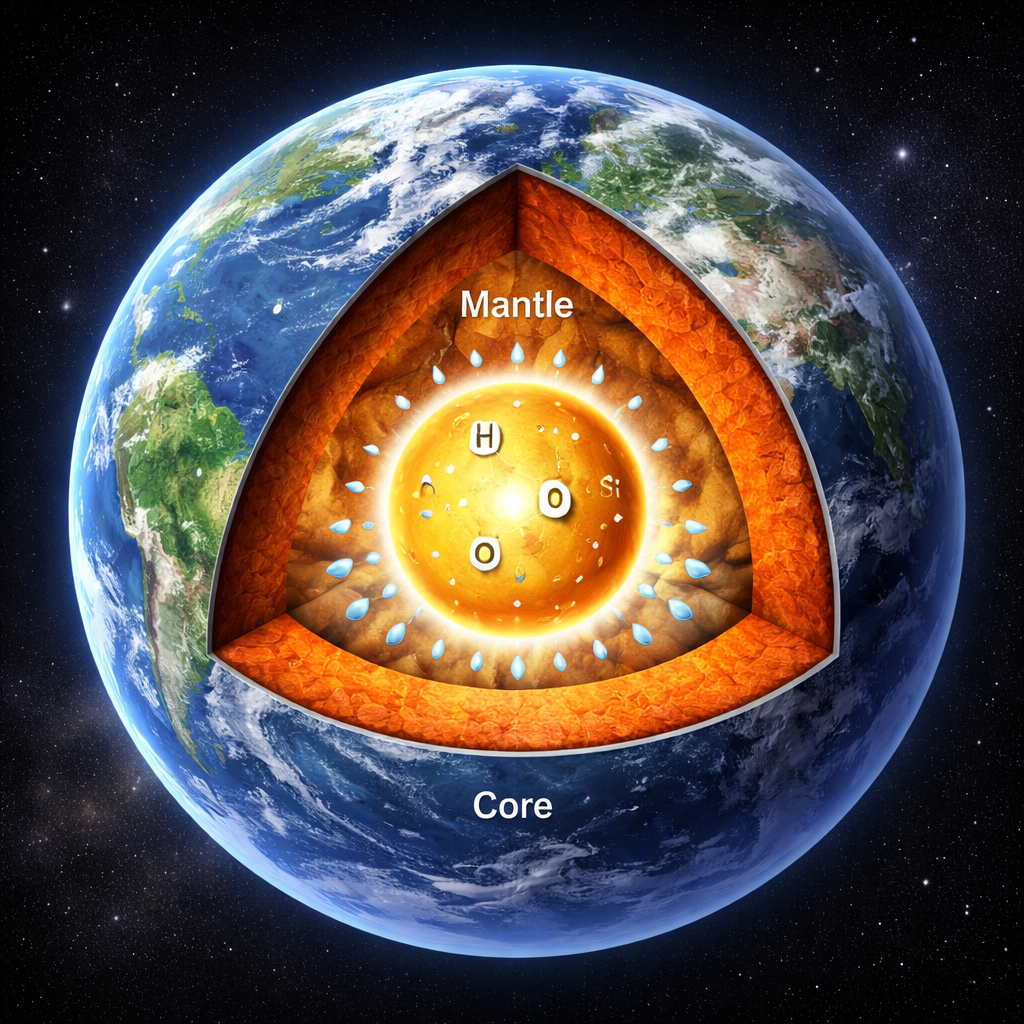
Most of Earth’s water is obvious: it fills our oceans, rivers and clouds. But for decades, scientists have suspected that a huge, invisible store of hydrogen—the key ingredient in water—might be locked away far below our feet, in Earth’s metallic core. This study delivers the first direct experimental evidence that hydrogen can be packed into the core in large amounts, showing that our planet may have carried much of its water inward from the very start, rather than receiving it mainly from icy comets later on.
Why Look for Water in the Core?
Hydrogen is the most common element in the Solar System, yet Earth is often described as “dry” compared with certain primitive meteorites. Although the surface is covered by oceans, earlier work suggested that even more hydrogen might reside in the core, alloyed with iron. Existing estimates, however, were wildly uncertain—spanning a factor of 10,000—because hydrogen is extremely difficult to measure under the crushing pressures and searing temperatures where Earth’s core formed. Most prior studies had to guess hydrogen content indirectly from tiny changes in crystal size, a method easily confused by the presence of other elements like silicon and oxygen.
Recreating Earth’s Fiery Beginnings
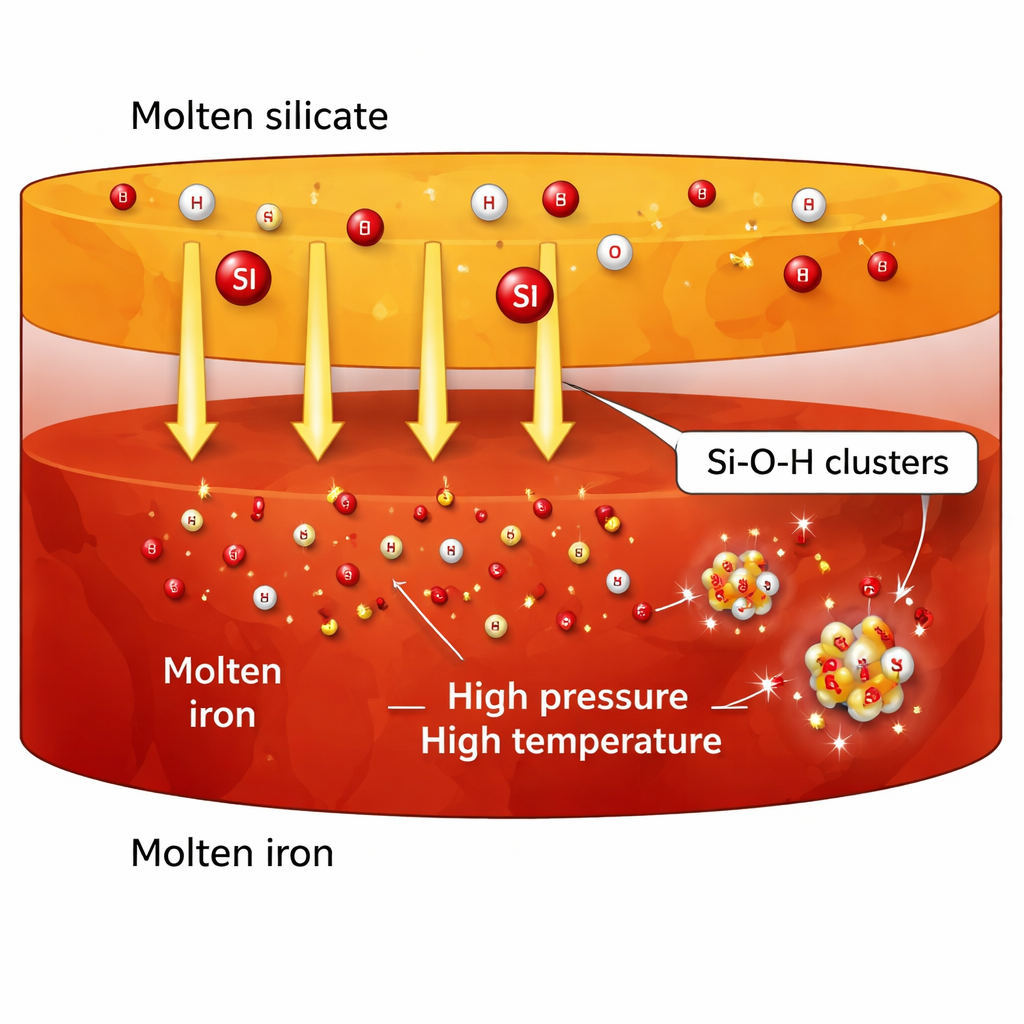
To tackle this problem, the authors recreated early Earth conditions by squeezing and heating tiny samples in diamond anvil cells. They sandwiched pure iron between thin layers of water-bearing molten rock and then blasted the sample with powerful lasers, reaching pressures up to more than a million times atmospheric pressure and temperatures above 5,000 kelvin. Under these conditions, iron behaves like a metallic melt, while the surrounding rock forms a magma ocean—an experimental stand-in for our planet’s birth environment. During these brief but intense heats, hydrogen, silicon and oxygen migrated from the molten rock into the molten metal, just as they would have during core formation 4.5 billion years ago.
Seeing Hydrogen at the Atomic Scale
After rapidly cooling the samples, the researchers used an advanced technique called atom probe tomography. They shaped the recovered metal into needle-like tips only tens of nanometers wide and then evaporated atoms from the tip one by one, measuring their mass and position. This let them build three-dimensional maps of the sample’s chemistry at nearly atomic resolution. They discovered that, as the molten metal cooled, silicon and oxygen collected into nanoscale clusters within the iron. Crucially, these clusters also contained large amounts of hydrogen, forming tiny regions enriched in all three elements together. The chemical signatures showed that this hydrogen could not be explained by stray gas in the instrument—it had to come from the experimental sample itself.
How Much Hydrogen Fits in the Core?
Because hydrogen and silicon bonded with oxygen in nearly equal molar amounts inside these clusters, the team could estimate hydrogen in the core by using silicon as a proxy. Unlike hydrogen, silicon content in Earth’s core is comparatively well constrained by geophysical models and experiments, falling between about 2 and 10 weight percent. Assuming the roughly one-to-one hydrogen-to-silicon ratio observed in the experiments, the authors infer that Earth’s core likely contains between 0.07 and 0.36 weight percent hydrogen. Expressed more intuitively, that is equivalent to about 9 to 45 times the amount of water currently present in Earth’s oceans.
What This Means for Earth’s Water Story
These findings support a picture in which Earth gained much of its water during the main stages of planetary growth, rather than relying primarily on late-arriving icy bodies. If the core houses dozens of oceans’ worth of hydrogen, then the bulk Earth may contain close to 1 percent water by weight when surface, mantle and core are all counted together. Over geological time, some of this deep hydrogen, bound in silicon- and oxygen-rich phases, could be released back into the mantle and perhaps even influence volcanic activity and the long-term water cycle. For non-specialists, the key idea is simple: our seemingly familiar blue planet may hide a vast, ancient ocean’s worth of hydrogen in its metallic heart, reshaping our understanding of where Earth’s water came from and how it circulates through the deep interior.
Citation: Huang, D., Murakami, M., Gerstl, S. et al. Experimental quantification of hydrogen content in the Earth’s core. Nat Commun 17, 1211 (2026). https://doi.org/10.1038/s41467-026-68821-6
Keywords: Earth core hydrogen, deep Earth water, planetary accretion, metal silicate partitioning, atom probe tomography