Clear Sky Science · en
Interventional applications of a Stroke Heat Risk Prediction Model produce health benefits
Why hot days matter for your brain
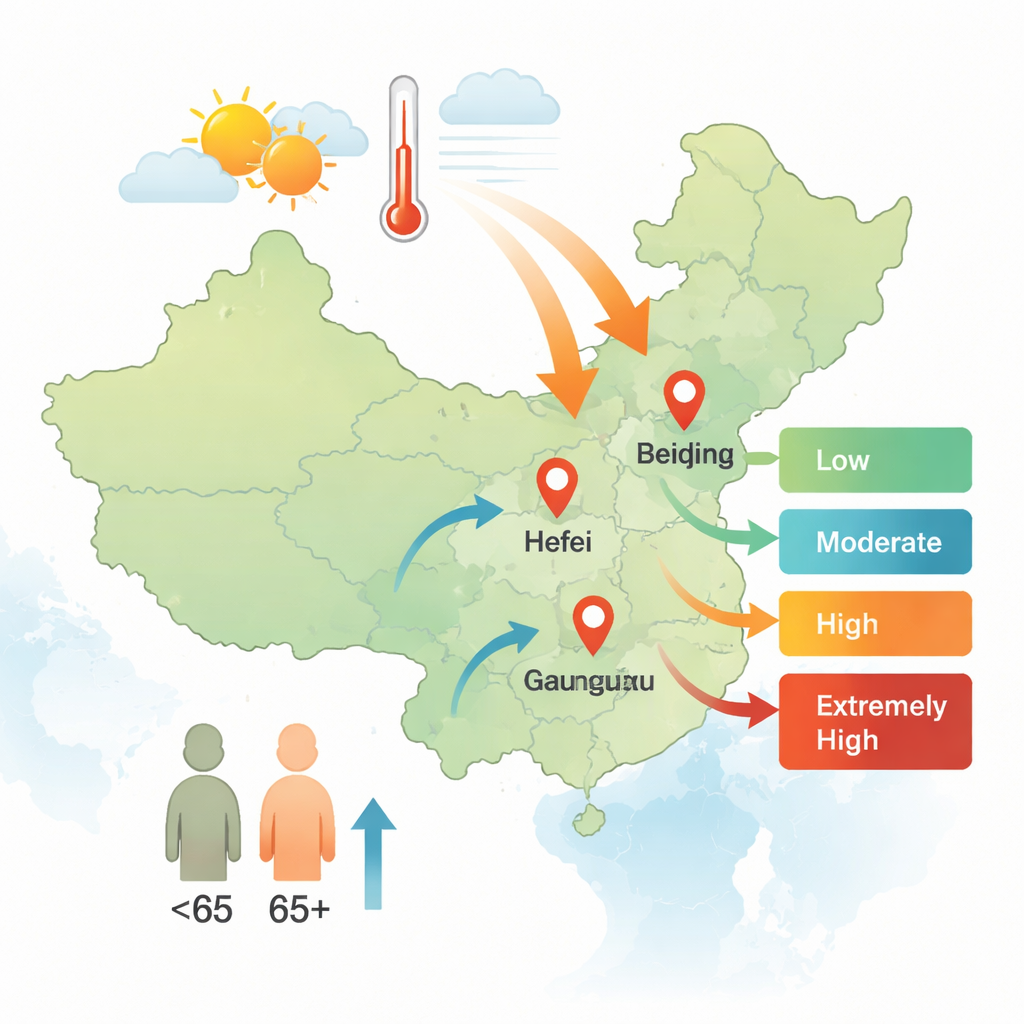
As summers grow hotter, most of us think about sunburn and dehydration, not strokes. Yet mounting evidence shows that high temperatures can quietly push vulnerable brains over the edge. This study asks a simple but urgent question: can we turn weather forecasts into precise health alerts that actually prevent heat-related strokes, especially in older adults? By tracking deaths across hundreds of Chinese counties over nearly a decade, the researchers build a new kind of warning system that translates heat into clear, graded stroke risk for different ages, regions, and sexes.
From weather reports to health risk scores
Most heat warnings today are designed by meteorologists, not doctors. They typically flash a color when temperatures pass a single national threshold, regardless of who lives there or how sensitive they are. The authors argue that this “one-size-fits-all” approach misses the real story: people in hotter climates may tolerate higher temperatures, and older adults are far more vulnerable than younger people. To fix this, they combed through 28,116 stroke deaths recorded in 304 counties across China between 2013 and 2022, combining those records with detailed temperature, humidity, wind, and air pollution data.
Finding the danger zone for stroke on hot days
Using statistical methods that track how daily temperature changes line up with daily stroke deaths, the team uncovered a curved relationship: as temperatures climbed above a local "comfort" point, stroke deaths first rose slowly and then much faster. The effect was strongest in people 65 and older, and present in both men and women. By examining where the risk curve steepened most sharply, the researchers set cutoffs that divide heat-related stroke risk into four intuitive bands based on “excess risk”: low (0–5%), moderate (5–10%), high (10–40%), and extremely high (40% and above). These bands form the backbone of their Stroke Heat Risk Grading Prediction Model.
Testing the model in the real world
The scientists did not stop at building the model; they tested it using more recent, person-level data from 2019 to 2022. They compared days tagged as low, moderate, high, or extremely high risk and asked how likely a stroke death was in each band. In the general population, the highest level was linked to about a 14% jump in stroke deaths compared with the lowest level, rising to about 16% in older adults. The pattern was clear and stepwise: each higher level brought higher risk, showing that the grading system meaningfully tracks health danger, not just temperature.
Outperforming traditional heat alerts
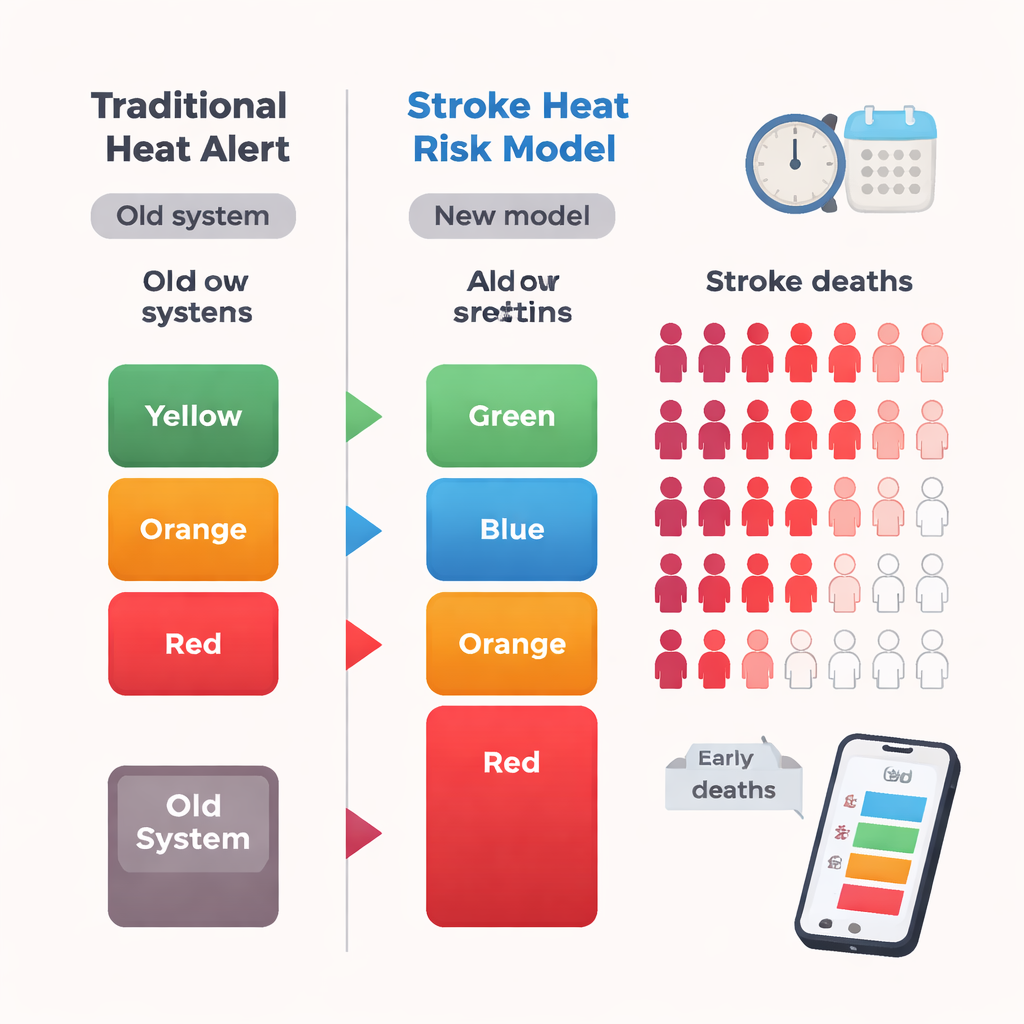
The team then pitted their health-centered model against the existing heatwave warning system used by the China Meteorological Administration. They used simulations to estimate how many stroke deaths due to heat could be avoided if protective actions were triggered whenever each system issued a warning. Across China from 2019 to 2022, they estimated 1,775 heat-related stroke deaths. The new model could have prevented about 49% of these deaths overall—nearly twice the 17% that might be avoided under the current meteorology-based system. For older adults, the potential benefit was even larger: about 60% of heat-attributable stroke deaths could be averted using the new stroke-focused alerts.
From research model to everyday digital tool
Because it uses only basic personal details—age, sex, and location—plus weather forecasts, the Stroke Heat Risk Grading Prediction Model can be built into smartphone apps, wearables, or remote medical devices. People could receive daily and week-ahead stroke heat-risk levels, along with simple advice on staying cool, adjusting outdoor activity, keeping medications on track, and seeking care if symptoms arise. In practical terms, the study concludes that a tailored, four-level, health-first warning system can substantially cut heat-related stroke deaths, particularly among older adults, and offers a realistic blueprint for turning climate data into lifesaving, personalized guidance.
Citation: Zhang, J., Zhang, M., Sun, Q. et al. Interventional applications of a Stroke Heat Risk Prediction Model produce health benefits. Nat Commun 17, 2058 (2026). https://doi.org/10.1038/s41467-026-68815-4
Keywords: heat-related stroke, climate and health, early warning systems, older adults, digital health tools