Clear Sky Science · en
Natural variation in Phosphatidylinositol 4-Kinase OsPI4Kγ7 and its interaction with OsLIC balance rice yield and latitudinal adaptation
How a Single Rice Gene Helps Feed a Changing World
Rice feeds more than half of humanity, so even small boosts in each plant’s productivity can translate into huge gains for global food security. At the same time, rice is grown from steamy tropics to cool northern plains, and varieties must flower at the right time for their local climate. This study uncovers how natural differences in one rice gene help balance two often competing goals: producing more grain and adapting to different latitudes.
A Molecular Lever for Grain Production
The researchers began by searching the genomes of hundreds of rice varieties for DNA changes linked to grain number per panicle, a key yield trait. They homed in on a gene called OsPI4Kγ7, which belongs to a family of enzymes originally known for modifying membrane fats but here acts as a protein kinase—a kind of molecular switch that adds phosphate groups to other proteins. Plants lacking this gene made shorter panicles with fewer side branches and fewer grains, while plants carrying a normal copy regained their productivity. These experiments showed that OsPI4Kγ7 is a positive driver of grain yield and shapes grain size by influencing how cells in the grain hull grow and divide. 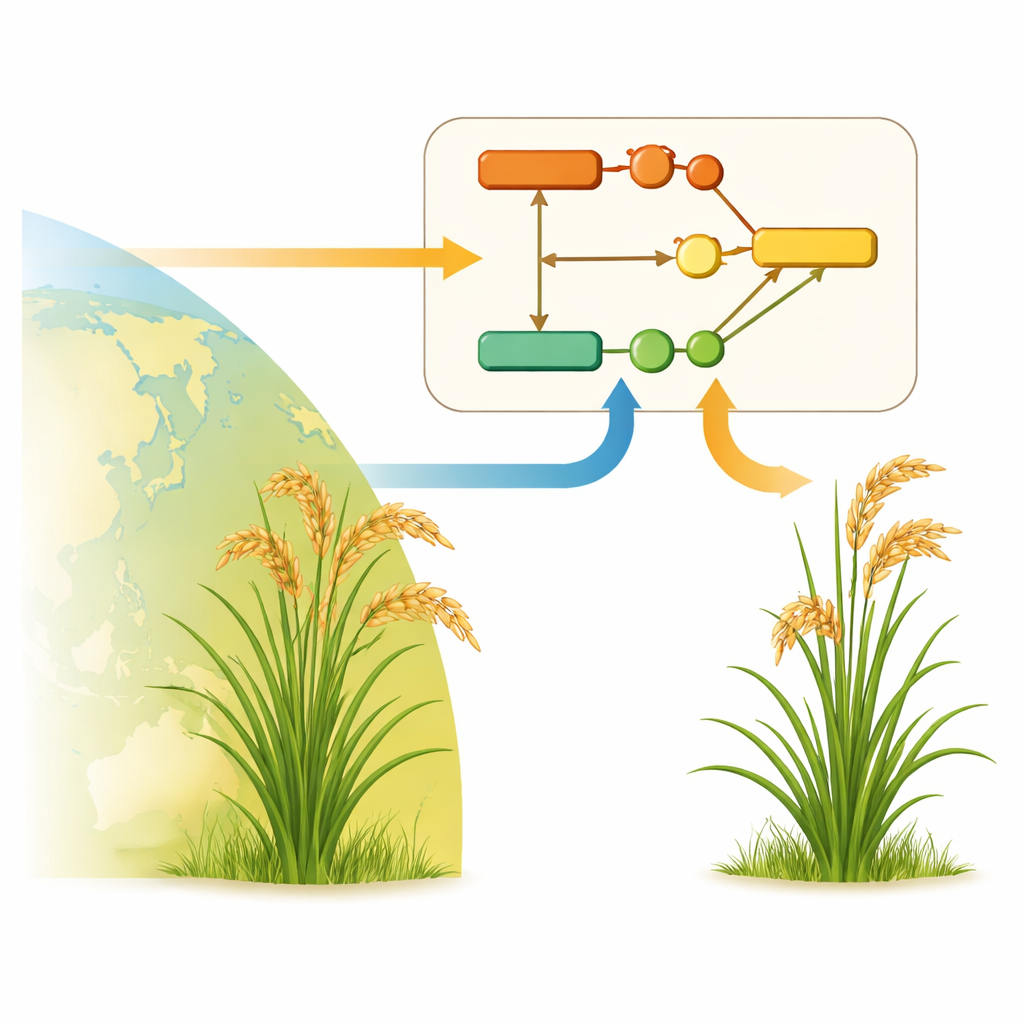
Teamwork Between Two Key Proteins
To understand how OsPI4Kγ7 exerts such influence, the team looked for its molecular partners. They discovered that it physically interacts with another protein called OsLIC, a transcription factor that sits at a crucial junction in the hormone network that controls rice architecture and grain production. In living cells, the kinase binds to OsLIC, stabilizes it against breakdown, and attaches a phosphate group at a single, critical position. This chemical tag encourages more OsLIC to move from the cell’s outer region into the nucleus, where it can switch genes on or off. When OsLIC carries a version of that site that mimics permanent phosphorylation, it becomes more stable and accumulates in the nucleus; when the site cannot be phosphorylated, OsLIC is rapidly degraded and less effective.
From Molecular Signals to Plant Shape
Once in the nucleus, OsLIC controls a set of downstream genes that fine-tune how leaves stand, how tall plants grow, and how many grains they bear. The study shows that OsPI4Kγ7, by boosting the active, nuclear form of OsLIC, strengthens its ability to repress some target genes and activate others, in line with an overall push toward higher yield and more favorable panicle structure. Importantly, when OsLIC was overproduced in plants that lacked OsPI4Kγ7, the benefit to grain number and yield was only partial. This indicates that OsLIC’s full yield-promoting power depends in part on being tuned by OsPI4Kγ7, but that other pathways can also feed into this hub.
Genetic Variants that Tune Yield and Flowering Time
Natural rice populations carry distinct versions, or haplotypes, of the OsPI4Kγ7 gene. The authors showed that the most important differences lie not in the protein itself but in its promoter—the DNA stretch that controls how strongly the gene is switched on. A single DNA letter change in this region alters how tightly another regulator, OsTb2, can bind and repress OsPI4Kγ7. One promoter version, called HapA, leads to higher gene activity, more grains per panicle, and greater yield. Another, HapG, results in lower activity and fewer grains. These variants also influence when rice plants flower: loss of OsPI4Kγ7 causes earlier heading, while extra copies delay it. That means the same gene simultaneously affects how much rice is produced and how long plants take to reach flowering.
Adapting Rice from the Tropics to Higher Latitudes
When the researchers mapped where the different OsPI4Kγ7 haplotypes occur around the world, a clear pattern emerged. The high-expression, high-yield HapA variant dominates in indica rice grown at low latitudes, where long growing seasons favor plants that take more time to build biomass and grain. In contrast, the lower-expression HapG variant is common in japonica rice cultivated at higher latitudes, where short summers reward plants that flower earlier, even if they yield somewhat less. Historical and evolutionary analyses suggest that as japonica rice spread northward from its tropical origins, selection favored HapG to ensure timely heading, helping rice colonize cooler regions. Modern breeding, however, has begun to reintroduce the high-yield HapA variant into improved backgrounds that already carry other adaptations, softening this trade-off and allowing high-latitude varieties to capture more of HapA’s yield benefits. 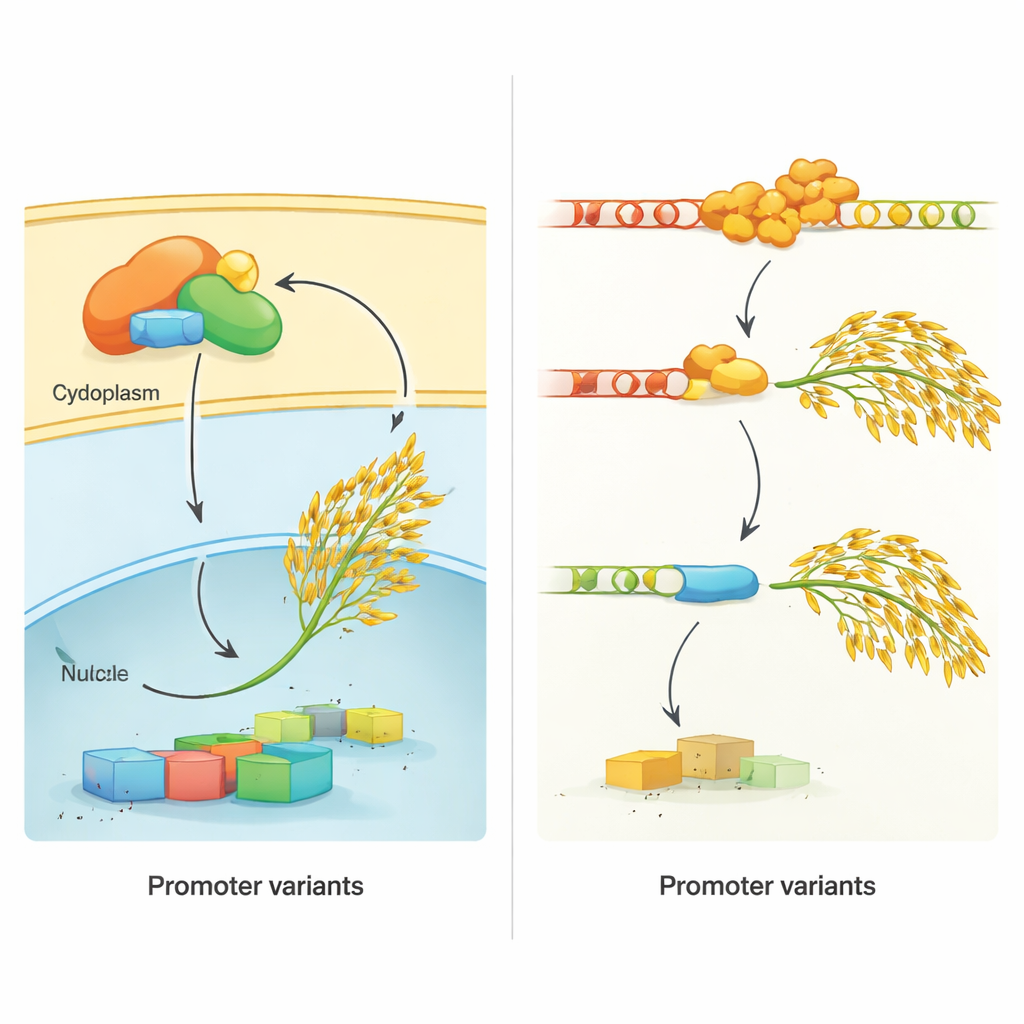
Balancing Food Production and Climate Adaptation
In plain terms, this work reveals how a single gene acts as a dial between “more grain” and “earlier harvest,” and how evolution and breeders have turned that dial differently in tropical indica and temperate japonica rice. By clarifying how OsPI4Kγ7 interacts with partner proteins, shapes hormone signaling, and varies across climates, the study offers a roadmap for designing rice varieties that keep pace with both rising food demand and shifting growing seasons.
Citation: Zhu, R., Yang, T., Han, S. et al. Natural variation in Phosphatidylinositol 4-Kinase OsPI4Kγ7 and its interaction with OsLIC balance rice yield and latitudinal adaptation. Nat Commun 17, 2090 (2026). https://doi.org/10.1038/s41467-026-68814-5
Keywords: rice yield, flowering time, latitudinal adaptation, plant breeding, gene haplotypes