Clear Sky Science · en
Duration of super-emitting oil and gas methane sources
Why a Few Methane Leaks Matter So Much
Most people picture climate pollution from oil and gas as a steady, invisible haze. This study shows a different reality: a small number of very large methane leaks from wells, compressors, tanks, and pipelines can dominate the pollution picture. By flying over New Mexico’s part of the Permian Basin with advanced sensors, researchers tracked how often these “super-emitting” sites turn on and off, how long they last, and how much they contribute to the region’s total methane problem.
Flying Eyes Over an Energy Hotspot
To understand these big leaks, the research team used an aircraft equipped with imaging instruments to scan nearly all oil and gas infrastructure on the New Mexico side of the Permian Basin during an 18-day campaign in spring 2024. They covered tens of thousands of wells, hundreds of compressor stations and gas plants, and thousands of kilometers of pipelines, often revisiting the same areas multiple times per day. This wide and repeated coverage let them see not just where large methane plumes occurred, but also whether they persisted, disappeared, or reappeared over hours and days. 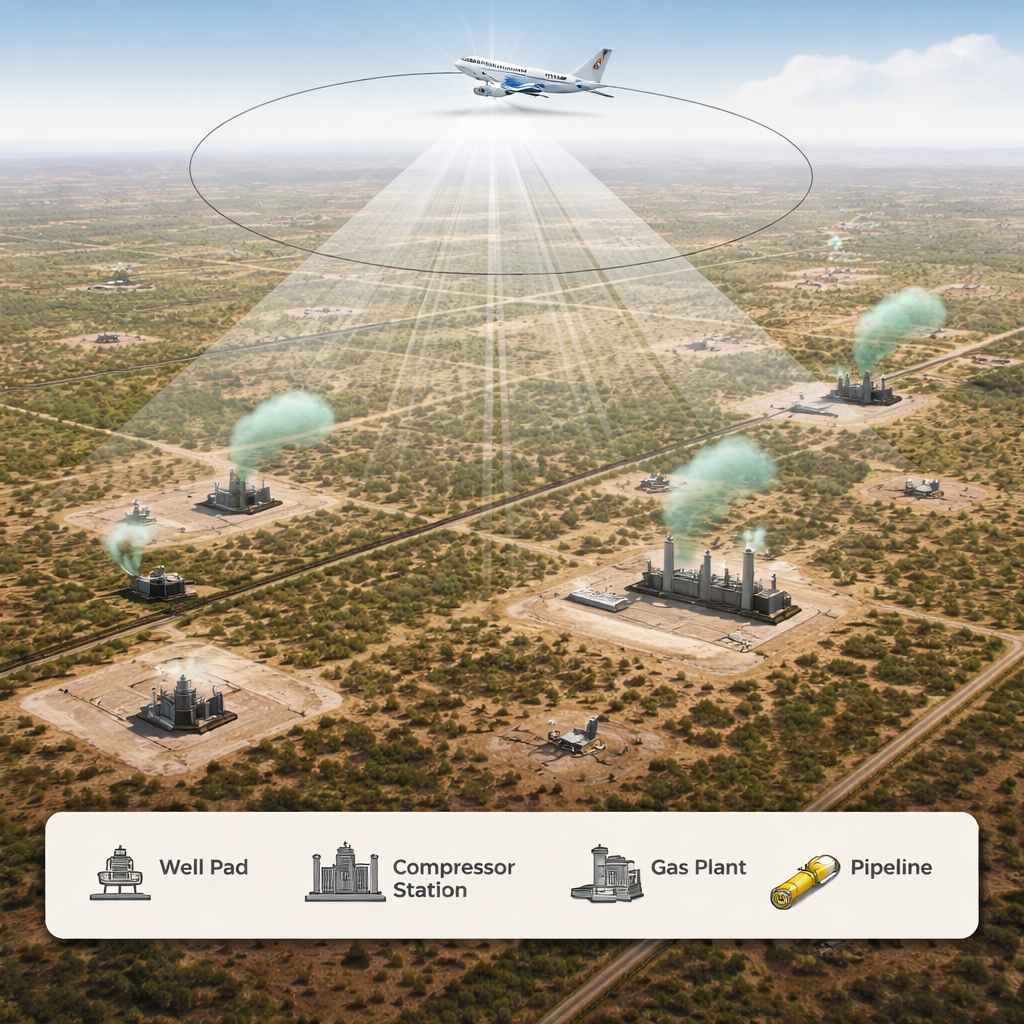
Big Leaks From a Tiny Fraction of Sites
The aircraft detected more than 500 individual sources that were releasing methane at very high rates, greater than 100 kilograms per hour. These came from a small fraction of the infrastructure—less than 1 percent of facilities and only about one detection per several hundred kilometers of pipeline. Yet when the researchers compared their airborne measurements to independent estimates of total methane emissions from satellites, they found that these super-emitters likely account for roughly half of all methane released in the studied area, with a plausible range from a bit more than one-third to nearly three-quarters. In other words, a handful of worst offenders produce a surprisingly large share of the climate-warming gas.
How Long Do Super-Emitters Last?
A key uncertainty for regulators and companies is whether these large leaks are momentary “burps” or long-lived problems. By tracking the same sites over many overflights, the team divided events into those that clearly started and stopped within the campaign, those that were already active or had not yet ended, and a small group that appeared to be leaking continuously for the full three weeks. Most events lasted at least a couple of hours, and some appeared to continue for days to weeks. When the researchers added up emissions using the shortest plausible durations, they obtained about half of what they would infer from a simple basin-average view. Using the longest plausible durations overshot the total, showing that realistic averages must lie in between—and that getting duration right is crucial for honest accounting.
Connecting Missing Hours and Missing Leaks
Because the aircraft could not watch every site at every moment, the team explored how many leaks they might have missed during the off-hours. They combined their measured “gap” between time-averaged and time-integrated emissions with simple assumptions about how strong and how long unseen events might be. This analysis showed that if super-emitters were truly very short-lived, lasting only minutes, there would need to be an unrealistically large number of them to fill the gap. Instead, the observed pattern fits a world where typical events last on the order of a few hours, with a smaller but important set of episodes stretching into days or longer. 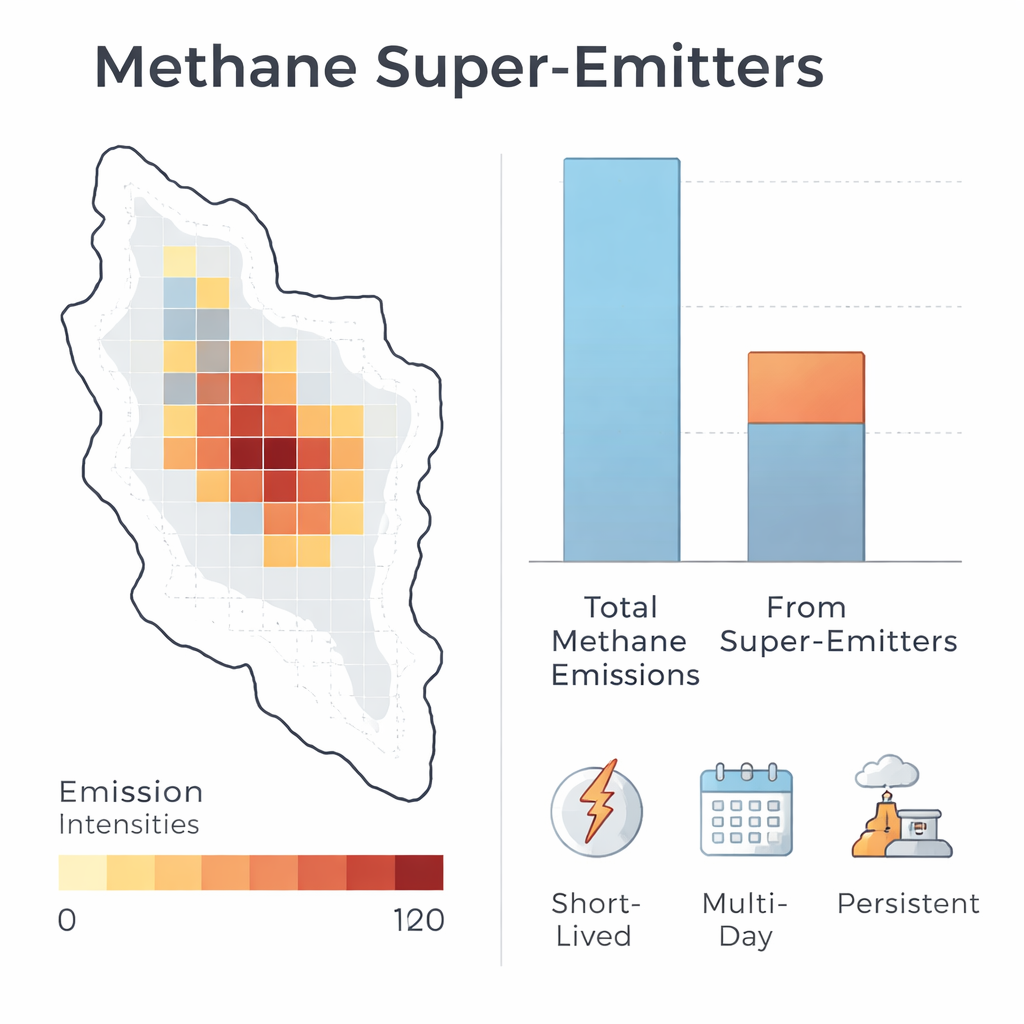
Which Pieces of Equipment Cause Trouble?
By matching methane plumes to high-resolution images and facility maps, the researchers tied leaks to specific types of equipment. Compressors and pipelines together made up nearly 40 percent of all detected sources and were prominent among the long-lived events. Emissions from generic well-site equipment tended to be more intermittent, consistent with shorter, planned operations. Tanks, often located at well sites, showed more persistent behavior, hinting at ongoing malfunctions or poor operating practices rather than brief safety releases. This breakdown points to where rapid repairs and better design could yield the biggest climate benefits.
What This Means for Cutting Methane
For a non-specialist, the main takeaway is that methane control is both a challenge and an opportunity. The study confirms that in a busy oil and gas region, roughly half of the methane pollution comes from a tiny share of very large leaks, many of which persist long enough to be found and fixed. It also shows that regulations and company reports need realistic estimates of how long big events last; using a single “typical” duration can badly misjudge total emissions. Frequent, wide-area monitoring—by aircraft, satellites, and other tools—combined with targeted follow-up on the worst and most persistent sources, offers a practical path to rapid methane reductions with outsized climate impact.
Citation: Cusworth, D.H., Bon, D.M., Varon, D.J. et al. Duration of super-emitting oil and gas methane sources. Nat Commun 17, 2011 (2026). https://doi.org/10.1038/s41467-026-68804-7
Keywords: methane, super-emitters, Permian Basin, oil and gas leaks, aerial monitoring