Clear Sky Science · en
A gradient-structured all-cellulose biofoam enabled by solvent-induced molecular assembly for sustainable insulation modules
A New Kind of Foam for a Cleaner Future
Foam is everywhere in our daily lives, from the insulation in our walls to the packaging that protects deliveries. Most of this foam is made from oil-based plastics that stick around in the environment for centuries and shed harmful microplastics. This article describes a new kind of foam made entirely from cellulose—the same natural material that makes up plant cell walls. The researchers show how to turn plant-derived cellulose into a strong, lightweight, and recyclable foam that can insulate buildings while sharply cutting pollution and carbon emissions.
Why Rethinking Plastic Foam Matters
Traditional plastic foams like polystyrene and polyurethane are popular because they are light, easy to shape, and good at blocking heat and noise. But they mostly come from non-renewable fossil fuels and release large amounts of greenhouse gases during production. Once discarded, these foams do not rot away; instead, they slowly break into tiny plastic fragments that pollute oceans, soil, and wildlife. As governments and international organizations push to curb plastic waste, engineers urgently need replacements that match or exceed the performance of plastic foams without their environmental cost.
Building Foam from Plants Instead of Oil
The team behind this work developed an “all-cellulose” foam they call All-Cel foam. They start by dissolving cellulose from biomass in a special liquid, then use ethanol—essentially alcohol—to gently trigger the cellulose molecules to reassemble into a solid foam. This process happens at room temperature and does not rely on toxic blowing agents or energy-hungry freeze-drying. As ethanol seeps into the liquid, the cellulose chains tangle together and lock into place, forming a three-dimensional network. Because this assembly happens at different speeds near the surface and deep inside, the foam naturally develops a clever “gradient” structure: the outer layers are denser with smaller pores, while the interior is more open with larger, honeycomb-like cells. 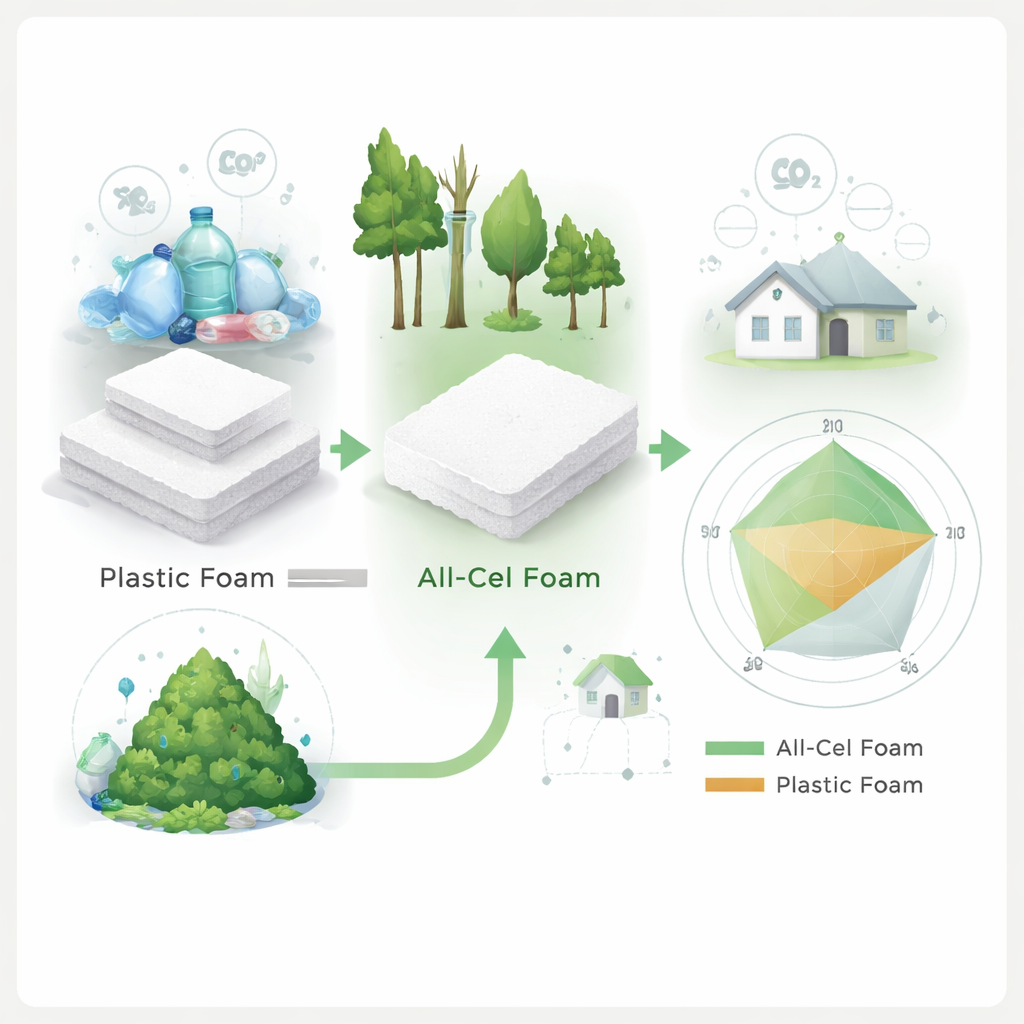
Lightweight, Tough, and Heat-Resistant
This gradient design gives All-Cel foam an unusual mix of properties. It is very light—about one-tenth the density of solid plastics—yet it can support roughly 400 times its own weight, with a compressive stiffness higher than common plastic foams used today. In bending and impact tests, it resists cracking and can absorb blows that shatter standard foams. The material also stands up well to heat: it keeps its stiffness up to around 200 °C and remains stable up to about 264 °C, temperatures at which many plastic foams soften, deform, or fail. When used as an insulating layer between a hot light source and a metal box, the foam sharply slows heat transfer, keeping the box only slightly warmer than room temperature even as the foam’s own surface becomes very hot. Computer simulations of buildings suggest that using All-Cel foam in walls can match the energy savings of widely used plastic insulation.
Safer in a Fire and Kinder to the Planet
Foam in buildings must also be safe in a fire. By soaking All-Cel foam in a solution of phytic acid, a plant-based flame retardant, the authors created a version that burns much less readily than common plastic foams. In controlled fire tests, this treated foam released far less heat and smoke, and the flames went out soon after the ignition source was removed—thanks to a protective char layer that forms on its surface. Just as important, the foam is easy to shape and reshape. It can be cast directly into molds, softened in water and reformed, and even recycled by dissolving used pieces back into solution to make new foam blocks. In soil, All-Cel foam gradually breaks down and disappears over a few months, unlike conventional foams that remain almost unchanged. A life cycle assessment shows that producing this cellulose foam can cut carbon emissions by up to more than half compared with some common plastic foams, while also reducing other environmental impacts. 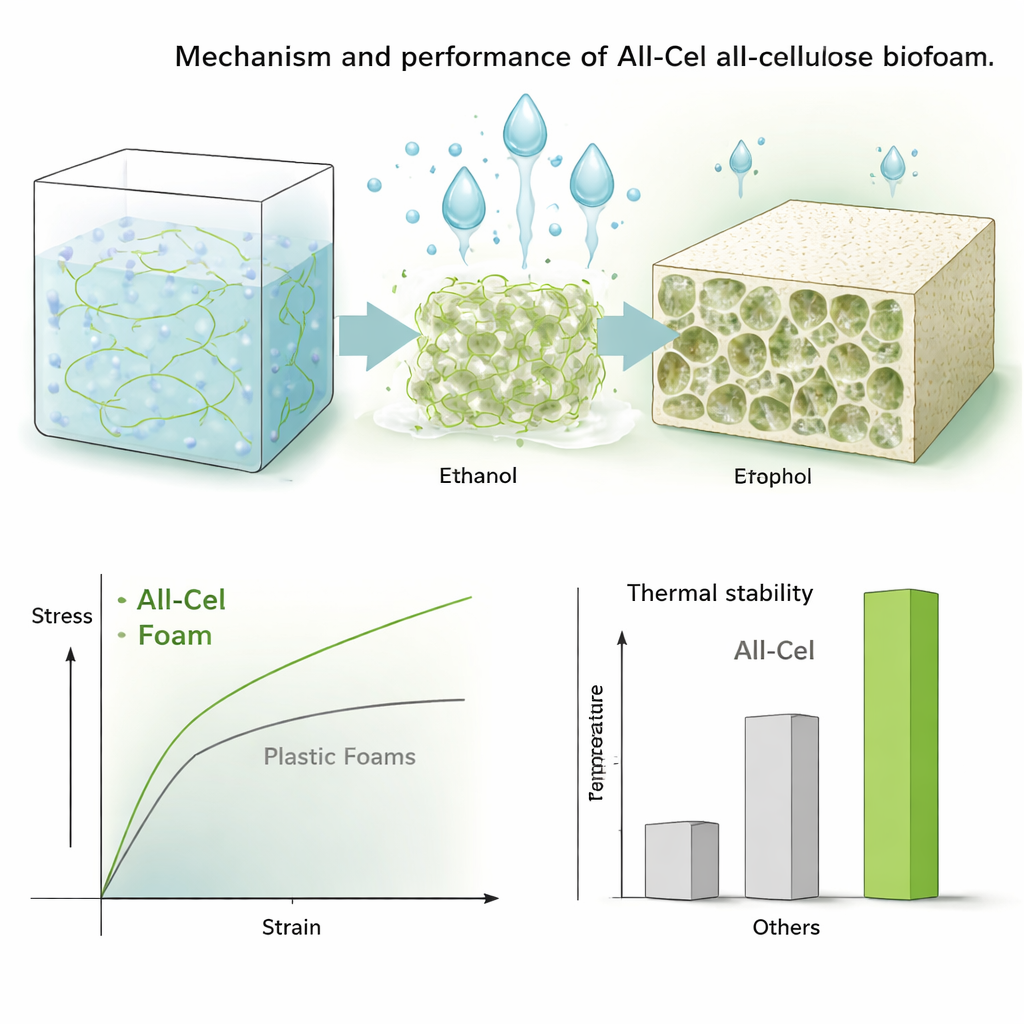
Toward Greener Buildings and Products
For non-specialists, the key message is simple: this research shows that plant-based materials can now compete with, and even surpass, many oil-based foams in strength, safety, and insulation performance. All-Cel foam combines the lightness and usefulness of familiar packaging and building foams with the advantages of renewability, recyclability, and biodegradability. If scaled up successfully, it could help make homes, vehicles, and products more energy-efficient while easing the burden of plastic waste on our planet.
Citation: Zeng, S., Tong, Z., Li, X. et al. A gradient-structured all-cellulose biofoam enabled by solvent-induced molecular assembly for sustainable insulation modules. Nat Commun 17, 1913 (2026). https://doi.org/10.1038/s41467-026-68803-8
Keywords: cellulose foam, green insulation, biodegradable materials, plastic foam alternatives, sustainable buildings