Clear Sky Science · en
Efficient multicolor X-ray excited persistent luminescence enabled by Gd-mediated trap clusters
Glowing After the X-Rays Turn Off
Imagine a medical scan or security screen that keeps glowing clearly long after the X-ray beam is switched off, without extra power and with less radiation to your body. This study reports a new family of materials that can store X-ray energy and slowly release it as visible light in several colors, from violet to red. These long-lasting glows could improve night-vision displays, medical imaging, data storage, and anti-counterfeiting technologies, all using sturdier and more efficient compounds than many options available today.
Why Long-Lasting Light Matters
Persistent luminescence materials keep shining for minutes to hours after a brief exposure to light or X-rays. They are already used in glow-in-the-dark signs and emergency markings, but most commercial versions mainly glow blue or green. Extending this behavior to violet, yellow, and red light, and combining several colors in a single, durable material, has been a major challenge. Existing red and yellow "glow" materials often rely on sulfides, which tend to be dim and chemically unstable, making them less suitable for demanding uses such as precise medical imaging or complex, full-color displays.
Trapping Energy in Tiny Clusters
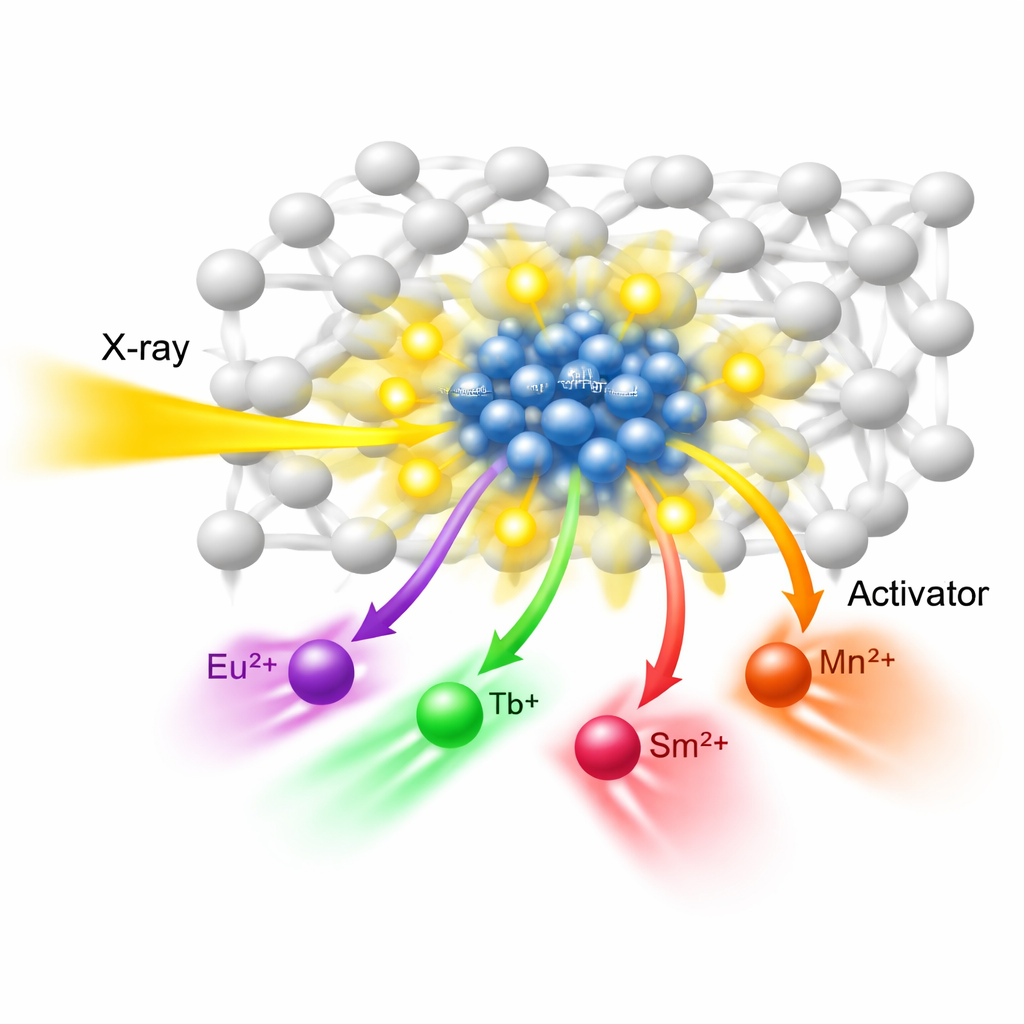
The researchers tackled this problem by designing a new way for the material to hold and manage energy at the atomic level. They started with a robust crystal framework made from alkaline-earth fluorochlorides (compounds containing metals such as barium, calcium, or strontium, along with fluorine and chlorine). Into this framework they added small amounts of gadolinium ions (Gd3+), which naturally group together into compact clusters surrounded by fluorine atoms. When X-rays hit the material, they create defects near these clusters that act like tiny energy traps. Instead of letting the energy wander far through the crystal—where it can be lost as heat—these traps confine energy close to the Gd3+ clusters, ready to be passed on efficiently.
From Invisible X-Rays to Multicolored Glow
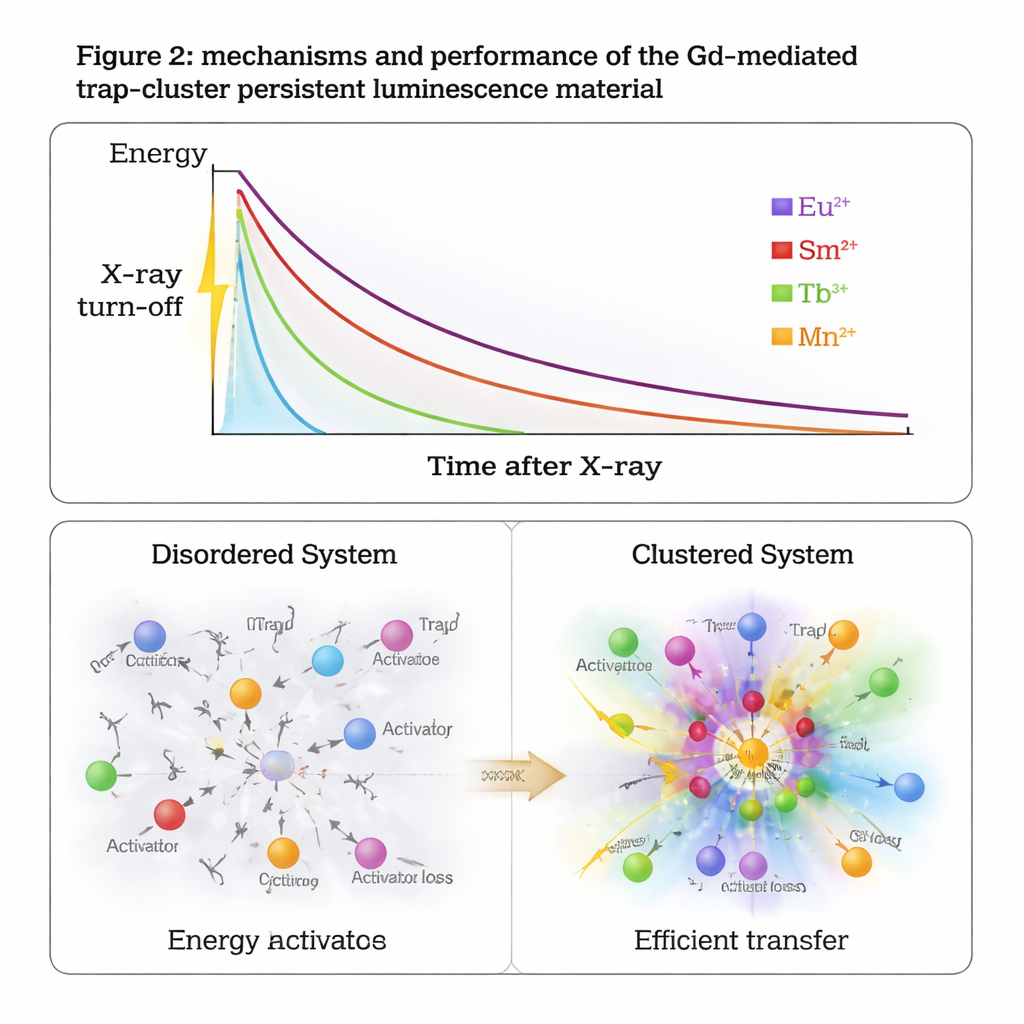
The Gd-based clusters do more than simply store energy: they also serve as hubs that hand it off to different light-emitting ions, called activators. By adding ions such as europium (Eu2+), samarium (Sm2+), terbium (Tb3+), or manganese (Mn2+) into the same host crystal, the team can tune the color of the afterglow across violet, green, yellow, and red. In barium fluorochloride, for example, Gd3+ boosts the violet glow from Eu2+ by about 33 times compared with Eu2+ alone, and similar enhancements—up to roughly 150 times—are seen for other activators and colors. Remarkably, this bright emission is not only strong but also sharp in color and remains stable even after months in air, outperforming widely used commercial glow materials under the same X-ray conditions.
Probing the Hidden Mechanics
To understand why these materials work so well, the authors combined advanced microscopy, X-ray spectroscopy, computer simulations, and measurements of how the glow fades over time. They confirmed that Gd3+ ions tend to cluster in the crystal and that energy traps form preferentially around these clusters, lowering the energy cost of creating and holding defects. Simulations show that when traps and light-emitting ions are crowded together, the chance that stored energy reaches a glowing center is far higher than when everything is spread randomly. Experiments also revealed that energy moves first from the traps to Gd3+ and then onward almost perfectly to the chosen activator, minimizing losses along the way. This clustered architecture, rather than any change in how the material initially absorbs X-rays, is what drives the large gains in brightness and duration.
From Dynamic Displays to Safer X-Ray Imaging
Because the violet glow from Eu2+ is so intense, it can act as a built-in light source to stimulate perovskite quantum dots—tiny crystals that emit bright, pure colors. By pairing the persistent violet emission with different quantum dots, the authors created a palette covering the full visible spectrum and demonstrated patterns whose colors evolve over time after a single X-ray exposure. In another showcase, a red-emitting samarium-based version formed a transparent film that can record high-resolution X-ray images at doses below those commonly used in clinical settings. The film captured fine line patterns and the hidden structure of electronic circuit boards, all using a brief X-ray pulse and reading the image from the delayed glow rather than during irradiation.
A New Blueprint for Glow-in-the-Dark Technology
In simple terms, this work shows how clustering special ions inside a sturdy crystal host can turn ordinary X-ray exposure into long-lasting, color-tunable light. By corralling energy close to where it is needed, the material reduces waste and shines brighter and longer than many established phosphors. The same design idea—building controlled trap clusters that feed different light emitters—could guide the development of next-generation glow materials for safer medical imaging, richer displays, and secure optical information storage, all without sacrificing stability or scalability.
Citation: Yang, B., Li, D., Deng, R. et al. Efficient multicolor X-ray excited persistent luminescence enabled by Gd-mediated trap clusters. Nat Commun 17, 1909 (2026). https://doi.org/10.1038/s41467-026-68799-1
Keywords: persistent luminescence, X-ray imaging, phosphors, quantum dots, optical displays